Itemized Tijuana Cost: $3,500–$7,000 Postbariatric Breast Reduction
Published September 19, 2026

Itemized Tijuana Cost: $3,500–$7,000 Postbariatric Breast Reduction
Expect to budget roughly $3,500 to $7,000 USD for an all-inclusive postbariatric breast reduction package in Tijuana, with more complex mastopexy-heavy cases running toward the higher end. Before you book anything, get an itemized quote in writing and confirm the surgeon has documented postbariatric case experience and operates in an accredited facility. You can find resources to compare verified quotes so you're not guessing at what's actually included.
TL;DR:
- Postbariatric breast reduction in Tijuana typically costs between $3,500 and $7,000 USD, with complexity, OR time, and anesthesia influencing the final price.
- All-inclusive packages should clearly separate surgeon, anesthesia, facility, and hospital stay fees, with additional costs like flights, accommodations, and revisions often not included.
- These procedures often require longer incisions, higher revision rates, and carry greater risks of wound healing delays due to extensive skin excision and repositioning.
- Waiting 12 to 18 months after bariatric surgery ensures weight and skin stability, reducing complications and improving the durability of results.
- Credentials, specific postbariatric experience, and facility accreditation are critical when selecting a surgeon, and detailed, written quotes help avoid hidden costs.
Table of Contents
- How Much Does Postbariatric Breast Reduction Cost in Tijuana?
- What Does an All-Inclusive Tijuana Package Actually Include?
- Why Is Postbariatric Breast Reduction More Complex Than a Standard Reduction?
- When Is It Safe to Have Breast Reduction After Bariatric Surgery?
- How Do You Choose a Qualified Postbariatric Surgeon in Tijuana?
- What Does Recovery Look Like After Postbariatric Breast Reduction?
- What's the Full Trip Budget Beyond the Surgery Itself?
- What Does the Clinical Evidence Say About Timing and Risk?
- Your Postbariatric Surgery Planning Checklist
- How Weight Loss Surgery Guide Helps You Compare Real Quotes
- Sources
- FAQ
How Much Does Postbariatric Breast Reduction Cost in Tijuana?
The number you see advertised online rarely tells the whole story. A "starting price" of $4,100 on a clinic landing page usually means surgeon fee only, before anesthesia, facility charges, or aftercare enter the picture. An all-inclusive quote, by contrast, bundles those pieces together, and that's the number you should actually be comparing between providers.
National medical tourism data pegs typical breast reduction pricing across Mexico between $3,500 and $7,000 USD, with Tijuana, Guadalajara, and Mexico City showing up most often in cost comparisons. Postbariatric cases tend to land in the middle-to-upper part of that range because the surgery itself is more involved than a standard reduction. You're not just removing glandular tissue and reshaping the breast. You're also managing significant excess skin, addressing severe ptosis, and often combining the reduction with a mastopexy in the same operation.
Three factors affect the price more than anything else: the price up or down more than anything else:
- Case complexity. A patient with moderate ptosis and good skin quality costs less to treat than someone with severe skin laxity after losing 100+ pounds.
- Operating room time. Postbariatric reductions frequently take longer than standard reductions because of the extra skin excision and repositioning work, and OR time is billed by the hour in most facilities.
- Hospital stay and anesthesia type. General anesthesia with an overnight hospital stay costs more than a same-day procedure under local anesthesia with sedation, though most postbariatric cases require the former.
Here's a rough sense of how packages tend to stack up, based on scope and complexity:
| Package tier | What it typically covers | Rough USD range |
|---|---|---|
| Entry-level reduction | Straightforward reduction, minimal skin excess, one night in the hospital | $3,500 to $4,800 |
| Standard postbariatric package | Reduction plus mastopexy, moderate skin excision, one to two nights in hospital | $4,800 to $6,000 |
| Complex/extended case | Significant skin excess, longer OR time, possible revision planning built in | $6,000 to $7,000+ |
These bands are directional, not a guarantee for your specific case. Your actual quote depends on your BMI, skin quality, breast volume, and whether the surgeon needs to combine techniques to get a durable result. Ask any clinic to break down the surgeon fee separately from the facility and anesthesia fee. If a provider doesn't itemize it, that's a signal to keep shopping.
What Does an All-Inclusive Tijuana Package Actually Include?
"All-inclusive" is one of the most inconsistently used terms in medical tourism, and it's worth pinning down before you commit to anything. Itemized quotes matter precisely because two clinics can quote the same headline number while covering completely different scopes of care.
Most legitimate all-inclusive packages in Tijuana cover:
- Surgeon's fee for the procedure itself, including preoperative planning.
- Anesthesia, typically general anesthesia administered by a certified anesthesiologist.
- Operating room and facility fee for the day of surgery.
- One to two nights of hospital stay for monitoring and initial recovery.
- Basic postoperative medications, usually pain management and antibiotics.
- One follow-up consultation before you're cleared to fly home.
What frequently gets left out, and what you should ask about directly:
- Airfare and ground transportation to and from the airport or border.
- Extended hotel accommodation beyond the first recovery night or two.
- Revision surgery policy if results need touch-up work later.
- Additional imaging or labs ordered locally if your U.S. workup is incomplete or outdated.
- Compression garments beyond a single basic set.
Pro Tip: Ask the clinic to send you a written, line-item quote before you pay any deposit, and cross-check it against a second provider's itemized breakdown. If one quote is dramatically lower, find out specifically what's missing rather than assuming it's just a better deal.
Why Is Postbariatric Breast Reduction More Complex Than a Standard Reduction?
Massive weight loss changes breast tissue in ways a standard reduction candidate never deals with; managing skin quality after such weight loss often involves post weight loss skin tightening strategies you can learn about in topical treatments like those detailed at the Copper Peptides Store. Losing 100, 150, or 200 pounds doesn't just shrink breast volume. It leaves behind stretched skin that has lost much of its elasticity, along with a proportionally higher ratio of loose skin to remaining glandular tissue. A surgeon planning your case has to solve for both problems at once, not just remove volume.
That's why postbariatric cases usually require a mastopexy-dominant approach rather than a pure reduction. A retrospective study of 36 postbariatric patients treated between 2010 and 2015 documented Thorek and inferior pedicle techniques as the most common surgical approaches, both of which involve more extensive skin excision and repositioning of the nipple-areolar complex than a typical reduction pattern.
Practical differences that show up in your case and your quote:
- Longer, more visible scarring. Extended incision patterns are often necessary to remove the volume of excess skin, and that means longer scars than a standard vertical or inverted-T reduction.
- Higher revision likelihood. Because skin quality is compromised, initial results sometimes settle or shift more than expected, and a planned touch-up procedure is more common than in standard cases.
- Nipple-areolar complex risk. Repositioning the nipple over a larger distance carries a real, documented risk of vascular compromise.
The same study noted wound-healing delays and risk of partial or complete nipple-areolar complex necrosis among its observed complications, a risk profile meaningfully different from a routine reduction. That single data point from a 36-patient cohort isn't a universal prediction for every case, but it explains why experienced surgeons plan these operations more conservatively and why OR time, and cost, tends to run higher.
When Is It Safe to Have Breast Reduction After Bariatric Surgery?
Timing is the single most controllable factor in getting a result that holds up. Clinical literature on postbariatric reshaping generally recommends waiting 12 to 18 months after bariatric surgery, or until weight has been stable for at least 6 months, before scheduling breast reduction or reshaping.
The logic is straightforward: your breast tissue keeps shrinking as you keep losing weight. If a surgeon operates while you're still losing, the skin envelope they close today may not match the volume you have in six more months. Waiting for stabilization lets the skin contract as much as it's going to naturally, which gives your surgeon more accurate measurements and a more durable surgical plan.
Before scheduling, most reputable surgeons will want to confirm:
- A stable BMI for a documented period, not just a lower number on a single visit.
- Current nutritional labs, since bariatric patients commonly run low on protein, iron, vitamin D, and B12, all of which affect wound healing.
- Medical clearance from your primary care provider or bariatric team confirming you're a safe surgical candidate.
- Realistic expectations about scarring and the possibility of a staged or revision procedure.
If you're still in the active weight-loss phase, that's not a reason to abandon the plan. It's a reason to get on a surgeon's calendar for a future date and use the waiting period to optimize your labs and nutrition instead.
How Do You Choose a Qualified Postbariatric Surgeon in Tijuana?
Credentials matter more here than in almost any other cosmetic procedure, because postbariatric cases punish inexperience. A surgeon who handles routine reductions well may not have the specific skill set for extensive skin excision combined with mastopexy, and that gap shows up in outcomes.
Work through this sequence before you commit to a provider:
- Confirm facility accreditation. Ask whether the hospital holds Joint Commission International (JCI) accreditation or certification from Mexico's Consejo de Salubridad General (SRC), and verify what that accreditation actually covers before assuming it applies to the specific procedure room you'll be treated in.
- Ask for postbariatric-specific before/after cases. A general portfolio isn't enough. You want to see patients who lost significant weight before their reduction or mastopexy, not just routine cosmetic reduction patients.
- Ask directly about complication and revision rates. A surgeon with real postbariatric experience should be able to speak to this without hesitation.
- Get a written follow-up and revision policy. Find out exactly what happens if you need a touch-up procedure, and whether that's included, discounted, or billed separately.
- Confirm how cross-border emergency care is handled if a complication arises after you've returned home.
The Aesthetic Society's patient guidance reinforces this point broadly: surgeon selection and realistic expectation-setting matter more for complex breast procedures than for almost any other category of cosmetic surgery.
Pro Tip: Before you book, request a written pain-management and follow-up plan, not just a verbal promise. A written plan protects you if something doesn't go as expected once you're back home.
What Does Recovery Look Like After Postbariatric Breast Reduction?
The first 48 to 72 hours are the roughest stretch. Expect limited mobility, swelling, and drains if your surgeon used them, plus a need for someone to help with basic daily tasks. Most patients aren't cleared to lift their arms above shoulder height during this window.

By the end of the first week, sutures and drains typically come out, assuming healing is on track. This is also when your surgeon does the first real assessment of how the nipple-areolar complex and incision lines are healing, which matters more in postbariatric cases given the higher documented risk of wound-healing delays.
The 10 to 14 day mark is when most surgeons make the call on travel clearance. Medical tourism guidance generally recommends planning for at least 10 to 14 days in-country to cover consultation, surgery, drain removal, and a final check before flying. More complex mastopexy-heavy cases sometimes need longer.
Watch for these red flags and have a plan to reach your surgical team quickly if they show up:
- Fever, spreading redness, or unusual drainage from an incision.
- Sudden increased pain not controlled by prescribed medication.
- Any change in nipple color or sensation that seems to be worsening rather than improving.
Build in a buffer day or two beyond your surgeon's minimum clearance estimate. Flight delays and border wait times are real variables, and you don't want your only margin to be the day you were medically cleared to fly.
What's the Full Trip Budget Beyond the Surgery Itself?
Your surgical quote is only part of the real cost of a Tijuana trip. Once you add flights, ground transportation, lodging for the recommended stay, and meals, the total often runs meaningfully higher than the headline surgery price.
Rough categories to plan for:
- Flights to San Diego or Tijuana, which vary widely depending on your home city and how far ahead you book.
- Ground transfer between the airport and the facility or hotel, which many clinics include but not all.
- Accommodation for 10 to 14 days, since you'll likely need a hotel or short-term rental for the full recommended stay, not just the surgery day.
- A companion's costs, if someone travels with you, which most surgeons strongly recommend for the first several days.
- Meals and incidentals for the full length of stay.
One detailed breakdown of Tijuana surgery trip costs for U.S. and Canadian patients shows total trip costs, surgery plus logistics, commonly landing between $4,000 and $12,000 depending on procedure complexity and how long you stay.
Build a contingency into your budget rather than planning to the dollar. Set aside extra for a possible extended stay if healing takes longer than expected, and ask upfront what a revision would cost if one becomes necessary. Book refundable flights when the price difference is small, coordinate your exact follow-up date with your surgeon before locking in a return flight, and buy travel or medical protection that specifically covers complications from surgery abroad.
What Does the Clinical Evidence Say About Timing and Risk?
The clinical literature on postbariatric breast reshaping is smaller than for many cosmetic procedures, but it's consistent on a few points that directly shape both safety and cost.
Reduction mammoplasty in post-bariatric patients differs meaningfully from standard reduction techniques. Surgeons commonly rely on Thorek and inferior pedicle approaches to manage the combination of excess skin and altered breast volume, and documented complications include wound-healing delays and risk to the nipple-areolar complex, underscoring the need for surgeons with specific experience in this patient population.
That framing, drawn from a retrospective review of 36 postbariatric patients treated over a five-year period, matters for three practical reasons. First, it confirms that "reduction" in the postbariatric context usually means something closer to a combined reduction-mastopexy, which is why quotes for these cases run higher than a routine reduction. Second, the documented complication pattern, wound-healing delays and nipple-areolar complex risk in particular, is exactly why the 12 to 18 month waiting period isn't just a formality. Operating on tissue that's still adjusting to weight loss stacks a second risk factor on top of an already more delicate procedure.
Third, it gives you specific questions to bring to any surgical consultation: ask which technique the surgeon plans to use and why, ask how they manage nipple-areolar complex viability in extensive skin excision cases, and ask what their own complication rate looks like for this specific patient population rather than for cosmetic surgery generally.
Your Postbariatric Surgery Planning Checklist
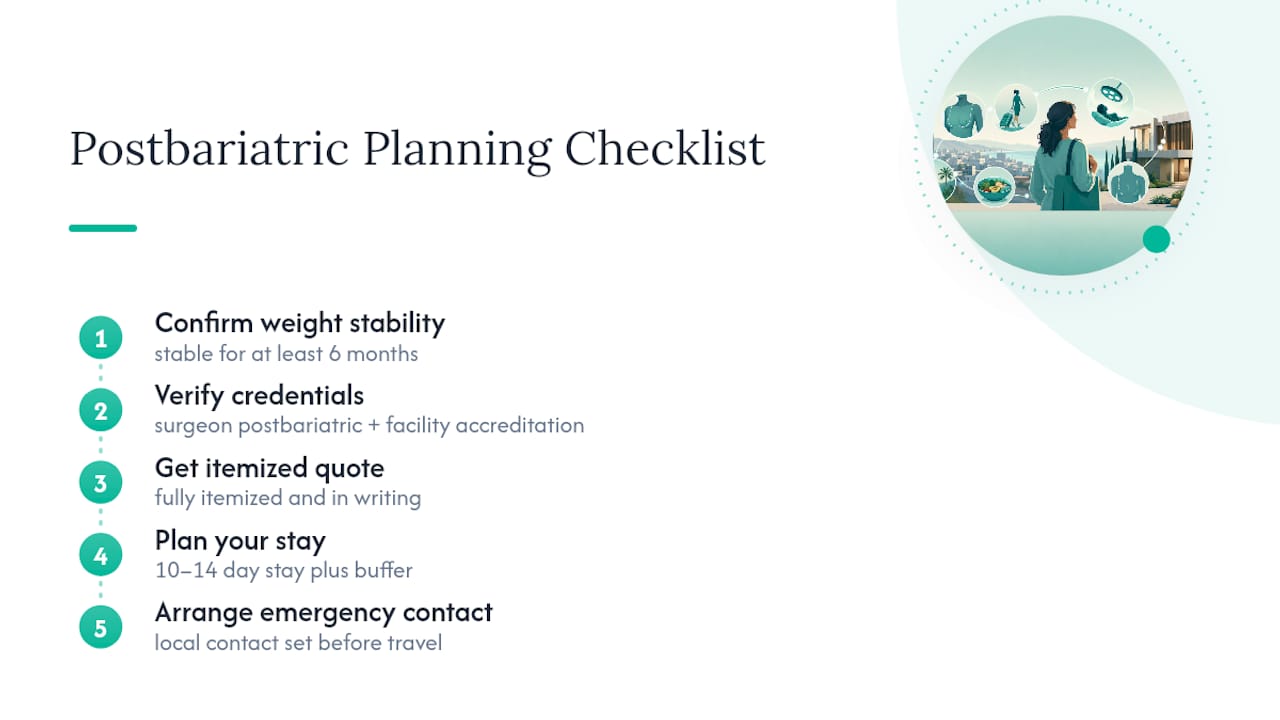
Work through this sequence in order: confirm your weight has been stable for at least 6 months, verify the surgeon's postbariatric-specific credentials and the facility's accreditation, get a fully itemized quote in writing, plan for a 10 to 14 day stay with a buffer, and arrange a local emergency contact before you travel.
Medical Reviewer: Dr. Ariel Santos, MD Last Reviewed: February 2026
This article is for educational purposes only and does not constitute medical advice. Always consult a licensed physician or board-certified plastic surgeon to evaluate your specific case before making surgical decisions. Facility credentials referenced in this guide, including affiliations with Obesity Control Center and CYNTAR.mx, should be independently verified through the accreditation resource before booking.
How Weight Loss Surgery Guide Helps You Compare Real Quotes
Some platforms provide itemized, verified quotes and pre-vetted provider directories for Tijuana instead of a single "starting price" that leaves out half the real cost.

That transparency matters most in postbariatric cases, where the gap between a surgeon-fee-only quote and a true all-inclusive number can run into thousands of dollars. Examples of this kind of itemized breakdown are published online so you can see what a real quote structure looks like before you contact a clinic. You still need to do your own homework: ask about postbariatric-specific experience, confirm accreditation status through resources like the evidence and verification library, and get everything in writing. Some services aim to shorten the verification process and connect patients to facilities screened for accreditation and surgical volume. Patients can use available provider directories to find a surgeon in Tijuana or request personalized quotes to see itemized numbers for specific cases before committing.
Sources
- Reduction mammoplasty techniques in post-bariatric patients: our experience.
- The Aesthetic Society — patient and surgeon guidance
- Reducción mamaria en México: costo, cirujanos y seguridad
FAQ
How Much Does Breast Reduction Cost in Mexico?
Typical all-inclusive breast reduction packages across Mexico run roughly $3,500 to $7,000 USD, with postbariatric cases often landing in the upper half of that range due to added complexity. Always confirm whether a quoted price includes anesthesia, hospital stay, and follow-up care.
Who Are Some Bariatric Surgeons in Tijuana?
Rather than naming individual surgeons, the safer approach is verifying credentials directly through a provider directory that screens for facility accreditation and documented case volume. Confirm any surgeon's specific postbariatric experience before booking, since routine reduction skills don't automatically transfer to these more complex cases.
What Does a Breast Reduction Typically Cost?
A standard, non-postbariatric breast reduction generally costs less than a postbariatric case because it involves less skin excision and shorter operating time. In Tijuana, entry-level reduction packages often start around $3,500 to $4,800, while postbariatric cases requiring combined mastopexy typically run higher.
How Many Kilos Do You Lose With Lipo 360?
Liposuction, including the 360-degree circumferential technique, is a body-contouring procedure aimed at removing localized fat deposits rather than achieving significant weight loss, and it is not a substitute for bariatric surgery. Realistic volume removed varies by case and should be discussed directly with a board-certified surgeon rather than estimated by weight lost.
When Is the Right Time for Postbariatric Breast Reduction?
Most surgeons recommend waiting 12 to 18 months after bariatric surgery, or until weight has been stable for at least 6 months, before scheduling breast reduction. Operating too early risks a surgical plan that no longer matches your body once weight loss continues.