Hospitals in Tijuana, Mexico: A U.S. Patient's Guide
Published August 6, 2026

Hospitals in Tijuana, Mexico: A U.S. Patient's Guide
Tijuana has hospitals and surgical centers that routinely serve U.S. patients, and the short answer is yes, they are worth serious consideration. The city sits minutes from the San Diego border, hosts facilities ranging from large multidisciplinary campuses to high-volume specialty surgical centers, and offers elective procedures at a fraction of U.S. prices. Your next step is specific: verify accreditation, confirm your surgeon's board certification, and request a fully itemized, all-inclusive quote before committing to anything.
Three quick checks to run before you go further:
- Does the facility hold Joint Commission International (JCI) accreditation, SRC/ISO designation, or valid Mexican Secretaría de Salud licensure?
- Is your surgeon board-certified, and can they provide a recent case log for your specific procedure?
- Does the package include bilingual concierge, on-site diagnostics, and a documented post-op follow-up plan that covers what happens after you return home?
If all three answers are yes, you have a provider worth evaluating seriously.
Table of Contents
- What types of hospitals and specialties does Tijuana offer?
- How do you verify a hospital and surgeon in Tijuana?
- What does treatment in Mexico actually cost, and how do you compare quotes?
- What logistics do U.S. patients need to plan?
- How do you choose the right Tijuana hospital and surgeon?
- What does a typical patient timeline look like?
- Weightlosssurgeryguide: verified providers and personalized quotes
- Key Takeaways
- What accredited care in Tijuana actually demands from patients
- Useful sources and accreditation resources
What types of hospitals and specialties does Tijuana offer?
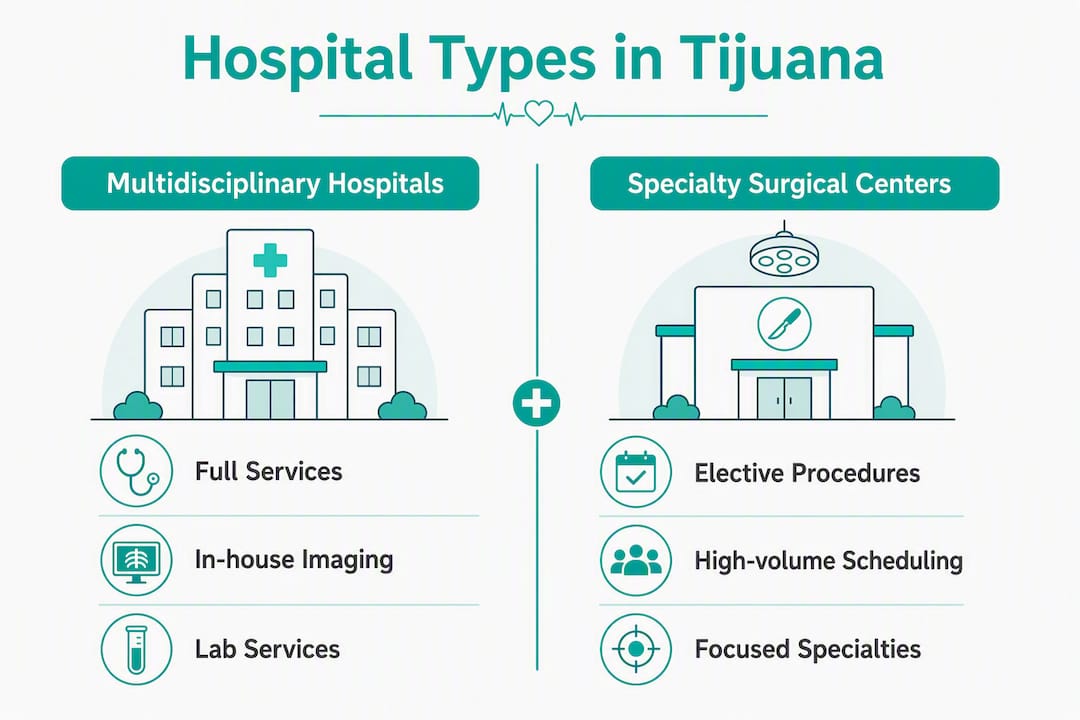
Tijuana's medical infrastructure splits into two distinct categories, and matching your procedure to the right type of facility matters more than most patients realize.
Large multidisciplinary hospital campuses function like tertiary care centers. They carry in-house imaging, laboratory services, ICU capacity, and trauma capability. Hospital del Prado, operating continuously since 1966, is one example of a long-established multidisciplinary specialty hospital serving both local and international patients. Hospital Angeles Tijuana is another campus-scale facility with a broad specialist roster. NewCity Hospital positions itself as a one-stop health campus, combining a specialized hospital, diagnostic imaging center, and on-site hotel in a single complex. These facilities handle complex cases, cardiac procedures, oncology, orthopedics, and general surgery alongside elective work.

High-volume specialty surgical centers focus on elective bariatric and cosmetic procedures. They run tighter scheduling, shorter average stays, and often bundle concierge logistics into the package price. Hospital CYNTAR, one of eight hospitals in Mexico with its specific accreditation profile, operates in this space with a focus on metabolic health, bariatric surgery, and expanding specialty services. The Baja Health Cluster positions Tijuana broadly as a medical tourism hub, with member facilities offering bundled packages that can include consultations, medications, follow-up care, and recovery accommodations.
The most common specialties for international patients include bariatric surgery (gastric sleeve, gastric bypass, duodenal switch), plastic and cosmetic surgery, dental restoration, LASIK and ophthalmology, orthopedic procedures, and cardiology. Oncology care and general surgery are also available at campus-level hospitals.
One practical note: specialty centers typically excel at high-volume elective procedures but may transfer complex post-op complications to a larger campus. Ask upfront which hospital your surgeon uses for emergencies.
How do you verify a hospital and surgeon in Tijuana?
Accreditation is not a marketing badge. JCI accreditation is an independent validation that a hospital meets internationally recognized safety and quality standards that go beyond local Mexican licensure. Not every Tijuana facility that claims JCI status actually holds it, so verify directly on the JCI website rather than taking a facility's word for it.
Your verification checklist:
- Confirm JCI, SRC, or ISO accreditation directly on the accrediting body's official website, not on the hospital's own marketing page.
- Ask for the surgeon's Mexican medical license number and board certification. Both are verifiable through official channels.
- Request published complication or outcome rates for your specific procedure. Reputable high-volume centers track these.
- Confirm the facility has on-site diagnostics (imaging, labs) and ICU availability, or a documented transfer agreement with a campus that does.
- Ask for a written post-op follow-up plan that names who manages complications after you return to the U.S.
Red flags that should stop you:
- Refusal to provide an itemized price breakdown before you commit.
- Vague or unverifiable staff credentials ("our surgeons are experienced" without specifics).
- No documented post-op protocol for cross-border patients.
- No bilingual support staff or concierge service.
- Pressure to book quickly or pay a large deposit before you have reviewed credentials.
Accreditation is your baseline, not your ceiling. A JCI-accredited facility has cleared a rigorous independent audit, but you still need to verify the individual surgeon's credentials, case volume, and complication management protocol. The facility's accreditation does not automatically extend to every physician who operates there.
Pro Tip: Ask the facility to send you the surgeon's case log for your specific procedure, not just a general CV. A surgeon who performs 200+ gastric sleeves per year carries a meaningfully different risk profile than one who performs 20. Also ask directly: "If I develop a complication after I return to the U.S., who do I call, and what is the protocol?" A facility that cannot answer that question clearly is not ready to serve cross-border patients.
What does treatment in Mexico actually cost, and how do you compare quotes?
U.S. patients often save roughly 60–75% on elective bariatric and cosmetic procedures in Tijuana compared with equivalent U.S. pricing. That range holds across gastric sleeve, gastric bypass, and most cosmetic procedures, though the exact figure depends on procedure complexity, facility tier, and what the package actually includes.
The savings are real, but the comparison only holds if you are comparing equivalent packages. A $6,500 all-inclusive gastric sleeve in Tijuana is not the same as a $6,500 quote that excludes anesthesia, labs, and follow-up visits.
| Line Item | Should Be Included | Often Omitted in Low-Cost Quotes |
|---|---|---|
| Surgeon and anesthesia fees | Yes | Anesthesia sometimes separate |
| Hospital stay (1–3 nights typical) | Yes | Extra nights charged separately |
| Pre-op labs and imaging | Yes | Frequently billed separately |
| Implants or consumables | Yes (cosmetic/orthopedic) | Often add-on cost |
| Medications (in-hospital) | Yes | Take-home meds often excluded |
| Post-op follow-up visits | Yes | Varies widely |
| Private transfer from border/airport | Yes (reputable centers) | Often excluded in base price |
| Recovery accommodation | Varies | Usually separate unless bundled |
When you receive a quote, ask for a sample itemized invoice, not just a package total. Then ask specifically: "What is NOT included in this price?" Facilities like Russald Medical Center explicitly market no-surprise-charge pricing and full cost breakdowns, which is the standard you should hold every provider to.
For a deeper look at why Americans travel to Tijuana for bariatric surgery, the cost structure and logistics are covered in detail.
Pro Tip: Request a written post-op follow-up plan alongside the itemized quote. The plan should specify who you contact if you develop complications at home, whether virtual follow-up visits are included, and whether the facility has a U.S.-based coordinator or partner clinician. A provider that bundles this into the package is worth more than one that charges less but leaves you without a safety net.
What logistics do U.S. patients need to plan?
The border crossing is easier than most people expect, but it still requires planning. Tijuana sits roughly 20–30 minutes from downtown San Diego, and several Tijuana hospitals, including Hospital México, offer private patient transport from San Diego directly to the facility. That service removes the stress of navigating the crossing yourself on surgery day.
Key logistics to plan:
- Documents: A valid U.S. passport is required. A passport card works for land crossings; a passport book is needed if you fly into Tijuana's General Abelardo L. Rodríguez International Airport.
- Border crossing: The San Ysidro and Otay Mesa ports of entry are the two main options. Some certified hospitals can arrange access to a medical lane that shortens wait times for patients traveling for care.
- Private transfers: Most reputable facilities offer private transport from the crossing or airport. Confirm this is included in your package.
- Insurance: Some Tijuana hospitals accept certain international or PPO plans. Confirm coverage in writing before you commit. For U.S. patients, standard domestic health insurance typically does not cover elective procedures abroad. Dedicated Mexico travel insurance for U.S. citizens can cover emergency medical costs during your stay and is worth carrying regardless of what your primary plan covers.
- Language: Bilingual staff are standard at facilities catering to international patients, but confirm this before booking, not after.
- Recovery stay: Most bariatric and cosmetic procedures require 3–5 days in Tijuana before it is safe to travel. Some facilities bundle recovery hotel accommodations; others partner with nearby hotels. Plan for this in your budget and schedule.
- Home follow-up: Before you leave, have a U.S.-based clinician identified who can manage post-op care. Ask your Tijuana provider to send discharge notes and imaging directly to that clinician.
Recommended timeline milestones:
- Weeks 4–8 before surgery: Virtual consultation, pre-op labs, and credential verification.
- Day before surgery: Arrive in Tijuana, pre-op check-in.
- Surgery day: Procedure performed; begin in-hospital recovery.
- Days 1–4 post-op: In-facility or local recovery hotel monitoring.
- Day 5–7: Border return, if cleared by your surgical team.
- Week 2 at home: First U.S.-side follow-up appointment.
- Months 1–3: Ongoing virtual follow-up with Tijuana team and U.S. clinician.
How do you choose the right Tijuana hospital and surgeon?
Start with procedure risk, not price. Complex cases, revisional bariatric surgery, cardiac procedures, or anything requiring ICU-level backup should go to a multidisciplinary campus with full trauma capability. A high-volume boutique surgical center is appropriate for straightforward elective procedures like a primary gastric sleeve or rhinoplasty, provided it holds proper accreditation.
Questions to ask during your screening call
- Who performs the procedure, and what is their board certification and annual case volume for this specific operation?
- Where exactly is the surgery performed? Is it in an accredited surgical suite within the hospital, or at a separate facility?
- What are the facility's documented complication rates for this procedure?
- What does the quoted package include, line by line?
- What is the protocol if I need emergency care after returning home?
How to weigh price against outcomes
The lowest quote is rarely the best value. A facility that publishes outcome data, provides a named surgeon with verifiable credentials, and includes documented follow-up care is worth more than one that undercuts on price but cannot answer basic questions about complication management. The Bariatric Surgery in Mexico guide for U.S. patients covers how to evaluate these trade-offs in detail.
Red flags that should disqualify a provider
- The surgeon's name is not disclosed until after you pay a deposit.
- The facility cannot provide an accreditation certificate on request.
- Post-op follow-up is described as "available if needed" rather than a structured protocol.
- The quote changes significantly between inquiry and booking.
- No bilingual coordinator is available to answer questions before surgery.
Pro Tip: Run a quick search for the surgeon's name on the Colegio Mexicano de Cirugía para la Obesidad y Enfermedades Metabólicas (CMCOEM) member directory if you are evaluating a bariatric surgeon. Membership is not a guarantee of quality, but absence from any professional body is a signal worth noting.
What does a typical patient timeline look like?
Most U.S. patients complete the full process, from first inquiry to returning home, in four to eight weeks. Here is how that typically maps out.
| Phase | Timing | Key Activities |
|---|---|---|
| Initial inquiry and virtual consult | 4–8 weeks pre-op | Provider selection, credential check, quote review |
| Pre-op labs and imaging | 2–4 weeks pre-op | Blood work, EKG, imaging (often done locally in the U.S.) |
| Travel and arrival | Day before surgery | Border crossing, transfer, pre-op check-in |
| Surgery | — | Procedure performed under general or regional anesthesia |
| In-hospital recovery | Days 1–2 | Monitoring, pain management, early mobility |
| Local recovery (hotel or facility) | Days 3–5 | Wound checks, dietary progression (bariatric), drain management |
| Return home | Day 5–7 | Border crossing with discharge paperwork and imaging |
| First U.S. follow-up | Week 2 | Labs, wound check, dietary or physical therapy referral |
| Ongoing virtual follow-up | Months 1–3 | Check-ins with both Tijuana team and U.S. clinician |
The timeline compresses for lower-risk outpatient procedures and extends for complex cases. Your surgical team should give you a written timeline before you book, not after.
Weightlosssurgeryguide: verified providers and personalized quotes
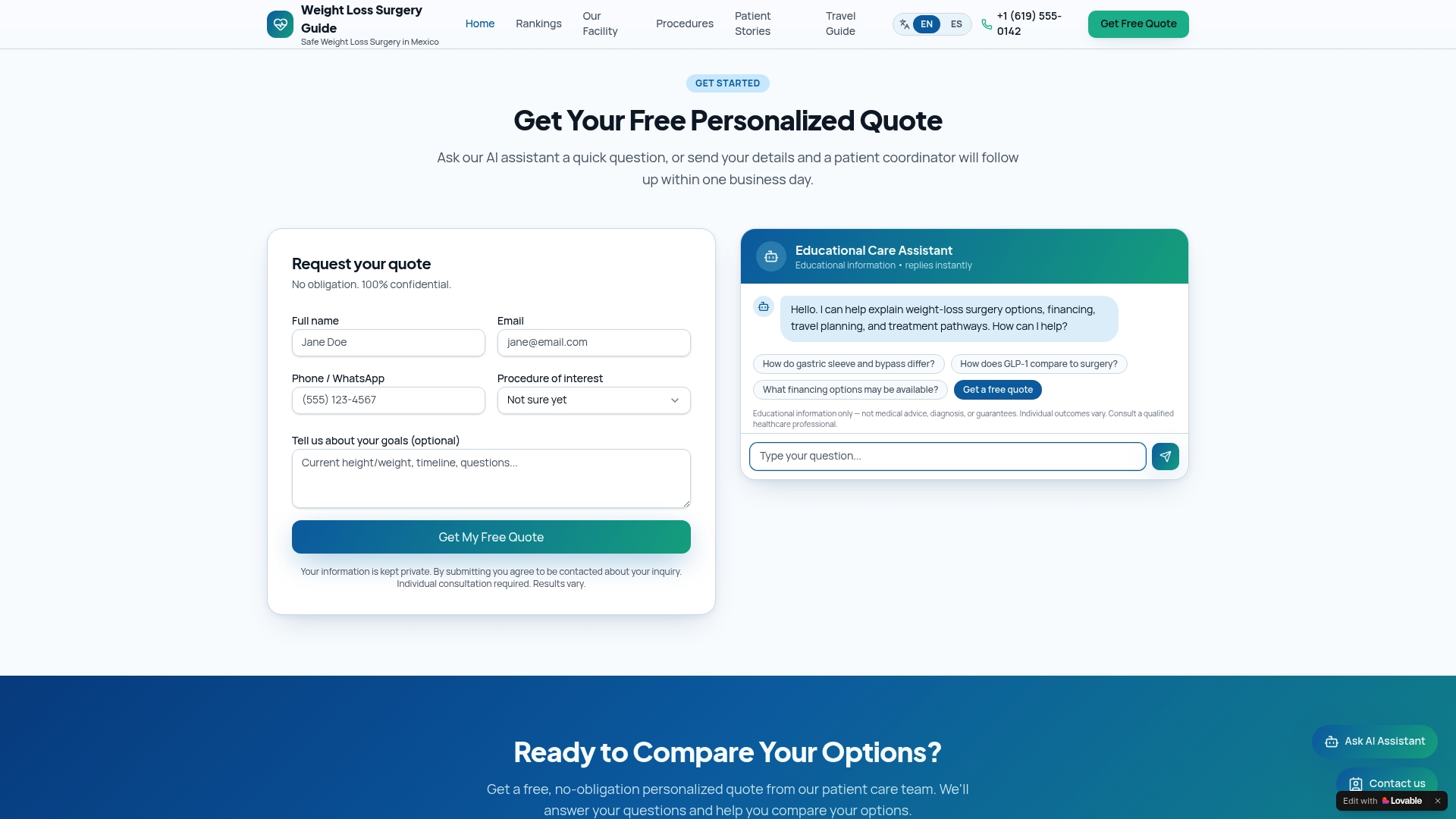
Sorting through Tijuana's hospitals and surgical centers takes time, and the stakes are high enough that guessing is not a reasonable strategy. Weightlosssurgeryguide does the verification work for U.S. patients: accreditation checks, surgeon credential confirmation, itemized quote coordination, and bilingual logistics support, all before you commit to a provider.
The service connects patients with Hospital CYNTAR and affiliated accredited providers through a structured matching process. You get a personalized, itemized quote that breaks down every cost line, a documented post-op follow-up plan, and a bilingual concierge team that handles transfers and recovery coordination. The accreditation standards used to vet providers, including JCI, SRC, and ISO designations, are explained in full on the site, along with the sources and verification methodology behind every provider recommendation.
This is educational content, not medical advice. Every patient should review their specific case with a licensed clinician before proceeding. To start a provider-matching inquiry or request a verified quote, visit the provider directory.
Key Takeaways
Tijuana hospitals serving U.S. patients range from large multidisciplinary campuses to high-volume specialty surgical centers, and choosing the right facility type, verifying accreditation, and securing an itemized all-inclusive quote are the three steps that determine whether your experience is safe and cost-effective.
| Point | Details |
|---|---|
| Verify accreditation independently | Check JCI, SRC, or ISO status directly on the accrediting body's site, not the hospital's own page. |
| Demand an itemized quote | Confirm anesthesia, labs, implants, follow-up visits, and transfers are all included before comparing prices. |
| Match facility type to case complexity | Use a multidisciplinary campus for complex or high-risk procedures; accredited specialty centers suit straightforward elective cases. |
| Plan travel and recovery logistics | Budget 5–7 days in Tijuana post-op, arrange a U.S.-side follow-up clinician before you leave, and carry Mexico travel insurance. |
| Use Weightlosssurgeryguide for verification | The provider directory connects U.S. patients with accredited Tijuana hospitals, verified surgeon credentials, and itemized quotes. |
What accredited care in Tijuana actually demands from patients
Most articles about medical tourism in Tijuana focus on the savings, and the savings are real. U.S. patients routinely save 60–75% on bariatric and cosmetic procedures compared with domestic pricing. But the patients who have the best outcomes are not the ones who found the cheapest quote. They are the ones who treated the verification process as seriously as they treated the surgery itself.
The gap between a well-run accredited surgical center and a facility that markets itself as one is not always visible from a website. JCI accreditation, documented surgeon case volumes, and a written post-op follow-up plan are not bureaucratic checkboxes. They are the infrastructure that determines what happens if something goes wrong at 2 AM after you have crossed back into California.
The other thing most articles understate is continuity of care. The best Tijuana providers have built systems for managing cross-border patients, including virtual follow-up, discharge summaries sent directly to U.S. clinicians, and clear escalation protocols. That coordination does not happen automatically. You have to ask for it, confirm it in writing, and verify that your U.S.-side clinician is actually prepared to receive and act on the information.
Tijuana is not a shortcut. It is a legitimate medical destination with real hospitals, real surgeons, and real outcomes. The patients who treat it that way tend to do well.
Useful sources and accreditation resources
Verify provider credentials and accreditation status through these primary sources before booking care:
- Joint Commission International (JCI): Search the official JCI-accredited organization directory to confirm a hospital's current accreditation status.
- Baja Health Cluster: Industry organization promoting verified medical tourism providers in Baja California.
- Weightlosssurgeryguide Accreditation Explainer: Plain-language guide to JCI, SRC, and ISO standards and what they mean for patient safety.
- Weightlosssurgeryguide Provider Directory: Verified bariatric surgeon listings with credential details and quote request tools.
- Bariatric Surgery in Mexico: Educational Guide: Procedure-level educational resource covering pre-op, surgery, and recovery planning.
This article is general educational information, not medical advice. Confirm your specific case, eligibility, and current accreditation status with a licensed clinician and the relevant accrediting bodies before making any medical decisions.
Medical Reviewer: Dr. [Reviewer Name] | Last Reviewed: 2026 | Publisher: Weightlosssurgeryguide
Links to Hospital CYNTAR credentials: cyntar.mx | Links to Obesity Control Center credentials: obesitycontrolcenter.com