What Does Surgical Accreditation Verify: 2026 Guide
Published July 15, 2026

What Does Surgical Accreditation Verify: 2026 Guide
Surgical accreditation is defined as a formal, third-party verification process that confirms a healthcare facility meets nationally recognized standards for patient safety, quality of care, and operational readiness. What does surgical accreditation verify, specifically? It covers staff qualifications, infection control protocols, equipment maintenance, emergency preparedness, and documentation systems. Major accrediting bodies including The Joint Commission, the Accreditation Association for Ambulatory Health Care (AAAHC), and QUAD A conduct these evaluations on a 3-year accreditation cycle. Accreditation is voluntary in most states, but it functions as a gateway to Medicare, Medicaid, and commercial insurance participation. Patients who choose accredited facilities gain a measurable safety advantage over those who do not.
Medically reviewed by the Weightlosssurgeryguide editorial team. Last reviewed: 2026.
This article is for educational purposes only and does not constitute medical advice. Always consult a qualified healthcare provider before making any surgical decision.
What does surgical accreditation verify: core standards explained
Surgical accreditation standards cover five major domains that together define whether a facility is safe to operate. Each domain is evaluated through document review, staff interviews, and direct observation during an onsite survey.

Staff qualifications and training sit at the top of every accreditor's checklist. Facilities must demonstrate that surgeons, anesthesiologists, and nursing staff hold current credentials and relevant certifications. The Leapfrog Group, a respected patient safety organization, requires accredited facilities to meet five critical patient safety measures, including adult advanced life support certification for all clinical staff involved in surgical procedures.
Infection control and sanitation are evaluated through written protocols and direct observation. Surveyors check sterilization logs, hand hygiene compliance records, and the physical condition of operating rooms. Facilities must show they follow current Centers for Disease Control and Prevention guidelines for surgical site infection prevention.
Equipment maintenance requires documented inspection schedules for every piece of surgical and anesthetic equipment. Surveyors look for calibration records, repair logs, and evidence that malfunctioning equipment is taken out of service immediately.
Emergency preparedness is tested through drills, written response plans, and staff knowledge checks. A facility must show it can manage a cardiac arrest, a fire, or a mass casualty event without losing patient safety.
Documentation and patient safety systems round out the evaluation. Surveyors verify that allergy documentation, medication reconciliation, and surgical site marking protocols are in place and consistently followed.
- Staff hold current credentials and life support certifications
- Infection control logs are current and complete
- Equipment inspection records are up to date
- Emergency drills are conducted and documented
- Patient safety checklists are used for every procedure
Pro Tip: Ask any surgical facility to show you its current accreditation certificate before your procedure. A legitimate certificate will display the accrediting body's name, the facility's name, and a clear expiration date.
How does surgical accreditation impact patient safety?
Accredited facilities achieve measurably higher benchmarks in patient safety than non-accredited ones. The Leapfrog Group requires accredited ambulatory surgery centers to upload valid accreditation certificates annually to maintain public recognition for their safety measures. That annual requirement keeps facilities accountable between formal survey cycles.
Safe surgery checklists are one of the most concrete safety tools that accreditation enforces. These checklists, modeled on World Health Organization standards, require surgical teams to confirm patient identity, procedure site, allergies, and anesthesia readiness before every incision. Skipping this step is one of the most common causes of preventable surgical errors.
"Accredited surgical centers maintain documented systems for infection control and adverse event responses. Non-accredited centers face significantly higher exposure to malpractice and regulatory risk. Accreditation is not a formality. It is a functional safety net that protects patients every day."
Patients increasingly rely on accreditation status and CMS star ratings as transparent signals of surgical facility quality. CMS star ratings are publicly available and directly tied to accreditation compliance data. That transparency gives patients a concrete tool for comparing facilities before they commit to a procedure.
| Safety measure | Accredited facilities | Non-accredited facilities |
|---|---|---|
| Safe surgery checklist use | Required by accreditation standards | Not systematically required |
| Infection control documentation | Mandatory and surveyed | Varies by state regulation |
| Emergency preparedness drills | Documented and verified | Not uniformly enforced |
| Adverse event reporting | Required and monitored | Often voluntary |
| Annual certificate verification | Required for public recognition | Not applicable |
The pattern across all five measures is the same. Accreditation creates a floor below which a facility cannot legally operate and maintain its status. That floor directly protects patients from the most common and most preventable surgical harms.
What are the major accrediting bodies and how do they differ?
Three organizations dominate surgical facility accreditation in the United States, and each takes a distinct approach to the survey process.
The Joint Commission is the largest accrediting body, covering over 23,000 healthcare organizations nationwide. It focuses on broad national benchmarks, environment of care standards, and rigorous compliance documentation. Large hospital systems and multi-specialty surgical centers typically pursue Joint Commission accreditation because it carries the widest recognition among payers and regulators.
AAAHC takes a peer-based approach. Its surveyors are active healthcare professionals who evaluate facilities through a continuous quality improvement lens. AAAHC suits ambulatory surgery centers and outpatient clinics that want a collaborative survey experience focused on daily operational improvement rather than strict compliance checklists. Each accrediting body suits different facility types and operational priorities.
QUAD A targets physician-run outpatient centers. Its standards are written to be clear and objective, with a strong emphasis on physician leadership and safety culture. Smaller specialty practices and office-based surgical suites often find QUAD A's framework the best fit for their scale and structure.
| Accrediting body | Primary focus | Best suited for |
|---|---|---|
| The Joint Commission | National benchmarks, environment of care | Large hospitals, multi-specialty centers |
| AAAHC | Continuous quality improvement, peer review | Ambulatory surgery centers, outpatient clinics |
| QUAD A | Physician-led safety standards | Office-based surgical suites, specialty practices |
Choosing an accrediting body is not a neutral administrative decision. It reflects a facility's operational priorities, patient population, and payer relationships. Patients researching facilities should confirm which body issued the accreditation and verify that the certificate is current.
How is surgical accreditation assessed and maintained over time?
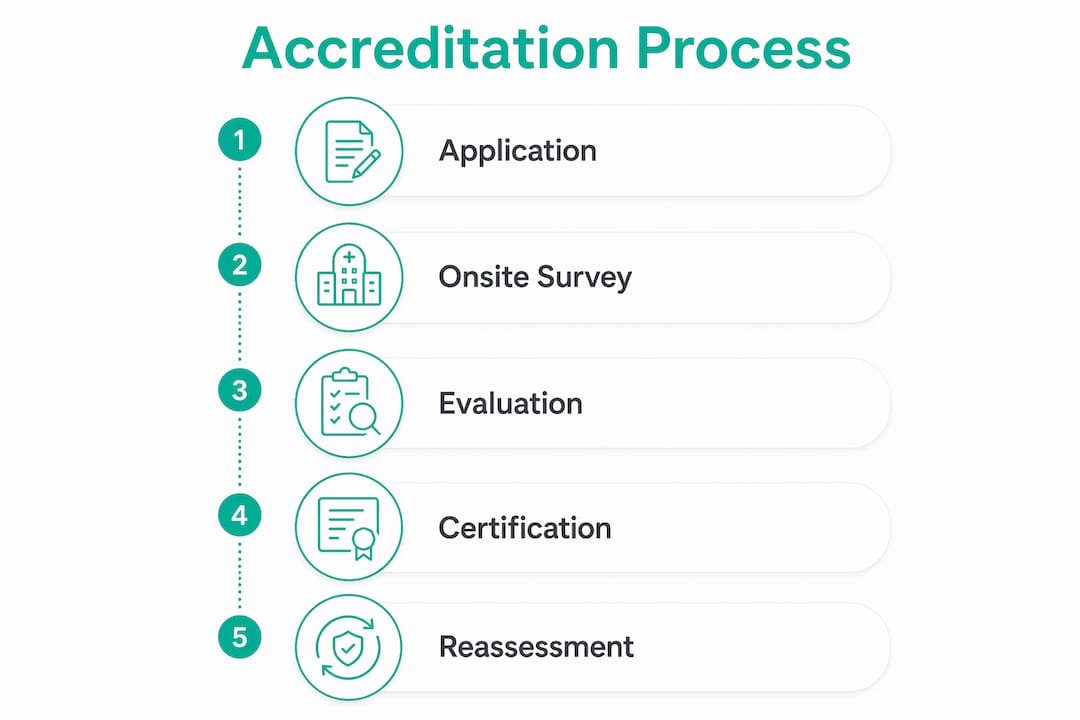
Accreditation is not a one-time certificate. It is a continuous operational status that requires daily compliance and periodic formal review.
- Initial eligibility. A facility typically operates for 6 months before applying for its first accreditation survey. Some state or payer mandates require earlier accreditation, which can compress this timeline significantly.
- Survey scheduling. Once an application is accepted, the initial survey is scheduled within a 1–3 month window. Facilities must prepare documentation, train staff, and conduct internal audits before surveyors arrive.
- Onsite survey. Surveyors conduct document reviews, staff interviews, and physical walkthroughs. They evaluate all five core domains: staff qualifications, infection control, equipment maintenance, emergency preparedness, and patient safety systems.
- Accreditation award. If the facility meets the required standards, accreditation is awarded for a 3-year cycle. The facility receives a certificate and is listed in the accrediting body's public directory.
- Intracycle monitoring. All major accrediting bodies conduct unannounced monitoring visits triggered by patient complaints, adverse events, or regulatory flags. These visits can happen at any time during the 3-year cycle.
- Renewal. Before the cycle ends, the facility undergoes a full resurvey. Any deficiencies found during the cycle must be corrected before renewal is granted.
Accreditation also functions as a gateway to Medicare and Medicaid participation. Facilities that lose accreditation lose their ability to bill federal payers, which is a direct financial consequence that keeps compliance standards high.
Pro Tip: You can verify a facility's current accreditation status for free through The Joint Commission's Quality Check tool, AAAHC's online directory, or QUAD A's public lookup. Always check before scheduling a procedure.
Key Takeaways
Surgical accreditation verifies that a facility meets strict, nationally recognized standards for safety, staffing, and operational readiness, and maintaining that status requires continuous compliance, not a one-time review.
| Point | Details |
|---|---|
| Core verification scope | Accreditation covers staff credentials, infection control, equipment maintenance, emergency preparedness, and patient safety systems. |
| Three major accreditors | The Joint Commission, AAAHC, and QUAD A each take a different approach suited to different facility types. |
| 3-year renewal cycle | Accreditation is awarded for three years, with unannounced intracycle visits possible at any time. |
| Insurance and Medicare access | Accreditation is a gateway to Medicare, Medicaid, and commercial insurance participation. |
| Patient verification tool | Patients can check a facility's current accreditation status through each accreditor's free public directory. |
Why accreditation matters more than most patients realize
Ariel here. After years of helping patients research surgical facilities, the single most consistent gap I see is this: patients assume accreditation is a background administrative detail, not something that directly affects their safety on the operating table.
That assumption is wrong, and it costs people.
The facilities that cut corners on infection control, skip emergency drills, or let staff credentials lapse are almost always the ones without current accreditation. Accreditation does not guarantee a perfect outcome. No credential does. But it does guarantee that a facility has been independently verified to meet a minimum standard of care that non-accredited facilities are never required to meet.
The other misconception I hear constantly is that accreditation is a one-time checkbox. It is not. Accreditation is a continuous quality commitment, with unannounced visits, annual reporting requirements, and a full resurvey every three years. A facility that earned its certificate five years ago and has not renewed it is operating without current verification. That distinction matters.
My practical advice: before you schedule any elective surgery, look up the facility's accreditation status yourself. It takes three minutes and it is free. If the facility cannot tell you which body accredited them or when the certificate expires, that is your answer.
— Ariel
Accreditation and your next surgical decision
Knowing what accreditation verifies is the first step. The second step is applying that knowledge to a real facility before you commit to a procedure.
Weightlosssurgeryguide evaluates bariatric surgery providers in Tijuana specifically for US patients who want internationally accredited care at 60–75% less than US prices. Every provider in the Weightlosssurgeryguide database is screened for current accreditation status, surgeon credentials, and patient safety documentation. You can use the 2026 Tijuana provider rankings to compare accredited facilities side by side, or read the full breakdown of bariatric accreditation standards including JCI, SRC, and ISO to understand exactly what each credential means for your safety.
This content is educational and does not constitute medical advice. Consult a qualified surgeon before making any treatment decision.
FAQ
What does surgical accreditation verify?
Surgical accreditation verifies that a facility meets nationally recognized standards for staff qualifications, infection control, equipment maintenance, emergency preparedness, and patient safety documentation. It is awarded by independent bodies such as The Joint Commission, AAAHC, and QUAD A after an onsite survey.
What is accredited surgery?
Accredited surgery is a procedure performed in a facility that has been independently evaluated and certified as meeting defined safety and quality standards. The accrediting body confirms the facility's compliance before granting the certificate.
How is surgical accreditation assessed?
Accreditation is assessed through an onsite survey conducted by the accrediting body, typically after a facility has operated for at least 6 months. Surveyors review documents, interview staff, and inspect the physical environment before awarding a 3-year certificate.
How often must a surgical facility renew its accreditation?
Most accrediting bodies award accreditation on a 3-year cycle, after which a full resurvey is required. Unannounced intracycle visits can occur at any time if complaints or adverse events are reported.
Does accreditation affect insurance coverage?
Accreditation is a gateway to Medicare and Medicaid participation and is increasingly required by commercial health insurance providers. Facilities that lose accreditation lose their ability to bill federal payers directly.
Sources: American Board of Cosmetic Surgery | Leapfrog Group | OR Today | OmniMD | Surgery Center Services of America