Bariatric Surgery Credentials Check Explained for 2026
Published July 3, 2026

Bariatric Surgery Credentials Check Explained for 2026
A bariatric surgery credentials check is the process of verifying a surgeon's board certifications, fellowship training, and facility accreditations to confirm they meet recognized safety and expertise standards. Skipping this step is one of the most common and costly mistakes patients make before weight loss surgery. The American Board of Surgery sets the baseline certification standard for bariatric surgeons in the United States, while the Metabolic and Bariatric Surgery Accreditation and Quality Improvement Program (MBSAQIP) governs facility standards. Weightlosssurgeryguide built its 2026 provider rankings around these exact verification criteria, so patients can compare surgeons and centers with confidence before committing to care.
Reviewed by the Weightlosssurgeryguide editorial team. Last reviewed: 2026.
This article is for educational purposes only and does not constitute medical advice. Always consult a qualified healthcare provider before making surgical decisions.
What does a bariatric surgery credentials check actually verify?
A bariatric surgery credentials check covers three distinct layers: surgeon certification, specialized training, and facility accreditation. Each layer answers a different question about safety and expertise.
Surgeon board certification confirms that a physician completed the required training and passed rigorous exams. The American Board of Surgery requires five years of residency plus comprehensive written and oral exams before granting certification. A medical license alone does not confirm this level of training. Licensure allows a doctor to practice legally; board certification is a voluntary, higher-level validation of specialized knowledge and ongoing professional commitment.
Fellowship training goes one step further. A one-year specialized fellowship in bariatric or minimally invasive surgery signals that a surgeon trained specifically in these procedures after residency. Not every licensed surgeon holds one, and the difference in technical skill is real.
Facility accreditation confirms that the hospital or surgical center meets published safety protocols, volume requirements, and outcome reporting standards. The MBSAQIP accreditation program, administered by the American College of Surgeons, is the recognized gold standard in the U.S. for bariatric surgery centers. Patients considering care abroad should look for equivalent international accreditations, which Weightlosssurgeryguide explains in detail on its bariatric accreditation page.
Which bariatric surgeon credentials are essential to verify?
Several credentials separate a qualified bariatric surgeon from a general surgeon who occasionally performs weight loss procedures. Knowing which ones matter most saves time and protects your safety.
- Board certification by the American Board of Surgery (ABS) or an equivalent national board. This is the non-negotiable baseline. It requires five years of residency and rigorous exams, confirming foundational surgical competence.
- Specialized fellowship in bariatric or minimally invasive surgery. A one-year focused fellowship is typical and signals dedicated post-residency training in weight loss procedures specifically.
- Focused Practice Designation in metabolic and bariatric surgery. The ABS awards this designation to surgeons who meet focused practice criteria and pass additional exam standards. Patients are safest with surgeons holding this designation versus general surgeons performing bariatric cases occasionally.
- Active membership in the American Society for Metabolic and Bariatric Surgery (ASMBS). ASMBS membership reflects ongoing professional engagement with the field, including access to current research and clinical guidelines.
- Procedural volume of at least 25 cases annually. Higher surgical volume is directly associated with lower complication rates and better patient outcomes. Volume is a proxy for maintained skill.
Pro Tip: Ask your surgeon directly how many bariatric procedures they perform each year. A confident, qualified surgeon will answer without hesitation. Vague answers or deflection are a red flag.
The Focused Practice Designation is the credential most patients overlook. It signals a surgeon dedicated through training and practice specifically to metabolic and bariatric surgery, a mark of deeper expertise than board certification alone. Checking for it takes two minutes on the ABS website and can meaningfully change your risk profile.

How to verify bariatric surgeon credentials independently
Independent verification takes less than 30 minutes and relies entirely on free, government-linked databases. Clinic websites and marketing materials are not reliable sources for credential confirmation.
- Search the National Provider Identifier (NPI) registry. The NPPES database assigns every U.S. healthcare provider a unique NPI number. NPI lookup tools confirm a surgeon's identity, specialty taxonomy code, and practice location. The taxonomy code is particularly useful: it shows whether a surgeon's self-described specialty matches their official classification.
- Check your state medical board website. Every state maintains a public portal listing license status, expiration dates, and any disciplinary actions. These records refresh frequently and are more current than insurer directories.
- Verify board certification through Certification Matters. The American Board of Medical Specialties operates Certification Matters (certificationmatters.org), a free public database. Enter the surgeon's name to confirm active ABS certification and any Focused Practice Designation.
- Confirm Focused Practice Designation directly on the ABS website. The ABS maintains its own searchable directory. Cross-referencing both the ABS and Certification Matters takes under five minutes and catches discrepancies.
- Document your findings. Screenshot or save each verification result with the date. If you consult multiple surgeons, this record lets you compare credentials side by side without relying on memory.
Pro Tip: NPI databases provide official taxonomy specialty codes that clarify whether a surgeon's self-described specialty matches their certification classification. A mismatch between the two is worth investigating before you proceed.
Clinic websites and patient review platforms are the least reliable sources for credential verification. They are not audited, not updated in real time, and sometimes contain outdated or aspirational information. Use them for general impressions only, never for factual credential confirmation.
Why does facility accreditation matter for bariatric surgery?
Facility accreditation sets the floor for safety, not just the ceiling for prestige. An accredited center operates under published protocols that govern everything from pre-operative screening to complication reporting.
MBSAQIP accreditation is the gold standard for bariatric surgery centers in the United States. Facilities must report outcomes, meet minimum volume standards, and follow standardized clinical care pathways to maintain their status. MBSAQIP also requires a designated Metabolic and Bariatric Surgery (MBS) Director who is a verified, actively practicing bariatric surgeon with full surgical privileges. That requirement alone filters out facilities where administrative staff rather than qualified surgeons lead clinical decisions.
Accreditation is also periodically audited through on-site visits that verify staff credentials, data integrity, and protocol compliance. This means an MBSAQIP designation is not a one-time award. It is an ongoing commitment to standards.
| Accreditation element | What it requires |
|---|---|
| Outcome reporting | Centers must submit complication and mortality data to a national registry |
| Volume standards | Minimum annual case volume to maintain accreditation status |
| MBS Director | A verified, actively practicing bariatric surgeon with full privileges |
| Clinical care pathways | Standardized pre-op, intra-op, and post-op protocols |
| Site audits | Periodic on-site verification of compliance and data integrity |
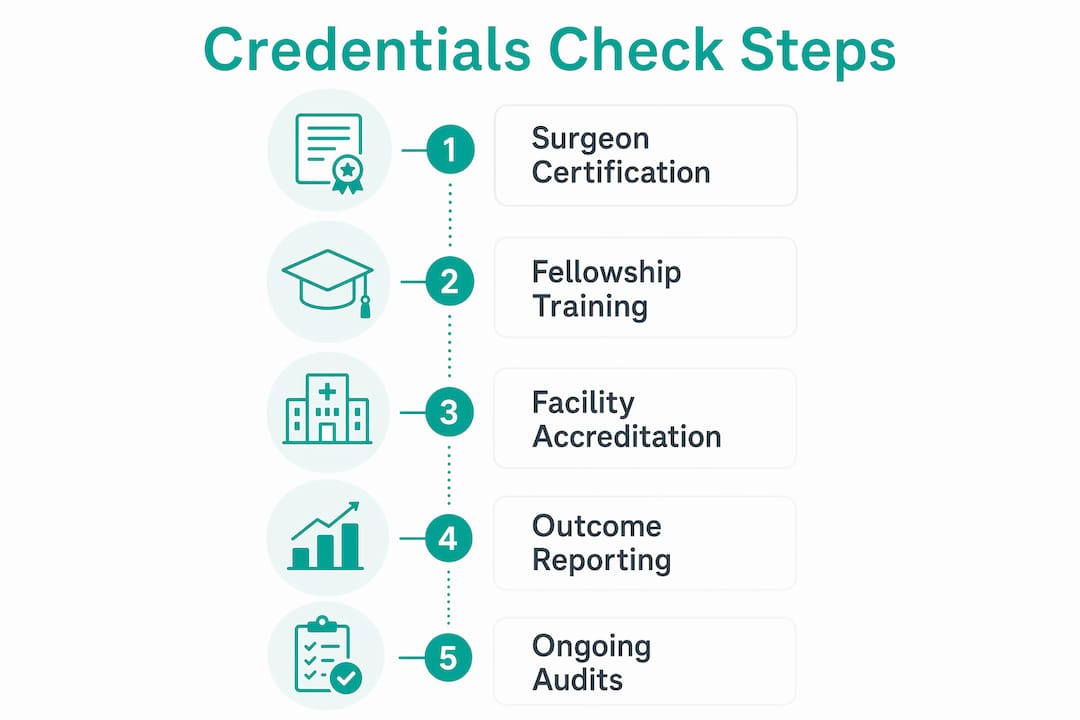
For patients considering surgery outside the U.S., equivalent international accreditations serve the same function. Weightlosssurgeryguide evaluates Tijuana facilities against these standards and publishes its findings in the 2026 provider rankings.
Key questions to ask any facility about accreditation:
- Is this center currently MBSAQIP-accredited or internationally equivalent?
- When was the last site audit, and what were the findings?
- Does the facility publish outcome data, including complication rates?
What to look for beyond credentials when choosing a bariatric program
Credentials confirm minimum competence. Program quality determines long-term outcomes. The two are related but not identical.
Surgeon procedural volume and revision expertise matter beyond the 25-case annual minimum. A surgeon who performs 150 cases per year and handles revisions of failed procedures brings a depth of experience that credentials alone cannot capture. Ask specifically about revision surgery volume, since revisions are technically more demanding than primary procedures.
Multidisciplinary team support is a structural feature of high-quality programs. Accredited bariatric centers employ nutritionists and mental health professionals as part of the care team. This support improves long-term weight loss success and addresses the psychological factors that drive eating behavior. A program without these team members is incomplete regardless of the surgeon's credentials.
Outcome transparency separates confident programs from guarded ones. Ask for the center's 30-day complication rate, readmission rate, and percentage of patients who achieve their target weight loss at one year. Programs that refuse to share this data are not programs worth choosing.
Pro Tip: Red flags in credential assessment include surgeons who cannot name their fellowship program, facilities that list accreditation without specifying the accrediting body, and programs that discourage you from independently verifying credentials. Legitimate programs welcome scrutiny.
The ASMBS medical tourism safety checklist is a practical tool for patients evaluating programs abroad. It covers credential verification, facility standards, and continuity of care, all in one document.
Key Takeaways
Verifying a bariatric surgeon's board certification, Focused Practice Designation, and facility accreditation through official sources like the ABS, MBSAQIP, and state medical boards is the most reliable way to protect your safety before weight loss surgery.
| Point | Details |
|---|---|
| Board certification is the baseline | The American Board of Surgery requires five years of residency and rigorous exams before granting certification. |
| Focused Practice Designation signals deeper expertise | The ABS awards this to surgeons who meet focused practice criteria beyond standard board certification. |
| MBSAQIP accreditation sets facility standards | Accredited centers must report outcomes, meet volume requirements, and undergo periodic site audits. |
| Independent verification uses free databases | The NPI registry, state medical board portals, and Certification Matters are the most reliable sources. |
| Multidisciplinary teams improve outcomes | Programs with nutritionists and mental health professionals produce better long-term results than surgical-only programs. |
Why I think most patients verify credentials too late
Most patients I speak with start checking credentials after they have already chosen a surgeon, not before. They find a clinic through social media, get a price quote, and then look up credentials to confirm a decision they have already emotionally made. That sequence is backwards, and it is the reason credential checks feel like a formality rather than a filter.
The distinction between a medical license and board certification is the single most misunderstood concept in this process. A license means a doctor passed medical school and a basic licensing exam. Certification means they completed a specialty residency, passed additional exams, and committed to ongoing education. For bariatric surgery specifically, the Focused Practice Designation adds another layer that most patients have never heard of before their first consultation.
My honest advice: start with the ABS website and the NPI registry before you contact a single clinic. Run the surgeon's name through both databases before you read their bio page or watch their testimonial videos. Marketing materials are designed to build trust. Official databases are designed to report facts. Use them in that order.
Patients who verify credentials first arrive at consultations with better questions and clearer expectations. They are harder to impress with vague answers and more likely to recognize when a program is genuinely strong. That confidence is not just reassuring. It is protective.
— Ariel
Verified bariatric providers, ranked and explained
Weightlosssurgeryguide evaluates bariatric surgeons and facilities in Tijuana against the same credential and accreditation standards described in this article. The 2026 rankings include verified board certifications, fellowship training records, and facility accreditation status for each listed provider.
Patients considering surgery in Mexico can review verified provider rankings that include accreditation details, outcome transparency ratings, and credential summaries. The site also maintains a sources and verification library where patients can cross-reference the databases and standards cited in this article. Every provider listed by Weightlosssurgeryguide has been evaluated against MBSAQIP-equivalent criteria and international accreditation benchmarks before appearing in the rankings.
This content is educational and does not replace a consultation with a qualified bariatric surgeon. Weightlosssurgeryguide does not provide medical advice.
Sources: American Board of Surgery | MBSAQIP 2026 Standards | NPPES NPI Registry | Bariatric Surgeon Evaluation Guide
FAQ
What is a bariatric surgery credentials check?
A bariatric surgery credentials check is the process of verifying a surgeon's board certification, fellowship training, and facility accreditation through official databases like the ABS, NPI registry, and state medical board portals. It confirms that both the surgeon and the facility meet recognized safety and expertise standards.
Is a medical license enough to qualify a bariatric surgeon?
A medical license alone does not confirm specialized bariatric surgery expertise. Board certification is a separate, voluntary validation that requires additional residency training, rigorous exams, and ongoing education beyond what licensure demands.
What is the Focused Practice Designation in bariatric surgery?
The Focused Practice Designation is awarded by the American Board of Surgery to surgeons who meet specific criteria for dedicated practice and advanced exam standards in metabolic and bariatric surgery. It signals a deeper level of specialization than standard board certification.
How do I verify a bariatric surgeon's credentials for free?
Search the NPPES NPI registry for the surgeon's identity and specialty code, check your state medical board website for license status and disciplinary history, and confirm board certification through the ABS website or Certification Matters. All three sources are free and publicly accessible.
Why does MBSAQIP accreditation matter when choosing a bariatric facility?
MBSAQIP accreditation requires facilities to report outcomes, meet minimum volume standards, employ a verified MBS Director, and undergo periodic site audits. It is the recognized gold standard for bariatric surgery centers in the U.S. and ensures the facility operates under published, audited safety protocols.