Your Bariatric Vitamin Schedule: A Stage-Based Guide
Published August 11, 2026

Your Bariatric Vitamin Schedule: A Stage-Based Guide
Every day after bariatric surgery, you need a bariatric-formulated multivitamin (with iron), calcium citrate split into divided doses totaling a moderate daily amount, vitamin D3 targeting a range recommended by specialists, and B12 at a dose suitable for oral or monthly injection administration. The single most important rule: keep calcium citrate and any iron-containing supplement at least 2 hours apart. These two nutrients compete directly for absorption, and taking them together can leave you deficient in both.
Why does timing matter so much? Bariatric procedures reduce stomach acid and shorten the segment of intestine where most nutrients are absorbed. Your gut can no longer compensate for a poorly timed dose the way it could before surgery. Bariatric surgery requires lifelong daily supplementation and annual blood tests to monitor iron, folate, calcium, and vitamin D — skipping either one is what turns a manageable gap into a serious deficiency.
Pro Tip: Anchor each supplement dose to a fixed daily event — waking up, brushing teeth, a meal, bedtime — rather than a clock time that shifts when your schedule does. Set phone reminders for the first 90 days until the habit is automatic. For the first 3 months, stick to chewable or liquid bariatric formulas; they are better tolerated and absorbed while your digestive tract heals.
Table of Contents
- What does your bariatric vitamin schedule look like by phase?
- Sample daily schedules for each post-op phase
- What are the recommended doses for each nutrient?
- What timing rules and interactions should you follow every day?
- How do you choose the right bariatric-formulated supplement?
- What should you do when a dose is missed or vomiting occurs?
- Which symptoms should you report, and when do labs need to happen?
- Medical disclaimer, reviewer, and sources
- Sources
What does your bariatric vitamin schedule look like by phase?
The schedule is not static. It changes meaningfully across four phases, and knowing when to shift gears prevents both under-supplementing early and missing escalations later.
Phase 1: Pre-op and hospital stay. Some programs start thiamine (vitamin B1) before surgery, particularly if your team anticipates prolonged reduced intake. Your surgical team will guide this. In the hospital, most programs supply a 28-day starter pack on discharge so you have the right formulations from day one.

Phase 2: Weeks 1–8 (blended and soft diet). Start your bariatric-formulated chewable or liquid multivitamin as soon as your team clears you for blended foods, typically within the first week. Add calcium citrate around day 7 post-op. Chewable or liquid bariatric-specific vitamins are recommended for the first 3 months because they are better tolerated and absorbed while the digestive system heals. Gummies are not a substitute — they routinely lack the micronutrient potency bariatric patients require.
Phase 3: Months 2–3. Continue chewable or liquid forms. If your team has prescribed additional iron (common for menstruating patients or after RYGB), begin that now with the 2-hour separation rule firmly in place. Clinical patient guides recommend separating calcium citrate and iron by at least 2 hours to maximize absorption of both.
Phase 4: Month 3 onward (long-term maintenance). Transition to bariatric-formulated adult capsules or tablets if tolerated. Your regimen stays essentially the same for life, with doses adjusted based on annual lab results. This is also when many patients shift from daily oral B12 to a weekly high-dose oral or monthly intramuscular injection, depending on their preference and absorption status.
One urgent flag: persistent vomiting at any phase is a thiamine emergency. Thiamine deficiency can become an acute, irreversible neurologic emergency if vomiting continues without replacement. Contact your clinic immediately — do not wait for a scheduled appointment.
Pro Tip: Before surgery, review the bariatric surgery consultation checklist to confirm your program has addressed pre-op thiamine and your discharge supplement plan. Programs that brief patients on supplements before surgery tend to have better early adherence.
Sample daily schedules for each post-op phase
The tables below show how to structure your day. These are illustrative examples — your bariatric team will adjust doses for your specific procedure, labs, and health history.
Phase 1–2: Weeks 1–8 (chewable/liquid forms)
| Time | Supplement | Notes |
|---|---|---|
| Wake | Bariatric chewable multivitamin (with iron) | Take with small sip of water |
| Breakfast | Calcium citrate chewable 500–600 mg | With or just after a small meal |
| Mid-morning | Vitamin D3 liquid/chewable IU | Can combine with calcium dose if product allows |
| Lunch | Calcium citrate chewable 500–600 mg | Second calcium dose; at least 2 hrs after multivitamin iron |
| Afternoon | B12 sublingual 500–1,000 mcg | Dissolve under tongue; skip if multivitamin already provides this amount |
| Dinner | Calcium citrate chewable 500 mg | Third dose if targeting 1,500 mg/day total |
| Bedtime | Thiamine (if prescribed separately) | Especially important if any nausea or vomiting occurred |
Phase 3+: Month 3 onward (capsule/tablet transition)
Extra-iron regimen (menstruating patients or RYGB/DS)
For patients who need 45–60 mg of elemental iron daily, the afternoon iron slot above becomes critical. Schedule it at least 2 hours after the lunch calcium dose and pair it with 250–500 mg of vitamin C to support absorption. Guideline dosing ranges set iron at a minimum of 18 mg/day, rising to 45–60 mg for menstruating women or after procedures with significant malabsorption.
Understanding what to expect from bariatric surgery during the early recovery weeks helps you anticipate the diet stages that govern when each supplement form becomes appropriate.
What are the recommended doses for each nutrient?
The table below reflects clinical guideline ranges. Bring it to your bariatric team to verify your regimen covers each nutrient at the appropriate level for your procedure.
| Nutrient | Daily dose range | Preferred form | Route / notes |
|---|---|---|---|
| Multivitamin | 1–2 tablets/capsules | Bariatric-formulated (not standard OTC) | Must include iron, B12, zinc, copper |
| Thiamine (B1) | 12 mg minimum in multivitamin; higher doses separately if at risk | Any absorbable form | IV/IM if vomiting persists |
| Vitamin B12 | 500–1,000 mcg/day oral; or 1,000 mcg/month IM | Sublingual, oral crystalline, or IM injection | Sublingual or IM preferred after RYGB |
| Folate | 500–800 mcg/day (800–1,000 mcg if childbearing age) | Methylfolate preferred | Included in most bariatric multivitamins |
| Iron | 18 mg/day minimum; 45–60 mg for menstruating women or RYGB/DS | Ferrous fumarate or ferrous gluconate | Avoid slow-release ferrous sulfate |
| Calcium | 1,200 mg/day (SG/RYGB); higher doses for DS | Calcium citrate only | Split into 500–600 mg doses; never take with iron |
| Vitamin D3 | ~3,000 IU/day; target serum 25-hydroxyvitamin D ≥30 ng/mL | D3 (cholecalciferol) | Higher doses if labs show deficiency |
| Vitamin A | 3,000 IU/day (higher doses considered for DS) | Preformed retinol or beta-carotene | DS patients need closer monitoring |
| Vitamin E | 18 mg/day minimum | Mixed tocopherols | Usually covered by bariatric multivitamin |
| Vitamin K | 90 mcg/day minimum (higher for DS) | K1 or K2 | DS patients often need separate supplementation |
| Zinc | 8 mg/day minimum; higher doses after RYGB/DS | Zinc citrate or gluconate | Ratio with copper matters; do not supplement zinc without copper |
| Copper | 1–2 mg/day | Copper gluconate | Zinc/copper imbalance causes neurologic symptoms |
The 25-hydroxyvitamin D target of ≥30 ng/mL is a monitoring threshold worth knowing. Many post-bariatric patients test below it even on 3,000 IU/day, which is why labs matter more than dose alone.
Calcium citrate is the only form that works reliably after bariatric surgery. Calcium carbonate requires a high-acid stomach environment to dissolve. After sleeve gastrectomy or gastric bypass, stomach acid is significantly reduced, so carbonate forms may pass through largely unabsorbed. Always check the label — many generic calcium supplements are carbonate, not citrate.
Regional guidance updated in January 2026 notes that some regimens require two daily multivitamin doses specifically to meet minimum copper requirements — a detail that standard single-dose OTC products often miss.
What timing rules and interactions should you follow every day?
A few rules govern the whole schedule. Get these right and the rest is mostly habit.
The non-negotiable separation rules:
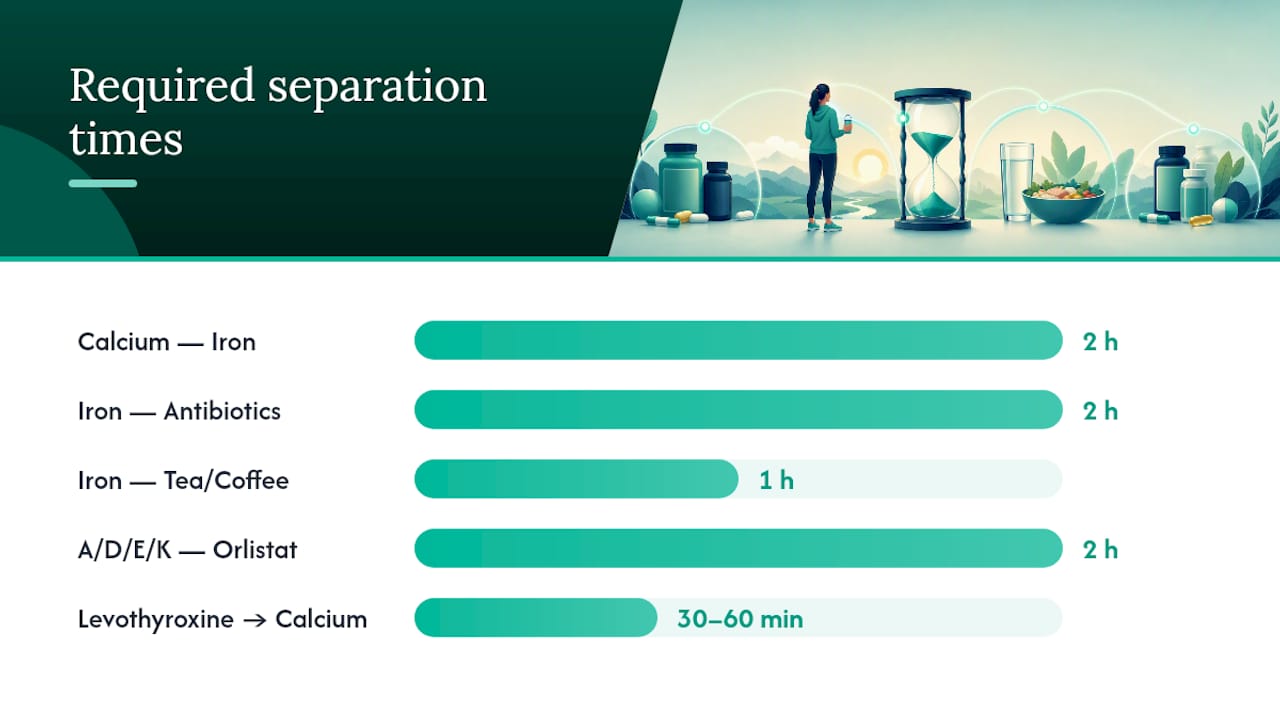
- Calcium citrate and iron: minimum 2 hours apart, every day. This is the rule most patients break first, and it is the one that causes the most preventable deficiencies.
- Calcium dose limit: no more than 500–600 mg per dose. The gut can only absorb roughly that amount at once, so splitting is not optional — it is how the math works.
- Tea and coffee: avoid taking iron supplements within an hour of either. Tannins bind iron and reduce uptake significantly.
- Vitamin C with iron: pairing 250–500 mg of vitamin C with your iron dose actively improves absorption. Orange juice or a vitamin C tablet both work.
- Ferrous sulfate slow-release: avoid this form. It is designed to release iron slowly along the intestine, but after bariatric surgery the relevant absorptive segment is shorter, so much of the dose may be wasted.
Medication interactions to flag with your care team:
| Supplement | Medication | Interaction | Action |
|---|---|---|---|
| Calcium citrate | Levothyroxine (thyroid) | Calcium reduces thyroid hormone absorption | Take levothyroxine 30–60 min before calcium |
| Iron | Tetracycline / fluoroquinolone antibiotics | Iron chelates the antibiotic, reducing its effectiveness | Separate by at least 2 hours |
| Multivitamin (iron) | Proton pump inhibitors (PPIs) | PPIs further reduce acid, impairing iron and B12 absorption | Discuss with prescriber; may need higher doses |
| Zinc | Copper | High zinc intake depletes copper | Never supplement zinc without copper in the same regimen |
| Fat-soluble vitamins (A, D, E, K) | Orlistat | Orlistat blocks fat absorption, reducing uptake of fat-soluble vitamins | Separate by 2 hours; monitor levels closely |
Pro Tip: Schedule supplements around protein-rich meals when possible — protein slows gastric emptying slightly, which can improve tolerance. More practically, use consistent clock anchors (7 AM, 12 PM, 3 PM, 9 PM) rather than meal times that shift day to day. Meals move; clock times do not.
How do you choose the right bariatric-formulated supplement?
Not every supplement labeled "bariatric" meets the same standard. Here is what to look for on the label before you buy.
Checklist for bariatric-formulated products:
- Iron included at 18 mg minimum per serving (not just trace amounts)
- B12 at 500–1,000 mcg per serving
- Calcium listed as calcium citrate (not carbonate, phosphate, or unspecified)
- Vitamin D3 (cholecalciferol), not D2 (ergocalciferol)
- Copper present (1–2 mg) alongside zinc to prevent imbalance
- No gummy form (potency is consistently inadequate for post-bariatric needs)
- Third-party tested or manufactured under USP or NSF standards
Brand examples available in the U.S.:
Bariatric Advantage offers chewable and capsule multivitamins specifically formulated for post-bariatric patients, with iron included and B12 at clinically relevant doses. Their Ultra Solo line is a commonly referenced option in program handouts.
Celebrate Vitamins (Celebrate) produces a wide range of bariatric-specific formats including chewables, capsules, and powders. Their calcium citrate chews are a practical choice for patients who struggle with large tablets early post-op.
Bariatric Fusion is known for its all-in-one multivitamin and mineral formulas in both chewable and powder formats, with iron and B12 at guideline-aligned levels. The powder format is particularly useful in the first weeks when swallowing is difficult.
Kirkland (Costco's house brand) is a cost-accessible option some programs include in their handouts as a budget-friendly multivitamin. It is not bariatric-specific, so patients using it typically need to supplement calcium citrate, B12, and iron separately to reach guideline targets.
Opurity (formerly Unjury's supplement line) offers bariatric-formulated vitamins with transparent labeling. Their products are available through specialty bariatric retailers and online.
A word on gummies: Gummy vitamins are widely marketed and easy to find, but they should be avoided after bariatric surgery because they routinely lack the iron, B12, and micronutrient potency that post-op patients require. The format is designed for general wellness, not for the elevated demands of a surgically altered digestive tract.
Program handouts from Kaiser Permanente include brand examples and cost approximations alongside sample schedules, and recommend bariatric-formulated multivitamins with 500–1,000 mcg B12 and iron ranging from 18–60 mg depending on patient factors. Buying from a bariatric specialty retailer (online or through your program's pharmacy) typically gives you better access to citrate-based calcium and higher-potency B12 than a standard drugstore shelf.
What should you do when a dose is missed or vomiting occurs?
Missing a single dose is not a crisis. Consistently missing doses is.
For a missed dose:
- Do not double up on the next dose. Take your next scheduled dose as planned and note the miss in your supplement log.
- If you miss calcium for a full day, simply resume the next morning — do not try to compress two days into one.
- If you miss iron for a day, the same rule applies. Doubling iron doses increases the risk of nausea and GI distress, which makes adherence worse, not better.
For vomiting after taking a supplement:
- Rehydrate with small sips of water or an electrolyte drink.
- Do not immediately repeat the supplement that triggered vomiting — wait until your next scheduled window and try with a small amount of food.
- If vomiting is persistent (more than 24 hours), contact your bariatric clinic. Prolonged vomiting is a thiamine emergency. Your team may recommend parenteral or intramuscular thiamine replacement rather than waiting for oral absorption to resume.
- Seek urgent care if you experience confusion, vision changes, or difficulty walking alongside vomiting — these can be early signs of Wernicke's encephalopathy from acute thiamine deficiency.
Adherence tactics that actually work:
- Weekly pill organizers reduce the cognitive load of daily decisions. Fill them every Sunday.
- Link each dose to a non-negotiable daily anchor: waking up, brushing teeth, a meal, bedtime. The anchor does not move; the supplement goes with it.
- For travel, pre-portion supplements into a labeled daily pouch. Airports and hotel rooms disrupt routines; a pouch removes the decision entirely.
- Bring your supplement log to every bariatric follow-up. Your team can spot patterns (missed afternoon doses, skipped iron) that labs alone do not reveal.
Pro Tip: Keep a simple one-page "supplement worksheet" — date, time, supplement, any symptoms — and photograph it weekly. At your follow-up visit, it gives your bariatric team more useful information than memory alone, and it takes about 30 seconds a day to maintain.
The family decision guide on Weightlosssurgeryguide includes resources for caregivers who help manage supplement organization, which is genuinely useful in the first weeks post-op when fatigue makes self-management harder.
Which symptoms should you report, and when do labs need to happen?
Deficiency symptoms often appear months or years after surgery, well after the initial recovery period. Knowing what to watch for between lab draws is the safety net.
Symptoms mapped to likely nutrient causes:
- Fatigue, pale skin, shortness of breath on exertion: iron deficiency anemia or B12 deficiency
- Tingling, numbness, or burning in hands and feet: B12 or thiamine deficiency (neuropathy)
- Hair thinning or shedding beyond the expected 3–6 month post-op phase: zinc, iron, or protein deficiency
- Brittle nails, easy bruising: vitamin C, zinc, or vitamin K deficiency
- Bone pain or stress fractures: calcium and vitamin D deficiency
- Confusion, memory problems, difficulty with coordination: thiamine or B12 deficiency (neurologic — seek urgent assessment)
- Night blindness or dry eyes: vitamin A deficiency (more common after DS)
- Muscle cramps or weakness: magnesium, calcium, or vitamin D deficiency
Recommended lab monitoring schedule:
When to escalate without waiting for the next scheduled lab:
- Rapidly falling hemoglobin or new-onset anemia symptoms: call your clinic within 48 hours.
- Any neurologic symptom (tingling, coordination problems, confusion): same-day or urgent care contact.
- Persistent vomiting beyond 24 hours: urgent thiamine assessment, as described above.
- Bone pain or a stress fracture with no clear trauma: request calcium, vitamin D, and PTH panel promptly.
Coordinating these labs with a U.S.-based provider is straightforward with the right setup. The US doctor coordination guide on Weightlosssurgeryguide walks through how to arrange follow-up labs and communicate your surgical history to a domestic clinician.
Medical disclaimer, reviewer, and sources
This article is educational content only. It is not a substitute for individualized medical advice, diagnosis, or treatment. Supplement doses, timing, and monitoring schedules vary by procedure type, individual health status, lab results, and clinical judgment. Always follow the specific guidance of your bariatric surgeon, registered dietitian, and primary care provider. Do not adjust your supplement regimen based on this article alone.
Medical reviewer: Ariel Last reviewed: (Insert review date)
This content was developed using primary clinical guidelines and patient-facing resources from Mayo Clinic Health System, Johns Hopkins Medicine, NCBI Bookshelf, Kaiser Permanente, Columbia Surgery, and NHS regional guidance (January 2026). All cited sources are linked inline throughout the article.
For facility credentials and accreditation standards relevant to patients considering surgery in Tijuana, see Hospital Cyntar and The Ariel Center and the bariatric accreditation standards page on Weightlosssurgeryguide. Source verification and the evidence library are available at the Weightlosssurgeryguide evidence library.
Contact your bariatric clinic or primary care provider for individualized dosing, lab interpretation, or any symptom that concerns you between scheduled visits.
What this schedule means in daily practice
The pill count surprises most patients. On a full long-term regimen, you may be taking 6–10 supplement doses across the day, not because the science is complicated, but because absorption limits and interaction rules force the spacing. That is normal, and it does get easier once the routine is set.
The schedule above is a framework, not a prescription. Your bariatric team will adjust it based on your procedure, your labs, and how your body responds. What matters most is not hitting every dose at the exact minute — it is the consistency over months and years that protects you from the deficiencies that show up quietly and late.
Key Takeaways
A lifelong bariatric vitamin schedule built around calcium-iron separation, bariatric-formulated products, and annual labs is the foundation of safe, sustained health after weight loss surgery.
| Point | Details |
|---|---|
| Separate calcium and iron | Keep calcium citrate and iron-containing supplements at least 2 hours apart, every day. |
| Split calcium doses | Take no more than 500–600 mg of calcium citrate per dose to stay within absorption limits. |
| Use bariatric-formulated products | Standard OTC multivitamins and gummies lack the iron, B12, and micronutrient potency post-op patients need. |
| Get annual labs | Monitor CBC, iron, ferritin, B12, 25-hydroxyvitamin D, zinc, copper, and calcium at least once a year. |
| Report neurologic symptoms urgently | Tingling, confusion, or coordination problems between lab draws warrant same-day contact with your clinic. |
Sources
Bring these to your bariatric visit if you need dose clarification or want to discuss guideline ranges with your team.
- Recommended postoperative supplementation — NCBI Bookshelf (bariatric surgery table)
- Bariatric vitamins recommended brands & daily requirements — Kaiser Permanente (PDF)
- N&W Medicines Optimisation Dietetic Team — Multivitamin and Mineral Supplementation following Bariatric Surgery (V3.0 Jan 2026)