Surgery Financing in Mexico: Check CAT Before You Borrow
Published October 15, 2026

Surgery Financing in Mexico: Check CAT Before You Borrow
The main ways to finance surgery in Mexico are clinic payment plans, medical financing companies, bank or personal loans, credit cards, Seguro de Gastos Médicos Mayores with important caveats, and personal savings or institutional loans. Before choosing any of these, compare the total cost of each option using the CAT (Costo Anual Total), confirm in writing what a clinic or insurer will actually pay, then move forward with documents and timelines in hand.
TL;DR:
- Compare each offer by its CAT, the total annual cost that includes interest, commissions, and fees; monthly payments alone can hide borrowing costs.
- Mend lists commissions of about 15% for six months, 30% for 12, 45% for 18, and 60% for 24; longer terms raise total cost.
- Major medical expense insurance often excludes elective procedures, while payment limits may leave a balance; get written approval for your specific procedure and provider.
- U.S. and Canadian patients often need financing at home because Mexican plans may require residency, someone local to co-sign, or a Mexican bank account.
- Ask whether a clinic reservation deposit is refundable, what happens if dates change, and whether quoted prices include aftercare, travel, accommodation, and every added fee.
Table of Contents
- Which financing routes exist and who they fit best
- How SGMM and private insurance actually pay for surgery
- How medical loan companies price credit and what they require
- What clinics require for in-house payment plans
- How long approval takes and what sample costs look like
- A decision checklist before you commit to any option
- Who reviewed this guide and when
- What a full surgery budget in Mexico actually includes
- From application to surgery date: a realistic timeline
- Financing surgery in Mexico as a U.S. or Canadian patient
- Managing currency exchange risk when paying in pesos
- Why the financing conversation needs to start earlier
- How we help you plan financing and find an accredited provider
- FAQ
- Sources
Which financing routes exist and who they fit best
Each route works differently depending on how much you need, how fast you need it, and whether you have documentation ready. Here is how the main options break down.
- Clinic or hospital payment plans: These work well for smaller balances and often include "meses sin intereses" for short terms, though they usually require a reservation deposit before scheduling.
- Medical financing companies: Firms like Mend structure credit specifically for procedures, charging a commission or fixed fee that scales with the term length, which suits larger balances that clinics will not finance directly.
- Personal loans and credit cards: These give you immediate access to funds if you are already approved, but you need to compare the real CAT against any promotional interest-free period before committing.
- Seguro de Gastos Médicos Mayores (SGMM): Major medical expense insurance may cover certain non-elective procedures under a tabulator or through reimbursement, though elective and aesthetic procedures are frequently excluded, so preauthorization in writing is essential.
- Employer assistance, institutional loans, or family support: Workplace savings funds, employee credit unions (cajas), or a private loan from family sometimes carries no commission at all, though a lender may still require a codeudor or aval if your income history is thin.
Matching the route to your timeline matters as much as matching it to your budget. A clinic plan may suit urgent needs; a medical financing company suits a planned procedure where you have time to gather documents.
How SGMM and private insurance actually pay for surgery
Many people assume a Seguro de Gastos Médicos Mayores policy will simply cover surgery once purchased. In practice, insurers use tabulators, tables that cap what they will pay for honorarios médicos, and that cap often falls short of what a clinic actually bills. A CONDUSEF explainer notes that policies typically include a basic coverage for medical fees, hospitalization, and diagnostics, but benefits, deductibles, and the hospital tier you choose all shift what you end up paying out of pocket.
Insurers also handle payment in different ways. Under reimbursement, you pay the clinic first and the insurer refunds the eligible amount afterward. Under pago directo, the insurer pays an in-network provider directly, which avoids the upfront cash crunch. For cirugía programada, a planned surgery, the insurer may pay the provider in advance, but only after reviewing and approving the case.
- Read the "Condiciones Generales" of your policy before assuming coverage applies to your procedure.
- Request written preauthorization from the insurer naming your specific surgery and provider.
- Run your numbers through CONDUSEF's GMM simulator to compare plans before buying or renewing.
Pro Tip: Ask your insurer in writing whether your specific procedure code falls under an exclusion before you schedule anything.
How medical loan companies price credit and what they require
Third-party medical financing companies price loans using a commission that rises with the repayment term rather than a simple interest rate. Public materials from Mend list commission bands around 15% for a 6-month term, 30% for 12 months, 45% for 18 months, and 60% for 24 months, so a longer term costs meaningfully more in total, not just in smaller monthly payments.

The figure that actually lets you compare lenders is the CAT, since it bundles interest, commissions, and other charges into one annual percentage that Mexican law requires lenders to disclose.
Expect to provide:
- Official identification and proof of address.
- Proof of income or bank statements from recent months.
- A debit or credit card on file for payment collection.
- An obligado solidario or aval, required by some lenders when your income history is limited.
Timing varies: online pre-approval and final disbursement depend on how quickly the lender verifies your documents and the clinic confirms the procedure date.
What clinics require for in-house payment plans
Clinic financing feels simpler than an outside loan, but the contract terms deserve the same scrutiny. Most clinics ask for a reservation deposit to hold your surgery date, and whether that deposit is refundable or simply applied to your total balance varies by provider, so ask before you pay it. Some clinics also add smaller line items, such as a "póliza jurídica" or legal-service policy fee, that raise the effective cost beyond the headline price.
Before signing, confirm:
- Whether the reservation deposit is refundable and under what conditions.
- What happens to your payment schedule if your surgery date moves.
- Whether a codeudor or guarantor is required and what that person's liability looks like.
- What proof-of-income documents the clinic needs to approve a payment plan.
- Any cancellation penalty and how far in advance you must cancel to avoid it.
A contract that answers all five questions clearly is a good sign you are dealing with a transparent provider.
How long approval takes and what sample costs look like
Clinic preauthorization for an in-house payment plan may move quickly, since the clinic controls its own approval process. Outside financing through a bank, credit card issuer, or medical lender can take longer, depending on how quickly you submit income verification.
CAT examples vary widely by lender and term. Caja CGV's Préstamo PROMOSALUD lists a maximum loan of $300,000 MXN, a monthly rate example of 1.5% plus VAT, and an average CAT example of 22.0% without VAT on a sample $50,000 MXN loan over 36 months. Running your own numbers through CONDUSEF's CAT comparison tool is the only reliable way to see how your actual offer stacks up against that example.
Some clinics require full prepayment before scheduling, especially for lower-cost procedures, while others allow a down payment with the remaining balance financed through installments once the procedure is confirmed.
A decision checklist before you commit to any option
Comparing offers on the right criteria protects you from a plan that looks affordable monthly but costs far more overall.
- Total cost including every commission and fee, not just the advertised monthly payment.
- The CAT for each financing offer, pulled from the lender's disclosure or run through CONDUSEF.
- The full payment schedule, including what happens if a payment is late.
- Written preauthorization from your insurer, if insurance is part of the plan.
- The cancellation and refund policy in case your surgery date changes.
- Who is required to co-sign and what their liability looks like.
- Whether aftercare and follow-up visits are included in the quoted price.
Ask your clinic directly: "What is the total cost including all fees, and is a reservation deposit refundable?" Ask your lender: "What is the CAT on this offer, and what happens if I pay it off early?" Ask your insurer: "Is this specific procedure covered under my tabulator, and can I get that in writing?"
Pro Tip: Get the total-cost quote in writing first, run the CAT through CONDUSEF second, then confirm your surgery date and refund terms last, in that order.
Who reviewed this guide and when
Author: Ariel. Medical reviewer: not publicly listed. Last reviewed: see the article's current review date. This article is educational and does not replace personalized medical or financial advice from a licensed professional. For credentials and provider background, see Obesity Control Center and CYNTAR.
What a full surgery budget in Mexico actually includes
A realistic budget covers more than the surgeon's fee. The clinic charge typically bundles the surgical fee, hospital stay, anesthesia, and some pre-operative labs, but financing costs sit on top of that. If you finance any portion, add the commission or interest from your chosen route, whether that is a clinic installment plan, a medical lender's commission band, or credit card interest.
Beyond the procedure itself, factor in travel. Flights to Tijuana vary by origin city and season, and ground transportation from the airport to the clinic is sometimes included in all-inclusive packages and sometimes billed separately. Accommodation for you and a companion during recovery adds another line item, since most bariatric and post-bariatric procedures require a few nights near the clinic before flying home.
Smaller but real costs include compression garments, prescribed medications, follow-up telehealth visits, and any lab work your home-country physician requires afterward. Exchange rate movement between the time you get a quote and the time you pay can also shift your final cost in U.S. or Canadian dollars, even when the peso price stays fixed.
Before booking, ask for one document that lists every charge: procedure, hospital stay, anesthesia, financing commission if applicable, and any travel or accommodation bundled into the package. Our guide to why accreditation beats price alone walks through how to read an all-inclusive quote line by line.
From application to surgery date: a realistic timeline
Financing and scheduling move in parallel, not one after the other. Here is roughly how the sequence unfolds for most patients.
First, request quotes from one or more clinics and decide whether to finance through the clinic, a medical lender, or a personal loan. If you are applying for third-party financing, submit identification and proof of income, since approval time varies.
Once financing is approved or your savings plan is confirmed, pay your reservation deposit to hold a surgical date. This is also when you should request any required preauthorization from an insurer, if insurance covers part of the procedure.
Before surgery, the clinic may request updated lab work and a pre-operative clearance, especially for bariatric procedures. Travel and accommodation bookings usually happen during this window once your date is locked in.
Recovery time before flying home varies by procedure, so confirm that window with your clinic before booking return flights. Our guide to choosing an accredited Mexico bariatric center covers how to vet a provider during this planning stage.
Financing surgery in Mexico as a U.S. or Canadian patient
Cross-border patients face a financing landscape that looks different from a Mexican resident's options. Mexican medical lenders and clinic payment plans generally require proof of Mexican residency, a local co-signer, or a Mexican bank account, which rules many foreign patients out of those specific products.
Instead, U.S. and Canadian patients typically rely on financing arranged in their home country: a personal loan from a home-country bank, a medical credit card, or savings, then pay the Mexican clinic directly in pesos or U.S. dollars depending on the provider's policy. Some providers also offer flexible payment timing that lets you pay a deposit from home and settle the remainder in person.
If your health plan includes any out-of-network or international benefit, request a reimbursement estimate before you travel. Our guide to bariatric surgery reimbursement for U.S. and Canadian patients walks through what documentation insurers typically request for a reimbursement claim.
Because the comparison math differs by country, treat a Mexican lender's CAT and a U.S. or Canadian lender's APR as two separate calculations. Converting one into the other does not give you an apples-to-apples number, so compare total cost in your own currency against the peso-denominated clinic quote instead.

Managing currency exchange risk when paying in pesos
Quotes from Mexican clinics are typically given in Mexican pesos, while your financing and income are likely in U.S. or Canadian dollars. That gap creates two risks worth planning around.
First, the exchange rate on the day you get your quote is not guaranteed to hold by the time you pay. A multi-week gap between your initial quote and your surgery date gives the peso room to move in either direction, which can make your final bill slightly higher or lower than expected in your home currency.
Second, if you finance through a U.S. or Canadian lender and pay the Mexican clinic in pesos, your card network or bank adds its own foreign transaction fee and conversion rate on top of the quoted price. Ask your clinic whether they can lock a quote in your home currency, and ask your card issuer or bank what fee applies to a foreign currency purchase before you travel.
Paying a reservation deposit early, once you have a firm quote, reduces how much of your balance remains exposed to exchange rate movement before your surgery date.
Why the financing conversation needs to start earlier
Most financing advice treats the loan or payment plan as the last step before surgery, something to sort out once you have already picked a clinic. That sequencing backfires. The CAT, the preauthorization letter, and the clinic's refund policy all change what a procedure actually costs, and discovering those details after you have committed to a date leaves you negotiating from a weaker position.
The more useful habit is to treat CONDUSEF's simulators as a first step, not a final check. Running the numbers before you shortlist clinics tells you what you can actually afford, which narrows your provider search to realistic options instead of ones you later have to walk away from.
What gets underestimated most is the co-signer requirement. It can surface late in an application and stall a procedure date if you have not lined up an obligado solidario in advance. Readers who ask about this upfront, rather than after approval, move through financing with far less friction.
— Ariel
How we help you plan financing and find an accredited provider
We built our comparisons around hospitals and surgeons in Tijuana so you can weigh financing routes against a provider's safety record, not just its price. We offer educational comparisons, help matching you with an accredited care team, and a free personalized quote based on the procedure and timeline you have in mind.
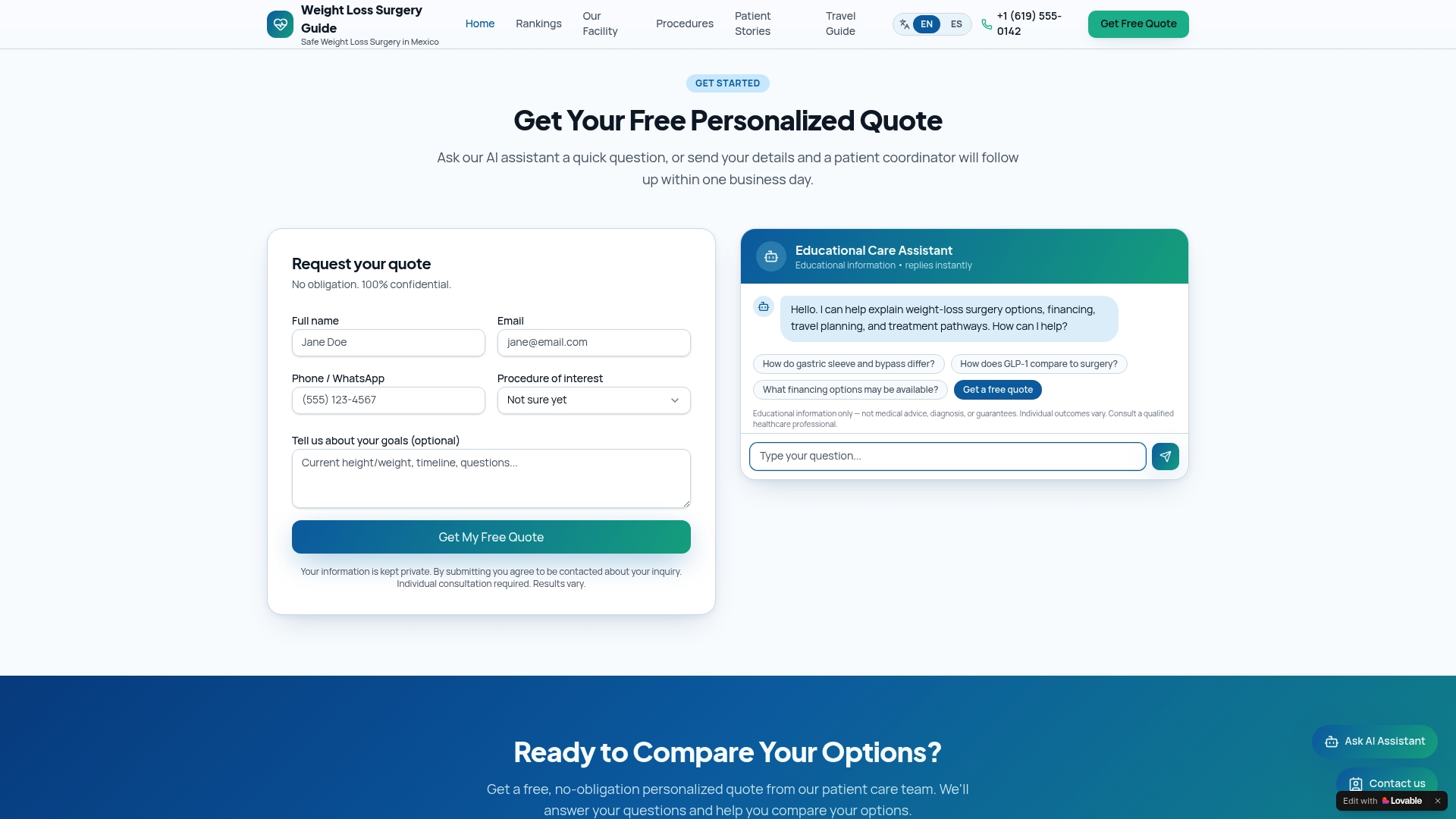
To request a quote, have ready: the procedure you are considering, your preferred surgery timeframe, and a rough budget range so we can point you toward financing routes that fit.
- Tell us your procedure and target timing.
- Share your approximate budget so we can match realistic clinic and financing options.
- Get a free personalized quote through our bariatric surgery Mexico guide.
Start with our main bariatric surgery guide to request your free personalized quote and get matched with an accredited provider.
This article is general information, not a substitute for advice from a qualified doctor. Consult a qualified healthcare professional about your own circumstances before acting on anything here.
FAQ
What can I do if I need surgery in Mexico but have no money?
Start by comparing clinic payment plans, medical financing companies, and personal loan options side by side using the CAT so you see true total cost, not just a monthly figure. Some clinics also offer short interest-free terms for smaller balances, and family support or an employer loan can cover a gap without added commissions.
Can I get a loan specifically for surgery?
Yes, medical financing companies and some banks in Mexico offer loans designed for procedures, often requiring identification, proof of income, and sometimes a co-signer. Compare the CAT across offers rather than the advertised commission alone, since that figure reflects the full cost of the credit.
How can I save up money for surgery?
Setting aside a fixed amount each month toward a dedicated account, combined with a clinic's reservation deposit structure, lets you reduce how much you need to finance. Pairing modest savings with a shorter-term, lower-commission financing option often costs less overall than financing the entire procedure.
How is healthcare financed in Mexico?
Healthcare in Mexico is financed through a mix of public institutions, private insurance like Seguro de Gastos Médicos Mayores, and out-of-pocket or financed payments for private care. Private procedures, including most elective and bariatric surgeries, are typically paid through a combination of clinic payment plans, third-party medical loans, or personal funds since SGMM often excludes or limits elective coverage.