Choosing a Mexico Bariatric Center: Accredited Options
Published August 22, 2026
Choosing a Mexico Bariatric Center: Accredited Options
Pick a hospital carrying real external accreditation, paired with a surgeon certified by CMCOEM and CMCG, and you've solved most of the risk before you ever board a flight. A national Delphi consensus of Mexican bariatric surgeons, drawing on a very large number of combined procedures, found that safety in cross-border bariatric care hinges far more on surgeon volume and recognized accreditation than on marketing language. That's the filter to apply before anything else.
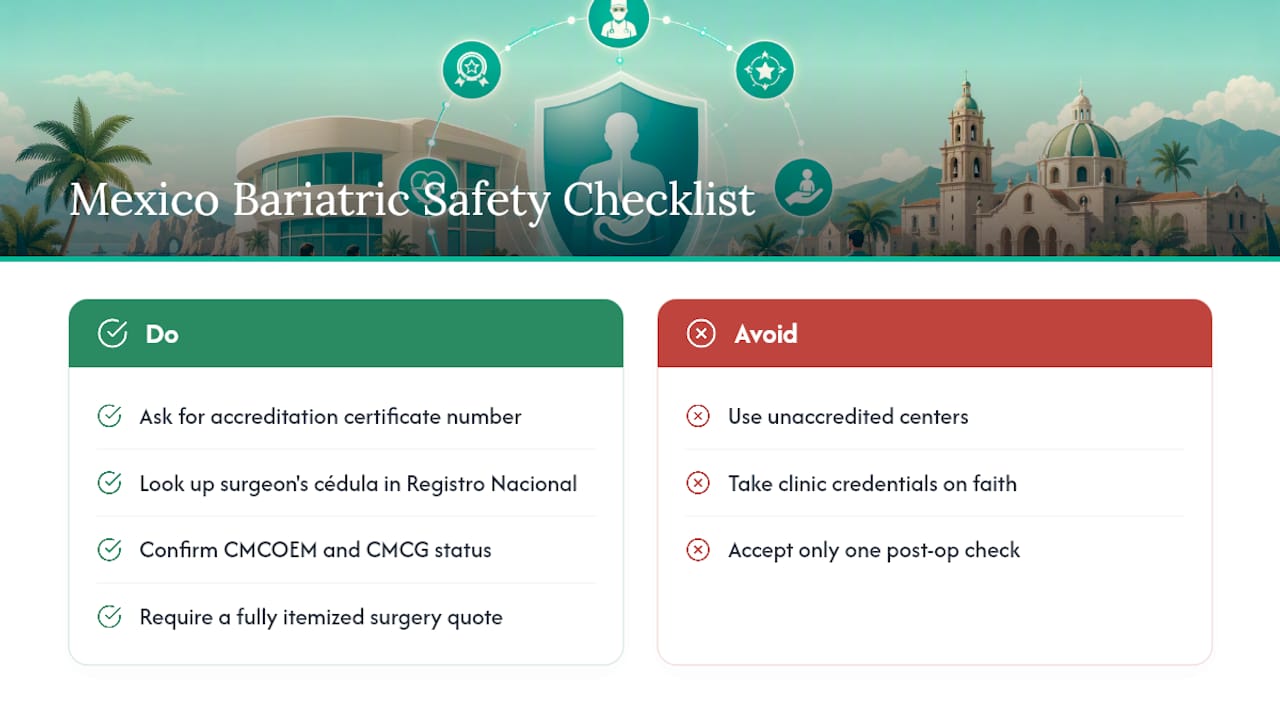
Before you request a quote, confirm the center has:
- External hospital accreditation (JCI, SRC, AAAASF, or SiNaCEAM)
- Board-certified surgeon with verifiable CMCOEM and CMCG credentials
- Documented annual case volume, not just years "in practice"
- A written 12-month follow-up program, not a one-time visit
Once those four boxes are checked, the fastest next step is to request a verified quote through a provider directory or draft a short verification email using the checklist below and send it to any center you're considering.
Key Takeaways
Safety in bariatric medical tourism depends primarily on external hospital accreditation, verified surgeon certification, documented case volume, and a real 12-month follow-up program.
| Point | Details |
|---|---|
| Accreditation first | Confirm JCI, SRC, AAAASF, or SiNaCEAM certification with an actual certificate number before anything else. |
| Certification stacks | Look for both CMCG and CMCOEM certification, plus a verifiable cédula profesional. |
| Volume beats marketing | Ask for documented case volume; higher volume tracks with lower complication rates. |
| Itemized quotes only | Insist on a written breakdown covering surgeon, hospital, anesthesia, meds, and follow-up. |
| Use a vetted directory | Weightlosssurgeryguide pre-verifies accreditation and follow-up programs before matching patients to providers. |
Where to independently verify these credentials
- PubMed listing for the national bariatric tourism consensus for the underlying safety research
- CMCOEM certification requirements to understand what surgeon certification actually verifies
- Weightlosssurgeryguide's references page for quick links to primary sources
A cédula lookup confirms a surgeon is legally licensed; the CSG page confirms whether a hospital's certification is active and current.
Medical reviewer: This article was reviewed for medical accuracy by the clinical team affiliated with Obesitycontrolcenter.com and Cyntar. Last reviewed: January 2026.
This article is for educational purposes only and does not constitute medical advice. Always consult a qualified physician to evaluate whether bariatric surgery is appropriate for your individual health situation. For details on specific procedures, see our gastric sleeve and bypass procedure guides.
Table of Contents
- What to check first when comparing a Mexico bariatric center
- Which accreditations and certifications actually matter?
- What does a bariatric surgery quote in Mexico actually include?
- What recovery and follow-up should you expect after surgery?
- How does a provider directory vet centers before listing them?
- What should you ask before booking a bariatric surgery quote?
- Get a Verified Quote Instead of Guessing From a Website
- Frequently Asked Questions
- Sources
What to check first when comparing a Mexico bariatric center
You can eliminate half your shortlist in ten minutes using seven questions. Run through them before you spend time on a phone consultation.
- Hospital accreditation. Does the facility carry JCI, SRC, AAAASF, or SiNaCEAM certification, and can they give you a certificate number?
- Surgeon certification. Is the surgeon certified by both CMCG and CMCOEM, with a cédula profesional you can look up independently?
- Case volume. How many bariatric procedures did this surgeon or surgical group perform last year?
- ICU and emergency capability. Is there 24/7 intensivist coverage and an on-site ICU, not just a "partner hospital nearby"?
- Follow-up program. Is there an explicit 12-month post-op plan, including who provides it?
- Itemized quote. Does the written estimate spell out what's included and excluded, or is it a single lump sum?
- Independent reviews. Can you find patient feedback outside the clinic's own website, along with a documented complication and transfer protocol?
Pro Tip: Treat vague phrases like "affiliated hospital" or "partner facility" as a red flag. Ask for the actual hospital name, address, and accreditation number, then verify it yourself before booking anything.
When you make first contact, lead with three questions: What's your surgeon's CMCOEM certification number? What's your annual case volume? What does your written quote include? A center with nothing to hide answers all three without hesitation.
Which accreditations and certifications actually matter?
Accreditation names get thrown around loosely in medical tourism marketing, so it helps to know what each one actually requires.
CMCG (Mexican Council of General Surgery) certifies general surgeons through examination and peer review, serving as a baseline credential most bariatric surgeons need before specializing further.
CMCOEM (Mexican College of Obesity Surgery and Metabolic Diseases) is the specialty benchmark for bariatric surgeons specifically. Its certification process requires documented specialist training, proof of minimally invasive surgery coursework, minimum case volume thresholds, and a practical and oral evaluation, with the CMCG providing external verification of the credential.
JCI (Joint Commission International), SRC (Surgical Review Corporation), and AAAASF are hospital and facility accreditors that audit clinical protocols, infection control, staffing ratios, and outcomes tracking through on-site inspection, not a paid badge.
SiNaCEAM, run under Mexico's Consejo de Salubridad General, is the national hospital certification framework that sets baseline safety and facility standards recognized across the country.
To verify any of these independently:
- Look up the surgeon's cédula through Mexico's Registro Nacional de Profesionistas
- Search JCI, SRC, and AAAASF public accreditation directories using the hospital's exact legal name
- Read how these hospital standards work before comparing certificate numbers side by side
- Request the SiNaCEAM certificate number directly from the hospital's administration
If a center claims accreditation but stalls when you ask for a certificate number, that hesitation is itself the answer.
What does a bariatric surgery quote in Mexico actually include?
Self-pay bariatric procedures in Mexico commonly run at a fraction of U.S. sticker prices, and most patients report meaningful savings once you factor in the total package rather than just the surgeon's fee. The range varies by procedure complexity, hospital tier, and what's bundled in, which is exactly why a single number is misleading and an itemized breakdown matters more than the headline total.
A transparent, complete quote should list:
- Surgeon fee
- Hospital and operating room fee
- Anesthesia
- Implants or surgical devices (staplers, mesh, etc.)
- Pre-op testing (bloodwork, EKG, imaging)
- Post-op medications
- Number of hospital stay nights included
- Follow-up visits or telehealth sessions
- Emergency transfer policy
- Ground transportation and border logistics
Costs that quietly get left off the initial estimate include cardiology or pulmonary clearance for higher-risk patients, additional lab panels, anti-embolism stockings, compounded medications, and private ambulance service if a border crossing is needed during recovery. None of these are exotic add-ons. They're routine, and a center that's upfront about them from the start is one worth trusting more.
Pro Tip: Ask two or three centers for the same itemized breakdown in writing, then compare them line by line. If one quote is dramatically lower with no explanation for what's missing, that gap is where the surprise bill will come from.
What recovery and follow-up should you expect after surgery?
The two procedures you'll see most often are sleeve gastrectomy and Roux-en-Y gastric bypass, with biliopancreatic diversion offered at some centers for higher BMI cases. Sleeve gastrectomy is simpler and has a shorter operative time; bypass involves rerouting the digestive tract and carries a different risk profile worth discussing directly with your surgeon, including long-term vitamin absorption.
A typical timeline looks like this: one to two nights in the hospital, restricted activity and a liquid-to-soft-food progression for the first two weeks, functional recovery by four to six weeks, and major weight-loss and health milestones tracked at three and six months. The reason credible centers push a full 12-month follow-up program isn't bureaucracy. It's because metabolic and nutritional issues often surface well after the incision has healed.

Comprehensive follow-up should include virtual nutrition counseling, psychological check-ins, wound assessment, a review of blood clot prevention measures, and a clear plan for what happens if something goes wrong after you've flown home. Top Tijuana clinics increasingly structure this as a full 12-month virtual program rather than a single follow-up call, and that structure is worth demanding in writing before you book. For a deeper breakdown of what that year should look like, see this guide to post-surgery follow-up care.
How does a provider directory vet centers before listing them?
Verification isn't a one-time glance at a website badge. Before any center appears in a matching service, the checks should include confirming the hospital's accreditation certificate number directly with the issuing body, verifying the surgeon's cédula and cross-checking CMCOEM and CMCG status, and reviewing documented case volume rather than accepting a round number from a sales call.
It also means confirming actual ICU and emergency capability, reading the center's written complication-management and follow-up policy in full, and pulling independent patient reviews from outside the clinic's own marketing.
A center worth listing has external certificates it will hand over without pushback, a documented multidisciplinary team including a nutritionist, psychologist, and anesthesiologist, a real 12-month follow-up structure, and a willingness to discuss its complication rates rather than deflect the question. If you want to see those documents yourself, you can request the underlying certificates and outcome summaries before a quote is finalized.
What should you ask before booking a bariatric surgery quote?
Before you sign anything, get direct answers to these in writing:
- What are the hospital's and surgeon's certificate numbers, and can I verify them independently?
- What was your documented bariatric case volume last year?
- What's your ICU capability and re-admission protocol?
- What does the 12-month follow-up schedule look like, and does the operating surgeon provide it personally?
- Can I get an itemized quote showing everything included and excluded?
- What's your emergency transfer policy, and what happens financially if there's a complication?
- Can you connect me with a past patient or point me to independent reviews?
A short email covering all seven, sent to two or three centers at once, tends to separate serious providers from marketing-first operations fast. Vague, deflected, or partial answers to more than one of these questions are reason enough to move on to the next center on your list.
Why accreditation and follow-up matter more than price alone
Accreditation, surgeon certification, documented case volume, and a real 12-month follow-up program are the strongest predictors of a safe outcome, stronger than any price on a brochure. That's the filter we apply, and it's why this guide points toward verified centers with long-term patient support instead of the lowest bid.
Get a Verified Quote Instead of Guessing From a Website
Comparing bariatric centers on your own means chasing down certificate numbers, cross-checking cédula registries, and hoping a clinic's "partner hospital" claim holds up. Weightlosssurgeryguide skips that legwork: every provider in the directory is checked for hospital accreditation, CMCOEM and CMCG certification, documented case volume, and a real 12-month follow-up plan before it's ever shown to a patient.
That means the quote you get back has already been screened against the exact seven-point checklist covered above, so you're not starting from zero with each center you contact. If you're ready to move past research and get real numbers, request a personalized quote through the provider directory and compare it against whatever else you've been sent.
Frequently Asked Questions
Is it safe to get bariatric surgery at a Mexico bariatric center? Safety depends almost entirely on which center and surgeon you choose. Facilities with genuine external accreditation and CMCOEM-certified, high-volume surgeons report outcome metrics that can be comparable to U.S. benchmarks, while unaccredited operations carry meaningfully higher risk.
How do I verify a surgeon's certification in Mexico? Ask for their cédula profesional number and look it up through Mexico's Registro Nacional de Profesionistas, then confirm CMCOEM and CMCG status directly, since both credentials should be independently checkable rather than taken on the clinic's word.
What's typically included in a bariatric surgery quote from a Tijuana hospital? A complete quote covers the surgeon fee, hospital and OR fee, anesthesia, implants or devices, pre-op testing, hospital stay nights, post-op medications, follow-up visits, and transfer or refund policies. Anything less than that itemized breakdown should raise questions.
How long is the follow-up program after bariatric surgery in Mexico? Reputable centers offer structured 12-month follow-up including virtual nutrition counseling and psychological support, not a single post-op check-in before you fly home.
What if a center won't share its accreditation certificate number? Treat that as a disqualifying red flag. A legitimately accredited hospital or CMCOEM-certified surgeon has nothing to hide and will provide verifiable numbers without hesitation.
This article is general information, not a substitute for advice from a qualified doctor. Consult a qualified healthcare professional about your own circumstances before acting on anything here.