How International Hospital Standards Work for Bariatric Surgery in Tijuana
Published August 15, 2026

How International Hospital Standards Work for Bariatric Surgery in Tijuana
Accreditation from Joint Commission International (JCI) or Mexico's federal Consejo de Salubridad General (CSG) raises the safety floor for facility systems and emergency readiness. It does not guarantee your surgeon's skill or cover the cost of complications. Before you pay a deposit, do three things: verify the certificate's scope and expiry date, confirm the surgery happens inside a full-service private hospital with an ICU, and arrange specialized medical-travel complication insurance.
Three entities anchor this guide:
- Joint Commission International (JCI): the leading international accreditor, recognized across borders
- Consejo de Salubridad General (CSG): Mexico's federal hospital certification, the domestic legal baseline
- ASMBS Medical Tourism Bariatric Surgery Safety Checklist: the professional society's patient-facing vetting tool, hosted at Weightlosssurgeryguide
Pro Tip: Download the ASMBS checklist before your first consultation call. It forces providers to answer specific questions they might otherwise skip.
Key Takeaways
Accreditation (JCI or CSG) is a required starting filter for choosing bariatric surgery in Tijuana, but surgeon volume, ICU access, and medical-travel complication insurance are equally non-negotiable layers of protection.
| Point | Details |
|---|---|
| Accreditation scope and limits | JCI and CSG verify facility systems, not individual surgeon skill — use both as a floor, not a ceiling. |
| Verify the certificate yourself | Check the JCI directory and CSG registry; confirm the certificate covers the surgical department at the exact address. |
| ICU and blood bank are mandatory | Surgery must occur inside a full-service private hospital with 24/7 intensivist coverage and an on-site blood bank. |
| Complication insurance is required | Standard travel insurance excludes elective surgery abroad; arrange specialized medical-travel complication coverage before departure. |
| Weightlosssurgeryguide | Provides the Evidence & Verification Library, ASMBS checklist, and a verified surgeon directory for accredited Tijuana hospitals. |
Table of Contents
- How do international hospital standards actually work?
- What Mexico's national certification (CSG) adds to the picture
- What accreditation reliably signals — and where it falls short
- Your pre-booking vetting checklist for Tijuana bariatric surgery
- How to verify an accreditation claim step by step
- When does accreditation tip your decision — and when does it not?
- Costs, timelines, and the insurance you must arrange before you travel
- Weightlosssurgeryguide connects you to verified, accredited options in Tijuana
- Primary sources for independent verification
- An editorial perspective on accreditation and what it actually protects
- Weightlosssurgeryguide: your verified starting point for accredited bariatric care in Tijuana
- Sources
How do international hospital standards actually work?
International hospital accreditation is an independent audit of whether a facility's systems meet a defined standard. JCI, the most recognized international accreditor, sends surveyors on-site every three years to evaluate specific operational domains:
- Surgical safety: pre-operative checklists, surgical timeouts, site marking
- Infection control: hand-hygiene compliance, sterilization protocols, isolation procedures
- Medication management: reconciliation at admission and discharge, high-alert drug protocols
- Emergency management: mass-casualty plans, backup power, fire safety
- Staff credentialing: verification of licenses, training records, competency assessments
- Facility safety: physical plant inspections, equipment maintenance logs
- Information management: patient record accuracy, data privacy, discharge documentation
For a bariatric patient, these translate to concrete protections: a surgical timeout that confirms you are the right patient getting the right procedure, antibiotic prophylaxis timed correctly before incision, and a blood bank available if hemorrhage occurs.
The three-year survey cycle matters. A certificate issued two years ago reflects conditions at that snapshot. Standards also update between cycles, so a hospital can be technically accredited while operating under older protocols. Always check the certificate's issue date, not just whether the logo appears on a website.
What Mexico's national certification (CSG) adds to the picture
CSG is the Mexican federal authority for private hospital certification. Passing a CSG audit means a hospital has met strict federal requirements on infection control, medication management, and facility safety. It is the domestic legal baseline — a hospital operating without CSG certification is operating outside the federal quality framework.
| Feature | CSG | JCI |
|---|---|---|
| Issuing authority | Mexican federal government | Independent U.S.-based nonprofit |
| Legal standing in Mexico | Required baseline for certified private hospitals | Voluntary international benchmark |
| Scope focus | Domestic clinical safety standards | Cross-border parity with international norms |
| Most useful for | Confirming legal compliance in Mexico | Signaling alignment with global safety standards |
| How to verify | Federal CSG registry | JCI online directory search |
The practical gap for U.S. and Canadian patients: a number of hospitals in Mexico hold JCI accreditation, concentrated in major cities like Mexico City, Monterrey, and Guadalajara. Many high-volume border clinics in Tijuana are freestanding ambulatory centers that may lack JCI or CSG accreditation. When a provider says "we work with an accredited hospital," ask for the hospital's name and certificate. The surgery must happen inside that accredited facility, not in an affiliated building down the street.
What accreditation reliably signals — and where it falls short
Accreditation consistently improves adherence to care processes: checklists get followed, medications get reconciled, infections get tracked. A WHO multi-country review found that accreditation commonly strengthens process compliance, even when its effect on clinical outcomes is mixed.
That "mixed" finding deserves attention. A longitudinal analysis of Mexican hospitals using time-series and panel regression methods found that accreditation status alone did not guarantee better outcomes — and in some indicators, accredited hospitals showed modest increases in in-hospital mortality post-accreditation. The researchers attributed this partly to case-mix shifts: accredited hospitals attract higher-complexity patients.
The practical implication: accreditation tells you the hospital has the right systems. It says nothing about whether your specific surgeon has done 50 or 500 sleeve gastrectomies, or whether the ICU is staffed around the clock.
Your pre-booking vetting checklist for Tijuana bariatric surgery
A Delphi consensus of experienced Mexican bariatric surgeons reached agreement on 40 of 52 safety statements for bariatric medical tourism, covering patient selection, pre- and post-operative phases, and legal safeguards. Their findings support a structured checklist approach.
Hospital-level checks
- Confirm the facility's legal name and that it matches the certificate exactly.
- Request a scanned copy of the current CSG and/or JCI certificate — check the issue date, expiry, and listed scope.
- Verify the certificate covers the surgical department where your procedure will occur.
- Confirm ICU availability with 24/7 intensivist coverage and a blood bank on-site.
- Ask for written complication-management protocols and transfer agreements with a tertiary hospital.
Surgeon-level checks
- Board certification through CMCOEM (Colegio Mexicano de Cirugía para la Obesidad y Enfermedades Metabólicas) or equivalent.
- Annual surgical volume: surgeons with higher annual bariatric case volumes tend to have better outcomes in volume-outcome research.
- Revision experience: ask specifically how many revision surgeries the surgeon has performed.
- Published or documented outcomes data when available.
Logistics and financial checks
- Itemized written quote covering surgery, anesthesia, hospital stay, and post-op medications.
- Written policy on who covers complication costs and what the process looks like.
- Telehealth follow-up plan for after you return home (see the follow-up care guide for timelines).
- Specialized medical-travel complication insurance arranged before travel.
Red flags
- Provider cannot name the specific hospital where surgery occurs.
- Pre-op contact is sales-only with no clinical coordinator involved.
- "Starting at" quotes with no itemized breakdown.
- No written complication or transfer policy.
Pro Tip: Ask which hospital department admits complications — the answer tells you whether the team has actually thought through what happens if something goes wrong, or whether they're improvising.
How to verify an accreditation claim step by step
- Search the JCI directory at jointcommissioninternational.org — enter the hospital name and confirm the listing shows an active accreditation with a current expiry date.
- Check the CSG federal registry through the Secretaría de Salud portal — search by hospital name and state (Baja California for Tijuana facilities).
- Request a scanned certificate via email. Read: issued date, expiry date, accredited scope (which services and locations), and the exact facility address.
- Match the address on the certificate to the address where your surgery is scheduled. A logo from Hospital A on the website of Clinic B is a red flag.
- Save everything — screenshots of directory listings, the certificate PDF, and the email thread. These matter if you need to dispute a billing or insurance claim later.
Check the Sources & Verification page for direct links to both registries and guidance on reading certificate documents.
When does accreditation tip your decision — and when does it not?
For a straightforward elective case (BMI 35–45, no major cardiopulmonary comorbidities, primary sleeve or bypass), accreditation plus verified surgeon volume and ICU access typically provides a reasonable basis for a travel decision.
Higher-risk scenarios change the calculus:
- BMI above 55, or significant cardiac or pulmonary disease: accreditation alone is insufficient. Prioritize hospitals with documented experience managing your specific comorbidities and consider whether a longer stay or a U.S.-based pre-op clearance is warranted.
- Revision surgery: the complication profile is meaningfully higher than primary cases. Surgeon revision volume matters more than the accreditation seal. Ask for specific revision case numbers.
- Post-bariatric plastic surgery: confirm the plastic surgeon's board certification separately from the bariatric team's credentials — these are different specialties.
For Canadian patients, provincial health plans almost never cover complications arising from elective surgery abroad, making complication insurance non-negotiable regardless of risk level.
Costs, timelines, and the insurance you must arrange before you travel
Accredited private hospitals in Tijuana typically charge more than freestanding clinics — the ICU infrastructure, intensivist coverage, and certification audits carry real overhead. The savings versus U.S. pricing remain substantial (commonly significantly lower for primary bariatric procedures compared to U.S. prices), but the lowest quote in your inbox is rarely from an accredited full-service hospital.

Typical planning timeline for a primary bariatric procedure: 2–3 days in Tijuana for surgery and initial recovery, with most patients returning home by day 4–5. Budget for a possible extended stay if complications arise.
Pro Tip: Standard travel insurance policies explicitly exclude elective surgery complications. Specialized medical-travel complication insurance — from providers that cover surgical complications abroad — is a separate product you must purchase before departure. Accreditation reduces clinical risk but does not pay bills; the insurance does.
Financial checklist before travel:
- Itemized written quote in hand (not a "starting at" figure)
- Medical-travel complication insurance policy confirmed and active
- Credit card or funds available for unexpected extended stay costs
- Clear understanding of the hospital's deposit and refund policy in writing
Weightlosssurgeryguide connects you to verified, accredited options in Tijuana
Weightlosssurgeryguide publishes the Evidence & Verification Library — a repository of certificate screenshots, accreditation explainers, and the ASMBS Medical Tourism Bariatric Surgery Safety Checklist — so you can verify claims before committing to a provider. The site's provider directory lists board-certified, high-volume surgeons operating inside accredited Tijuana hospitals, including Hospital Cyntar, with documented credentials and published surgical volume. For U.S. and Canadian patients who want a verified match rather than a cold search, Weightlosssurgeryguide offers personalized quote requests tied to specific accredited facilities. Request your verified match and certificate documentation at Weightlosssurgeryguide.
Primary sources for independent verification
- JCI accreditation explained — Avia: what JCI inspects and how the three-year cycle works
- JCI-accredited hospitals in Mexico — Avia: current list and coverage gap analysis for border clinics
- Choosing a good hospital in Mexico — Mexico Handbook: CSG explained and how to check status
- Longitudinal analysis of accreditation effects in Mexico — PMC: the study showing mixed outcome effects in Mexican hospitals
- WHO review of accreditation programmes — WHO IRIS: multi-country evidence on accreditation and outcomes
- Consensus statements on bariatric surgery tourism — Springer 2023: Delphi panel safety statements from Mexican bariatric surgeons
- Sources & Verification — Weightlosssurgeryguide: certificate verification guidance and registry links
An editorial perspective on accreditation and what it actually protects
Accreditation is genuinely useful — and genuinely oversold. The seal tells you the hospital passed an audit of its systems on a specific date. It does not tell you whether the surgeon operating on you has done this procedure 20 times or 2,000 times, whether the ICU nurse-to-patient ratio is adequate on a Sunday night, or whether the clinic's "partner hospital" relationship means anything more than a referral agreement on paper.
What concerns me most in the Tijuana market is the gap between marketing and infrastructure. A provider can display a JCI logo from an affiliated hospital while performing surgery in a freestanding clinic that has never been surveyed. Patients who do not ask the right questions — specifically, "What is the name of the hospital where I will be admitted if I have a complication?" — may not discover this until they need an ICU.
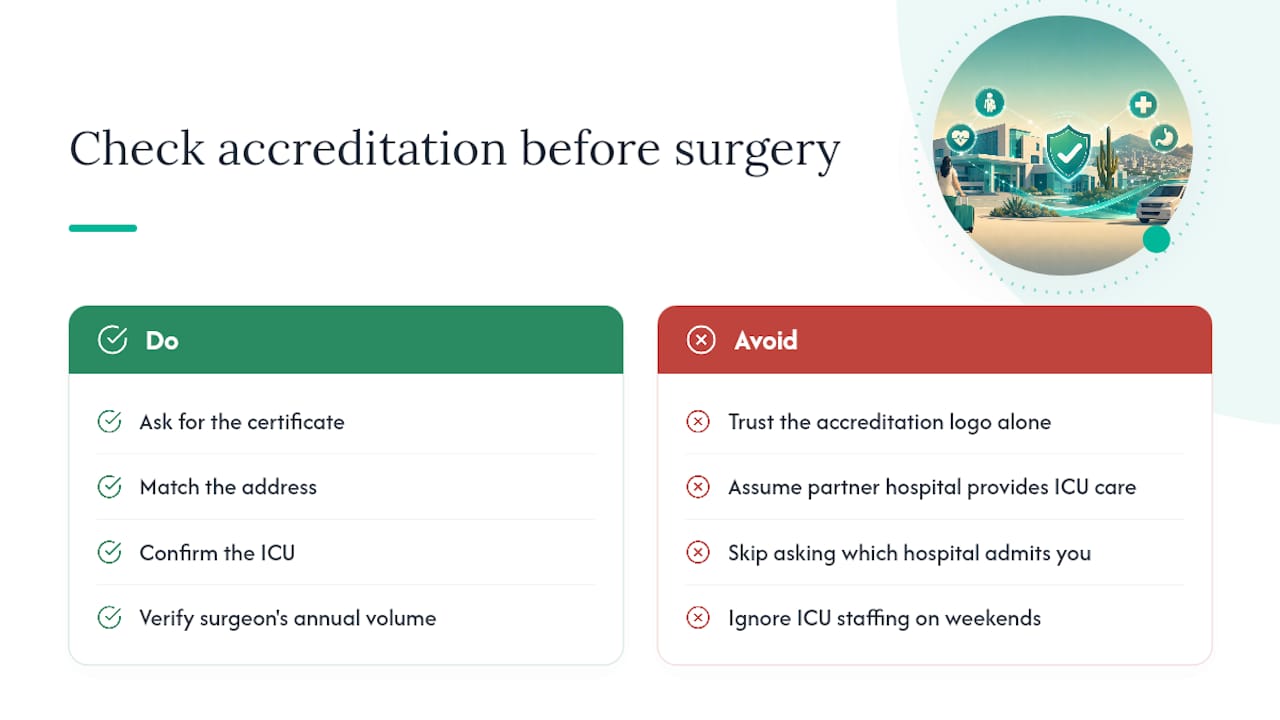
The checklist approach works. Ask for the certificate. Match the address. Confirm the ICU. Verify the surgeon's annual volume. Buy the complication insurance. These five steps do more for your safety than any logo on a website.
Reviewed by: [Medical Reviewer Name], [Last Reviewed Date]
This article is educational information, not individual medical advice. Confirm current accreditation status, surgeon credentials, and insurance requirements with the relevant authorities and a qualified medical professional before making any surgical decision. For Hospital Cyntar credentials and procedure pages, visit Cyntar and Obesitycontrolcenter.com.
Weightlosssurgeryguide: your verified starting point for accredited bariatric care in Tijuana
Patients who arrive at a Tijuana consultation already holding a verified certificate, a completed ASMBS checklist, and a confirmed complication insurance policy negotiate from a position of knowledge. Weightlosssurgeryguide is built to get you there. The site aggregates accreditation explainers, certificate verification guidance, and a curated directory of board-certified, high-volume surgeons at accredited hospitals — so you are comparing documented options, not marketing claims. U.S. patients can start at the U.S. patient guide; Canadian patients have a dedicated resource at the Canadian patient guide. Request your free personalized quote and verified provider match at Weightlosssurgeryguide.
This article is general information, not a substitute for advice from a qualified doctor. Consult a qualified healthcare professional about your own circumstances before acting on anything here.
Sources
- Controlled interrupted time series and panel regression analysis of hospital accreditation effects in Mexico — PMC
- JCI accreditation explained — Avia
- Choosing a Good Hospital: What Accreditations to Look for in Mexico - Mexico Handbook
- Consensus statements on bariatric surgery tourism — Springer (2023)
- WHO review of accreditation programmes and their effects (multi-country review)