Informed Consent for Surgery: What Patients Need to Know
Published July 25, 2026

Informed Consent for Surgery: What Patients Need to Know
Informed consent for surgery is a formal communication process in which your surgeon explains the procedure, its risks, its benefits, and your alternatives, and you voluntarily agree to proceed. It is not simply signing a form. The American Medical Association defines it as a patient-centered dialogue built on shared decision-making, free from coercion, and clearly documented in the medical record. The American College of Surgeons adds that no surgeon can guarantee outcomes, so understanding that surgical results vary is itself a core part of what you are consenting to. The Joint Commission frames the entire process as a communication challenge, not a paperwork task.
Before surgery, you have the legal right to accept or refuse any procedure. That right holds even after you have signed a form. The surgery informed consent process exists to protect your autonomy, build trust with your care team, and create a documented record that both you and your providers can rely on. The sections below cover every component of that process, from the legal framework to what happens when a patient cannot speak for themselves.
- Informed consent is a conversation, not just a signature
- You must receive information about the diagnosis, procedure, risks, benefits, and alternatives
- You can refuse or withdraw consent at any time
- The attending surgeon is ultimately responsible for obtaining your consent
- Special rules apply for emergencies, language barriers, and patients who lack decision-making capacity
Table of Contents
- What are the key components of surgical informed consent?
- What are the legal and ethical rules governing surgical consent?
- Who is responsible for obtaining your surgical consent?
- When should informed consent be obtained, and how?
- Special situations that change how consent works
- What experts say about improving the informed consent process
- Key Takeaways
What are the key components of surgical informed consent?
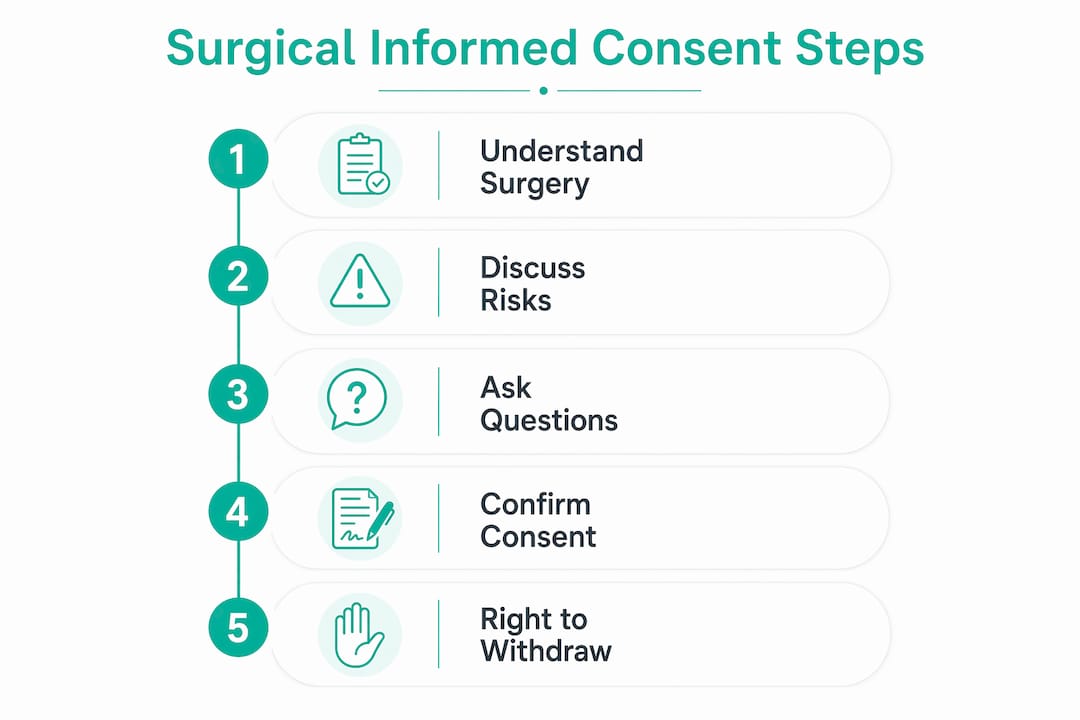
Valid informed consent for surgery requires more than a general conversation. Six specific elements must be communicated and documented for the consent to hold up legally and ethically.
- Diagnosis and nature of the procedure. Your surgeon must explain what condition is being treated and exactly what the operation involves, in plain language. Medical jargon reduces understanding and should be avoided.
- Risks and benefits. Both must be disclosed. Risks that pose a substantial chance of serious harm must always be mentioned, even if they are rare. Benefits should be framed realistically, not as guarantees.
- Alternatives. Your surgeon must briefly explain other treatment options, including the option of doing nothing, with the pros and cons of each compared to the proposed surgery.
- Likelihood of achieving your goals. The American College of Surgeons is explicit: no physician can guarantee surgical outcomes. Your consent should reflect an understanding that results depend on your individual health and condition.
- Provider and facility disclosures. You have the right to know who will perform the surgery, whether trainees will be involved, and what facility policies apply.
- Documentation. A signed consent form, combined with notes in your medical record describing what was discussed, creates the legal record. The signature alone is not the consent; the conversation is.
The teach-back method sits at the center of good consent practice. After the surgeon explains the procedure, you are asked to repeat back the key points in your own words. This confirms real understanding, not just passive listening. A signature on a consent form is only legal documentation, not proof that you actually understood what you agreed to.
If you are preparing for bariatric surgery, reviewing a bariatric surgery consultation checklist before your consent appointment can help you track which elements have been covered and which questions remain.
What are the legal and ethical rules governing surgical consent?
Informed consent is both a legal requirement and an ethical obligation. Legally, performing surgery on a patient who has not given valid consent can constitute battery, regardless of whether the surgery went well. Ethically, the process rests on the principle of patient autonomy: your right to decide what happens to your own body.

The AMA's Code of Medical Ethics frames the core purpose as fostering trust and shared decision-making. Consent must be patient-centered, free from any pressure to agree, and documented with both signed forms and medical record notes. The ethical obligation does not end when the form is signed; if new information about the procedure or your condition emerges before surgery, your surgeon must update you.
Legally, the attending surgeon carries ultimate responsibility. Delegation to a junior resident or a nurse does not transfer that responsibility. Courts have consistently held that if a patient was not adequately informed, the documentation of a signature does not protect the provider. Clear, specific notes about which risks were discussed are a surgeon's strongest legal defense.
You have the right to refuse surgery at any time, including after signing the consent form. Withdrawal of consent must be respected immediately. No pressure, persuasion, or delay in honoring that withdrawal is ethically or legally acceptable.
Pro Tip: The teach-back method is the single most effective tool for confirming real comprehension. Ask your surgeon or nurse to have you explain the procedure and its main risks back to them before you sign anything. If you cannot do it, the explanation was not complete enough.
Who is responsible for obtaining your surgical consent?
The attending surgeon or licensed independent provider must personally obtain your informed consent. This duty cannot be delegated to junior medical staff or nursing personnel, though both groups play supporting roles in the process.
- The attending surgeon leads the consent conversation, explains the procedure and risks, answers clinical questions, and signs the documentation.
- Nurses arrange translation services, witness the signing of consent forms, verify that the correct consent form matches the scheduled procedure, and flag any concerns about patient comprehension.
- Junior staff may assist with patient education materials and logistical preparation, but they cannot substitute for the surgeon's direct explanation.
- The patient or authorized representative must sign the consent form and has the right to ask questions, request more time, or decline.
One area where teams sometimes get this wrong: a resident or physician assistant explains the procedure, the patient signs, and the attending surgeon never has a direct conversation with the patient before the operation. That sequence does not satisfy the legal or ethical standard. The surgeon performing the procedure must be the one who confirms the patient's understanding.
For patients whose loved ones are involved in the decision, Weightlosssurgeryguide's family decision guide outlines how spouses and caregivers can participate constructively in the consent and surgical planning process.
When should informed consent be obtained, and how?
Timing matters more than most patients realize. The best practice is to obtain consent at the time surgery is scheduled, not on the day of the procedure. When consent happens the morning of surgery, patients may feel pressure to proceed even if they have doubts, simply because all the arrangements are already in place. That pressure can compromise the voluntariness that valid consent requires.
- Consent should happen early enough that you have time to reflect, research, and return with questions.
- The conversation must occur before any sedating medications are administered.
- Decision aids, written materials, and graphical explanations can supplement the verbal discussion and improve comprehension, as The Joint Commission recommends.
- After the discussion, the teach-back method confirms understanding before the form is signed.
- The signed form and a summary of what was discussed should be placed in your medical record immediately.
If consent was obtained well in advance of surgery, your surgeon should confirm it again on the day of the procedure, particularly if your health status has changed or new information has come to light.
Pro Tip: Before your consent appointment, write down your questions about the indication for surgery, the specific risks, the recovery timeline, and what alternatives exist. The American College of Surgeons notes that surgeons vary in how thoroughly they explain each area, so a written list keeps the conversation complete.

Special situations that change how consent works
Most consent conversations follow a straightforward path. Several situations require a different approach.
Patients who lack decision-making capacity. If you are temporarily or permanently unable to make medical decisions, an authorized surrogate, typically a healthcare proxy, power of attorney, or next of kin, makes decisions on your behalf. The surrogate's role is to decide as you would have decided, not as they personally prefer.
Telephone consent. When you or your authorized representative cannot be present in person, telephone consent is acceptable provided a witness is present during the call. The documentation must include the names and relationship of all parties, the date, and signatures from both the witness and the provider who obtained consent.
Emergency surgery. When you cannot consent and delay would cause serious harm or death, two physicians may authorize surgery with full documentation of the clinical rationale. You must be informed of what occurred as soon as you are able to receive that information.
Language barriers. Consent obtained through a family member acting as an informal interpreter does not meet the standard of care. Certified medical interpreters or professional translation services must be used. Providing materials in your primary language is part of the facility's obligation, not an optional courtesy.
Consent validity and state laws. Informed consent does not expire automatically, but some states require that consent be re-obtained within a specific window, such as 30 days before surgery, to account for changes in your condition. If your health status changes significantly after you sign, the consent should be revisited regardless of state law.
Withdrawal of consent. You can revoke consent at any time, including after signing. Verbal withdrawal is sufficient; you do not need to complete a separate form. The care team must stop the procedure if withdrawal occurs before surgery begins.
Understanding the full range of bariatric surgery complications before your consent conversation gives you the context to ask sharper questions and make a genuinely informed decision.
What experts say about improving the informed consent process
The AMA, the American College of Surgeons, and The Joint Commission all point to the same gap: patients routinely sign consent forms without truly understanding what they have agreed to. The form gets signed; the understanding does not always follow.
The AMA stresses that shared decision-making is the core purpose of the process. A consent conversation that feels like a one-way briefing, where the surgeon talks and the patient nods, misses the point entirely. The patient's values, preferences, and questions must shape the discussion.
The American College of Surgeons underscores that surgical results vary and no guarantees can be made. Surgeons who allow patients to leave the consent conversation with unrealistic expectations are setting up both parties for a difficult outcome. Realistic framing is not pessimism; it is the surgeon's professional obligation.
The Joint Commission has identified patient comprehension as an ongoing challenge in healthcare settings and advocates strongly for decision aids, plain-language materials, and the teach-back method to close the gap between signing and understanding. Health organizations should treat informed consent as a communication process, not merely a signed form.
Top recommendations from these three bodies:
- Use the teach-back method every time, without exception
- Obtain consent early, at scheduling, not on the day of surgery
- Provide written materials in the patient's primary language
- Use decision aids and visual tools to supplement verbal explanations
- Document the specific risks discussed, not just the fact that a conversation occurred
- Confirm consent again on the day of surgery if significant time has passed
- Never allow a patient to leave the conversation with unresolved questions
For patients considering weight loss surgery, bariatric accreditation standards at JCI, SRC, and ISO-certified facilities include specific requirements for the consent process, which is one reason accreditation matters beyond just surgical skill.
Key Takeaways
Informed consent for surgery is a legally required, patient-centered communication process that protects your right to make voluntary, fully informed decisions about your own care.
| Point | Details |
|---|---|
| Consent is a process, not a form | The conversation and comprehension matter; a signature alone does not constitute valid informed consent. |
| Surgeon responsibility is non-delegable | The attending surgeon must personally obtain consent; junior staff and nurses cannot substitute for that conversation. |
| Timing affects validity | Consent obtained at scheduling, not on the day of surgery, reduces pressure and supports genuine voluntariness. |
| Special rules apply in edge cases | Emergencies, language barriers, and patients lacking capacity each require specific documented procedures. |
| You can withdraw at any time | Consent can be revoked verbally before surgery begins, and the care team must honor that immediately. |
Disclaimer: This article is for educational purposes only and does not constitute medical advice. Always consult a qualified healthcare provider for guidance specific to your situation.
Medically reviewed by the Weightlosssurgeryguide editorial team. Last reviewed: 2026.
Sources: American Medical Association Code of Medical Ethics, American College of Surgeons, The Joint Commission, NCBI/PMC, AORN, ASC Focus Magazine.
Considering weight loss surgery and want to understand your options with fully accredited providers? Weightlosssurgeryguide's 2026 provider rankings compare accredited bariatric surgeons in Tijuana so US patients can make a genuinely informed choice, with full transparency on credentials, procedures, and pricing.
For patients exploring specific procedures, Weightlosssurgeryguide covers gastric bypass and other surgical options in detail, with the kind of risk and outcome information that belongs in every informed consent conversation. You can also review Medicare coverage for weight management to understand what insurance may cover before your consultation.
Recommended
- Surgical Weight Loss Definition: What You Need to Know | Weight Loss Surgery Guide
- Bariatric Surgery Consultation Checklist: 2026 Guide | Weight Loss Surgery Guide
- Bariatric Surgery Complications: Awareness Guide 2026 | Weight Loss Surgery Guide
- Bariatric Surgery Financial Planning Guide | Payment Options & Cost Estimates