What a Calorie Actually Means and Why It's on Every Label
Published August 20, 2026

What a Calorie Actually Means and Why It's on Every Label
A calorie is a unit of energy, plain and simple. It measures how much energy your body can get from food or drink, and it also measures energy in physics more broadly, which is where a lot of the confusion starts. When you see "calories" on a nutrition label, what you're actually looking at is kilocalories, though the packaging almost never says so.
That distinction matters because your body doesn't just burn calories to lose weight. It uses them to keep your heart beating, your brain firing, and your muscles moving every second of the day. Food energy gets measured against a few key benchmarks:
- Kilocalorie (kcal): the unit on nutrition labels, equal to 1,000 small calories
- Joule: the scientific SI unit, with 1 kcal equal to roughly 4,185 joules
- Atwater factors: the standard method used to calculate the calorie counts on packaged food
A slice of bread, a tablespoon of olive oil, a can of soda. Every one of those numbers on the label traces back to the same basic idea: energy in, measured in a unit most people misname every single day.
Key Takeaways
Calories measure energy, food labels use kilocalories under a simplified name, and how much energy your body needs depends on far more than a single formula can capture.
| Point | Details |
|---|---|
| Calorie equals energy unit | A calorie measures energy; food labels list kilocalories under the shortened name "calorie." |
| Fat carries the most energy | Fat delivers about 9 kcal per gram, versus roughly 4 kcal per gram for carbs and protein. |
| Labels are estimates | Packaging calorie counts come from Atwater-based calculations, not a direct lab burn of that product. |
| Quality affects outcomes | Equal-calorie foods can differ in satiety and metabolic effect depending on nutrient content. |
| Formulas need context | Calculators like Mifflin-St Jeor give a starting estimate; medical conditions call for professional guidance. |
Table of Contents
- Calories Means What, Scientifically Versus Nutritionally?
- How Do Scientists Measure Calories in Food?
- How Many Calories Are in Carbs, Protein, Fat, and Alcohol?
- Do All Calories Affect Your Body the Same Way?
- Calories, Energy Balance, and Your Weight
- How Do You Estimate Your Daily Calorie Needs?
- What People Get Wrong About Counting Calories
- Frequently Asked Questions
- Sources
Calories Means What, Scientifically Versus Nutritionally?
Scientists and dietitians aren't always talking about the same "calorie." The small calorie (written as lowercase "cal") is defined as the energy needed to raise 1 gram of water by 1 degree Celsius. It's a tiny amount of energy, so tiny that using it to describe a meal would require numbers in the thousands, which is exactly why nutrition switched to a bigger unit.
The kilocalorie (kcal, or "Calorie" with a capital C) equals 1,000 small calories. When a cereal box says "150 calories per serving," it means 150 kilocalories. Nobody adds the prefix because it would confuse more people than it would help, but the number itself is still kilocalories underneath.
Converting to joules gets you into stricter scientific territory. One calorie equals about 4.1855 joules, so one kilocalorie equals roughly 4,185 joules, or about 4.2 kilojoules. European food labels often list both kcal and kJ side by side, which is why a granola bar might read "95 kcal / 398 kJ." Nutrition sticks with kilocalories because the numbers stay in a readable range. Physics and chemistry prefer joules because it's the internationally recognized SI unit, and it avoids the whole small-calorie-versus-large-calorie mixup entirely.
Pro Tip: If you're reading a label with kJ instead of kcal, divide the kilojoule number by roughly 4.2 to get a ballpark kcal figure. It won't be exact, but it'll get you close enough to compare products.
How Do Scientists Measure Calories in Food?
The old-school method is a bomb calorimeter: you burn a food sample completely inside a sealed chamber, then measure how much the surrounding water heats up. That heat measurement tells you the food's gross energy content, and it's how the original calorie values got established.
But your body isn't a bomb calorimeter. You don't absorb 100% of the energy in food, since digestion is messy and some energy leaves the body unused. That's why food labels rely on Atwater factors instead — a set of average estimates for how much energy the human body actually extracts from each macronutrient after digestion, absorption, and metabolic loss are factored in.
- Bomb calorimeter: measures raw, total heat energy in a lab setting
- Atwater system: estimates usable, metabolizable energy for humans
- Labels: built from Atwater math, not direct calorimetry on your specific meal
Pro Tip: Every calorie count on packaging is an estimate, not a lab measurement of that exact product. Manufacturers calculate it from ingredient composition, and the FDA allows some margin of error, so treat label numbers as close approximations rather than precise science.
How Many Calories Are in Carbs, Protein, Fat, and Alcohol?
Not all nutrients pack the same energy punch. Fat carries more than twice the energy density of carbs or protein, which is a big part of why high-fat foods feel calorie-dense in small portions.

These figures come from long-established nutritional science, and they hold up across food types. A medium apple runs around 95 calories, almost entirely from carbohydrate. A tablespoon of olive oil, pure fat, comes in around 120 calories despite weighing far less than the apple. A slice of white bread lands near 80 calories, and a standard 12 ounce beer delivers roughly a moderate calorie amount, mostly from alcohol rather than any nutrient your body actually needs.
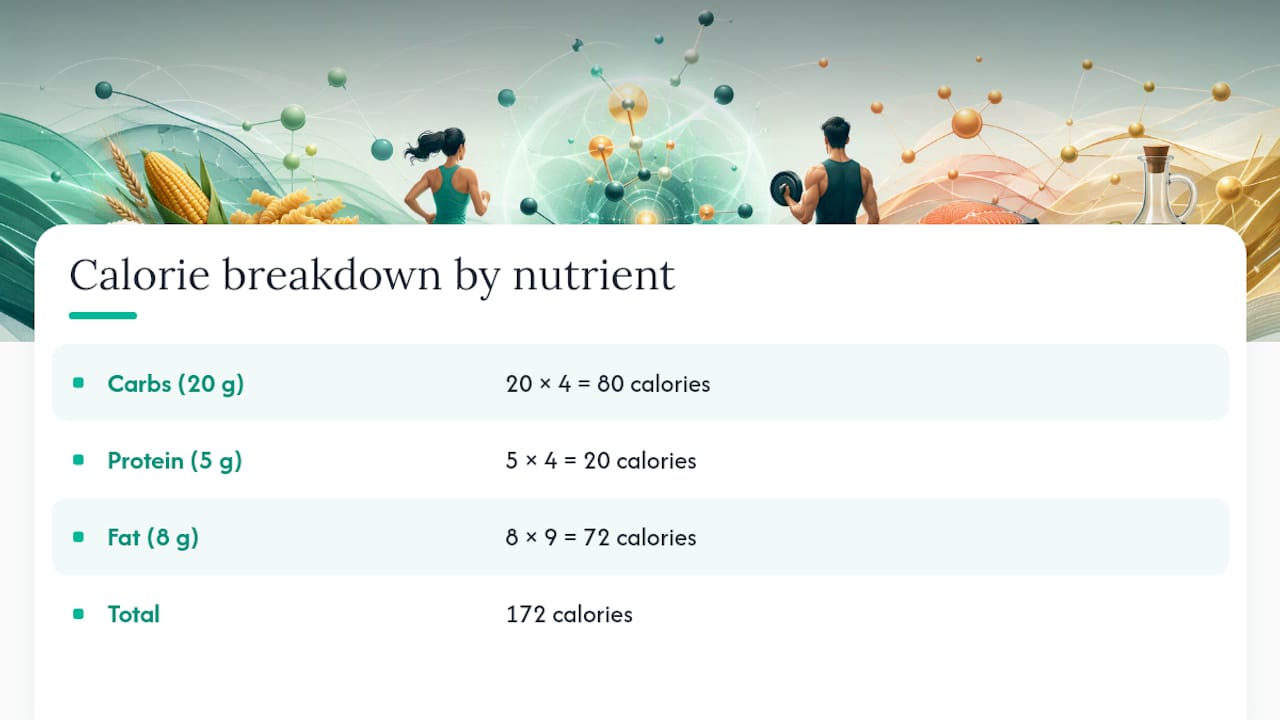
Here's a quick calculation you can run yourself: if a snack has 20 grams of carbs, 5 grams of protein, and 8 grams of fat, you'd estimate (20 x 4) + (5 x 4) + (8 x 9) = 80 + 20 + 72 = 172 calories. That's roughly the math label makers use before rounding.
Do All Calories Affect Your Body the Same Way?
Not exactly, and this is where a lot of well-meaning diet advice goes sideways. Calories don't automatically become body fat the moment you eat them. Your body burns most of what you consume just to keep functioning, and only genuine excess intake over time gets stored as fat.
- Myth: eating fat makes you gain fat directly. Reality: any macronutrient consumed in excess of your needs contributes to weight gain.
- Myth: all calories affect health identically. Reality: source and nutrient density change how full you feel and how your metabolism responds, even at equal calorie counts.
- Myth: the word "calorie" on a label means something different from "kilocalorie." Reality: they're the same number, just informal packaging language.
- Myth: exercise alone controls weight. Reality: intake and expenditure both matter, and neither works in isolation.
Calories, Energy Balance, and Your Weight
Weight management comes down to a straightforward relationship: calories in versus calories out. Eat more energy than your body uses, and the surplus gets stored, mostly as fat, with some going to glycogen in your muscles and liver. Eat less than you burn, and your body pulls from those reserves instead.
Your body spends calories in three main ways: basal metabolic needs (keeping organs running), physical activity, and the thermic effect of food, which is the energy cost of digesting what you eat. Basal metabolism usually accounts for the biggest share of daily burn, even for people who exercise regularly.
One caution worth knowing: prolonged, aggressive calorie restriction can trigger metabolic slowdown, where your body adapts by burning fewer calories at rest to protect itself. This is one reason crash diets often stall out. For anyone considering medical or surgical weight management, a food-quality lens matters as much as raw counting, and decisions like these should always involve a licensed clinician rather than a calculator alone.
How Do You Estimate Your Daily Calorie Needs?
A rough starting rule of thumb: many adults require a typical range of daily calories depending on age, sex, size, and activity level. For something more precise, the Mifflin-St Jeor equation is the formula most dietitians reach for first.
- Calculate your basal metabolic rate using your weight, height, age, and sex.
- Multiply that number by an activity factor. A sedentary person might use 1.2, while a moderately active person might use 1.55.
- The result is a rough estimate of daily maintenance calories, not a diagnosis.
A sedentary office worker would need somewhat fewer daily calories compared to a moderately active person with similar basal metabolic rate, reflecting activity differences. These calculators, including USDA FoodData Central, are useful starting points, but they don't account for medical conditions, medications, or post-surgical metabolic changes.
If you're managing a health condition, recovering from surgery, or planning for one, a registered dietitian or clinician can build a personalized target that a generic formula simply can't replicate.
What People Get Wrong About Counting Calories
Most calorie advice treats the number on the label as gospel, and that's the biggest blind spot in mainstream nutrition talk. The Atwater system behind those numbers was built decades ago on average estimates, not on measuring your actual metabolism, your gut bacteria, or how well you digest a particular food that day. Two people eating the identical 500 calorie meal can extract meaningfully different amounts of usable energy from it.
The conventional advice, "just count calories and the rest sorts itself out," undersells how much food quality shapes hunger and long-term adherence. A 500 calorie plate of vegetables and lean protein keeps most people fuller than 500 calories of refined carbs, and that difference in satiety drives behavior more than the number itself ever will.
What should you prioritize first? Get the concept straight (calorie equals energy, label equals kilocalories), then stop treating every calculator result as precise. If you're facing a real medical decision, whether that's managing a chronic condition or considering surgical intervention, the conversation needs a clinician who knows your history, not a formula built for averages. Understanding how accredited surgical teams evaluate candidates matters more at that point than any calorie app on your phone.
Medical Reviewer: This article was reviewed for factual accuracy by the clinical team affiliated with Obesitycontrolcenter.com and CYNTAR.mx. Last reviewed: January 2026.
Disclaimer: This article is for educational purposes only and does not constitute medical advice. Calorie needs vary significantly by individual health status, and decisions about weight management, particularly surgical options, should always involve a qualified physician or registered dietitian. Learn more about accredited bariatric procedures available through Weightlosssurgeryguide's affiliated providers, or request a personalized quote to discuss your specific situation with a clinical team.
Frequently Asked Questions
What does "calories" actually mean on a food label? It means kilocalories. The word "calorie" on packaging is shorthand for kilocalorie, which equals 1,000 of the small scientific calories used in physics and chemistry.
Is a calorie the same as a kilocalorie? No. One kilocalorie equals 1,000 small calories. Nutrition labels use kilocalories but drop the "kilo" prefix, which is the single biggest source of public confusion about the term.
Why do fats have more calories than carbs or protein? Fat is more energy-dense at the molecular level, delivering about 9 kcal per gram compared to roughly 4 kcal per gram for carbohydrates and protein.
Are calorie counts on food packages exact? No, they're estimates. Manufacturers calculate them using Atwater factors based on ingredient composition, not by burning each individual product in a lab.
Do all calories affect your body the same way? Not entirely. The total count matters for weight, but nutrient quality affects satiety, digestion, and metabolic response even when two foods have identical calorie totals.
This article is general information, not a substitute for advice from a qualified doctor. Consult a qualified healthcare professional about your own circumstances before acting on anything here.
Sources
For deeper verification, see Britannica's calorie definition, the Merck Manual on measuring food calories, and NHS guidance on understanding calories. Weightlosssurgeryguide maintains its own references and sources page for readers who want the full evidence trail behind our content.
- Calorie | Definition & Measurement | Britannica
- Calories — StatPearls / NCBI Bookshelf
- How are calories in foods measured? — Merck Manual
- Understanding calories — NHS
- Calorie — Wikipedia
Recommended
- Dieting Fatigue: How to Feel Better Fast | Weight Loss Surgery Guide
- The Role of a Dietitian in Bariatric Care: What Patients Need to Know | Weight Loss Surgery Guide
- Peppermint Oil for Weight Loss: What the Science Says | Weight Loss Surgery Guide
- GLP-1 Cost Calculator | Estimate Long-Term Treatment Costs