The Role of a Dietitian in Bariatric Care: What Patients Need to Know
Published July 30, 2026

The Role of a Dietitian in Bariatric Care: What Patients Need to Know
Medically reviewed by a bariatric-trained clinician | Last reviewed: 2026 | This article is general educational information, not medical advice. Always confirm your specific care plan with your surgical team and a qualified registered dietitian.
A bariatric dietitian plans, monitors, and adapts your nutrition from the first pre-op visit through lifelong follow-up, protecting your nutrient status, supporting wound healing, and reducing your risk of complications. The Mechanick 2019 perioperative guidelines, co-sponsored by ASMBS, OMA, and AACE, require a registered dietitian consultation for staged diet progression after surgery. A 2026 systematic review of 4,173 patients across 13 studies confirmed that more frequent dietary counseling improves secondary outcomes including nutritional status, complication management, and micronutrient stabilization.
The three things a bariatric dietitian does that no other team member covers:
- Pre-op optimization: Nutritional assessment, addressing deficiencies, and prescribing a very-low-calorie diet (VLCD) where indicated to reduce surgical risk
- Staged diet progression: Guiding the transition from clear liquids to pureed foods to solids in the days and weeks after surgery
- Lifelong lab and supplement follow-up: Monitoring iron, B12, vitamin D, calcium, and other nutrients annually to prevent late deficiencies
Table of Contents
- What is a bariatric dietitian and who are they on your care team?
- When will you actually see a dietitian throughout the process?
- What does a bariatric dietitian actually do at each stage?
- What labs and measurements does your dietitian track?
- How do dietitians manage common nutrition complications?
- What does the evidence say about dietitian involvement?
- How do you choose a bariatric dietitian and what does it cost?
- What happens at your first dietitian appointment and follow-up visits?
- Key Takeaways
- Why consistent follow-up matters more than most patients expect
- Useful sources and further reading
What is a bariatric dietitian and who are they on your care team?
A bariatric dietitian holds an RD or RDN credential (Registered Dietitian or Registered Dietitian Nutritionist) from the Commission on Dietetic Registration, plus specialized training in metabolic and bariatric surgery (MBS) nutrition. The RD/RDN credential requires a supervised clinical internship and a national board exam. When you are vetting a program, ask specifically whether their dietitian has experience with MBS patients, not just general weight management.

The OMA clinical practice statement positions the dietitian as a foundational member of the interprofessional bariatric team, integrated into checklists and enhanced recovery pathways. That team typically includes the bariatric surgeon, anesthesiologist, behavioral health clinician or psychologist, primary care physician, and in many programs a pharmacist and nurse coordinator.
What separates the dietitian from everyone else on that list is scope. The surgeon operates and monitors anatomical healing. The psychologist addresses mental health and eating behavior. The dietitian owns nutrition monitoring, supplementation management, food-behavior counseling, and the practical mechanics of what you eat and when. They are also often the first clinician to catch early post-op complications, such as dumping syndrome or a developing stricture, through focused dietary symptom reviews before those issues escalate.
When will you actually see a dietitian throughout the process?
Visit timing varies by program, but the structure below reflects what major guidelines and observational data support.
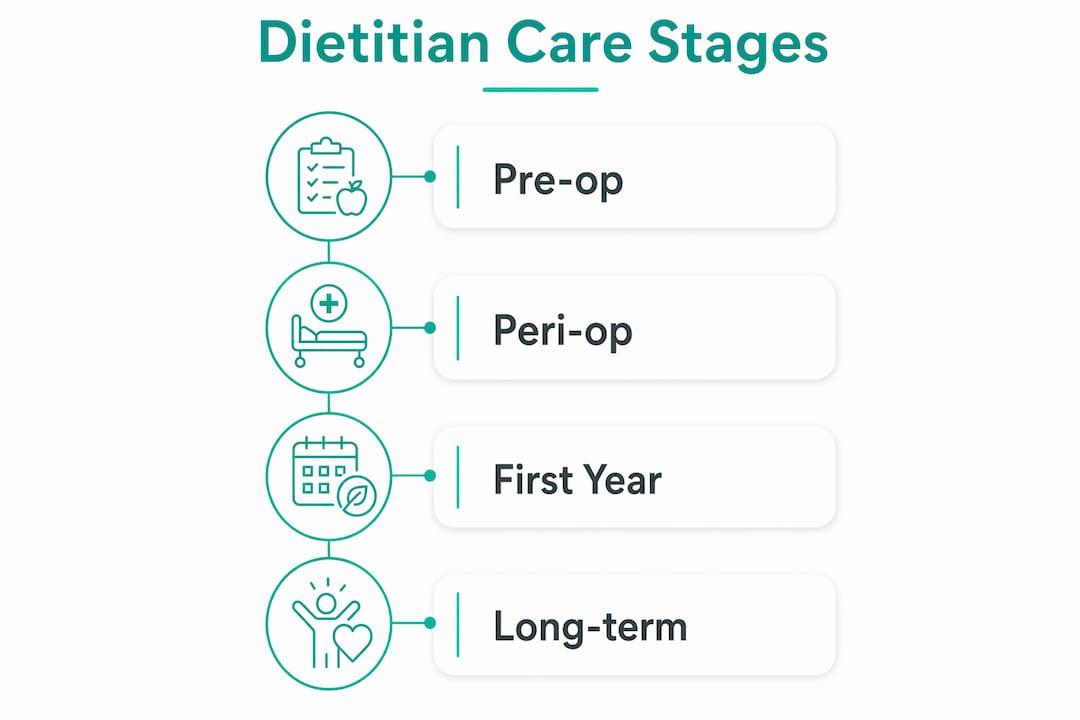
| Phase | Typical Timing | Primary Purpose |
|---|---|---|
| Pre-op baseline | 1–3 visits before surgery date | Nutrition assessment, deficiency correction, VLCD initiation |
| Immediate post-op | Days 1–8 (inpatient or early outpatient) | Staged diet start, hydration, protein education |
| Early follow-up | Weeks 2–12 (biweekly or monthly) | Tolerance monitoring, supplement initiation, protein targets |
| First-year follow-up | Months 3, 6, and 12 | Lab review, intake assessment, supplementation adjustment |
| Long-term | Annually thereafter | Deficiency screening, weight maintenance, behavioral support |
Programs that document three or more RD visits in the first 12 months show better nutritional outcomes in early follow-up. That cadence is not arbitrary. Nutrient levels shift fastest in the first year, and catching a B12 or iron drop at month 3 is far easier to correct than addressing it at month 18.
Delivery format matters less than consistency. Group and individual pre-op counseling both show beneficial effects on readiness and early outcomes, so if your program offers group sessions, that is not a downgrade. Telehealth follow-ups are now widely used for routine check-ins, though lab draws and physical assessments still require in-person visits.
What does a bariatric dietitian actually do at each stage?
Before surgery
The pre-op phase is where the dietitian sets the foundation. They conduct a full dietary recall and nutrition assessment, review your labs for existing deficiencies, and work with the surgical team to optimize your metabolic status before the procedure. Per the Mechanick 2019 guidelines, this includes targeting A1C control to reduce surgical risk in patients with type 2 diabetes. If your program requires a VLCD in the weeks before surgery, the dietitian prescribes and monitors a very-low-calorie, high-protein diet to shrink liver size and reduce operative difficulty.
They also counsel you on pre-op protein targets adjusted for body weight, medication interactions with dietary changes, and smoking cessation if relevant.
Peri-op and the first weeks after surgery
The Mechanick guidelines specify that a low-sugar clear liquid program can usually begin within 24 hours after surgery, and that diet progression must be guided by an RD knowledgeable about the post-op bariatric diet. The standard staged progression runs: clear liquids → full liquids → pureed → soft foods → regular textures, with each stage lasting several weeks depending on your procedure and tolerance.
Protein and hydration are the two non-negotiables in this window. Most programs target a moderate daily protein intake from the start, with patients working toward that goal incrementally. Hydration goals are typically moderate, with fluids sipped slowly throughout the day. The dietitian teaches you to avoid straws and carbonated beverages early on, both of which can introduce air and cause discomfort or distension.
Pro Tip: Keep a simple daily log of your protein grams and fluid ounces in the first 8 weeks. Showing your dietitian a real record at each visit is far more useful than trying to recall intake from memory, and it helps them catch problems before they become deficiencies.
The first year post-op
Close follow-up in months 1–12 focuses on three things: protein intake, food tolerance, and supplementation. The Annals of Translational Medicine review outlines specific micronutrient risks and the Nutrition Care Process for long-term monitoring, noting that deficiencies in iron, B12, vitamin D, and calcium are the most common and most preventable with consistent supplementation and lab tracking.
Food aversions are common in this period, particularly to red meat and high-fat foods. The dietitian helps you find protein sources you can actually tolerate, adjusts texture recommendations based on your healing, and monitors for signs of protein malnutrition such as hair thinning, fatigue, or muscle loss.
Long-term and lifelong care
Annual lab reviews, supplementation dose adjustments, pregnancy planning, and weight-regain troubleshooting all fall within the dietitian's long-term scope. The Dietitians Australia role statement enumerates these competencies explicitly, from pre-op assessment through lifecycle care. For patients who experience weight regain, the dietitian provides behavioral nutrition support and can identify maladaptive eating patterns that warrant referral to a behavioral health clinician.
Understanding metabolic adaptation is part of this long-term picture. The dietitian helps you distinguish normal metabolic shifts from patterns that need clinical intervention.
What labs and measurements does your dietitian track?
The dietitian does not typically order labs independently in most U.S. programs. They recommend the monitoring schedule and flag abnormal results, while the surgeon or primary care physician places the orders. Coordinating this hand-off with your U.S.-based primary care provider is one of the most practical things you can do to avoid gaps in follow-up.
Standard monitoring schedule:
- Baseline (pre-op): Complete metabolic panel, iron studies, ferritin, B12, folate, vitamin D (25-OH), calcium, PTH, albumin, A1C (if diabetic or pre-diabetic), CBC
- 3 months post-op: Iron, B12, vitamin D, albumin/prealbumin, CBC, metabolic panel
- 6 months post-op: Full panel repeat; adjust supplementation based on results
- 12 months post-op: Full panel; assess protein intake, body composition if available
- Annually thereafter: Full micronutrient panel, metabolic panel, A1C where indicated
Beyond labs, the dietitian tracks dietary recall, protein intake totals, hydration status, GI symptoms (dumping, nausea, vomiting), food texture tolerance, and anthropometrics including weight and, in some programs, body composition via DEXA or bioelectrical impedance.
The NCBI StatPearls bariatric counseling resource notes that long-term surveillance for nutritional deficiencies is a core competency of the interprofessional bariatric team, with dietitians playing a central role in that surveillance.
How do dietitians manage common nutrition complications?
Nutrition problems after bariatric surgery are predictable enough that experienced dietitians have clear protocols for each one. Recognizing them early is the difference between a quick dietary fix and a hospital admission.
Dumping syndrome occurs when food moves too quickly from the stomach into the small intestine, causing nausea, sweating, cramping, and diarrhea within 15–30 minutes of eating (early dumping) or hypoglycemia 1–3 hours later (late dumping). The dietary fix is straightforward: smaller meals, no liquids with meals, and eliminating high-sugar and high-fat foods. Most patients see significant improvement within two to four weeks of strict adherence.
Dehydration is the most common reason for readmission in the first 30 days. The dietitian reinforces sipping fluids continuously throughout the day, avoiding caffeine and carbonated drinks early on, and recognizing warning signs like dark urine, dizziness, and headache.
Protein malnutrition shows up as fatigue, hair loss, and muscle wasting, usually when protein intake falls below 60g per day consistently. The dietitian adjusts meal structure to prioritize protein at every meal before vegetables or starches, and may recommend a protein supplement if food intake alone is insufficient.
Micronutrient deficiencies in iron, B12, and vitamin D are the most clinically significant long-term risks. Iron deficiency is particularly common in menstruating patients after gastric bypass. B12 absorption is impaired after procedures that bypass the stomach's intrinsic factor production. Vitamin D deficiency compounds calcium absorption problems and raises fracture risk over time.
Pro Tip: If you are experiencing persistent nausea, vomiting more than twice a day, or cannot tolerate any fluids for more than 12 hours, contact your surgical team the same day. These are not "adjustment" symptoms. They are red flags.
Immediate actions for red-flag symptoms:
- Stop oral intake and seek same-day medical evaluation for persistent vomiting or inability to tolerate fluids
- Contact your dietitian within 24 hours for sustained food intolerance lasting more than three days
- Report rapid, symptomatic weight loss (more than 2 lbs per week after month 3) to your surgical team
- Flag any neurological symptoms, including tingling or numbness, to your physician immediately as potential B12 or thiamine deficiency signs
For a broader look at post-surgical risks and how the care team manages them, the bariatric surgery complications guide on Weightlosssurgeryguide covers the clinical picture in detail.
What does the evidence say about dietitian involvement?
The case for consistent dietitian follow-up is not just clinical consensus. It is backed by a growing body of research.
That finding matters because it reframes what dietitian care is actually for. Weight loss after bariatric surgery is driven primarily by the procedure itself. The dietitian's job is to protect everything else: your nutrient stores, your muscle mass, your long-term metabolic health. Programs that treat dietitian follow-up as optional are misreading the evidence.
The Mechanick 2019 guidelines, co-sponsored by ASMBS, OMA, AACE, and the American Society of Anesthesiologists, embed the dietitian into perioperative checklists and enhanced recovery after bariatric surgery (ERABS) pathways. The OMA CPS update reinforces this, providing clinician-focused nutrition assessment tools and positioning the dietitian as a core team member, not a supplemental resource.
Observational data linking three or more RD visits in the first 12 months to better nutritional outcomes gives programs a concrete benchmark. Three visits is a floor, not a ceiling.
How do you choose a bariatric dietitian and what does it cost?
Questions to ask before committing to a program or dietitian:
- Are you a credentialed RD or RDN with specific experience in metabolic and bariatric surgery?
- How many bariatric patients do you currently follow, and what procedures do you see most often?
- What is your visit cadence for the first year, and do you offer telehealth follow-ups?
- Which labs do you track, and how do you communicate results to my primary care physician?
- Do you have a protocol for supplementation adjustments, or is it individualized?
- How do you handle food aversions, dumping, or weight regain when they come up?
On credentials, the RD/RDN is the non-negotiable baseline. Beyond that, ask how long they have worked with post-surgical patients specifically. General weight-management dietitians and bariatric dietitians are not interchangeable. The staged diet protocols, micronutrient monitoring schedules, and complication recognition skills are distinct competencies.
Cost and insurance: Most U.S. insurance plans cover pre-op dietitian visits when bariatric surgery is deemed medically necessary, and many cover post-op visits as part of a bundled program. Out-of-pocket costs for individual visits typically range from $75–$200 per session without insurance. Telehealth visits often run lower and are increasingly covered under standard insurance plans. If you are considering surgery abroad, confirming your U.S. dietitian follow-up plan before the procedure is worth the time. Weightlosssurgeryguide's bariatric surgery guide for U.S. patients covers how to structure that coordination.
Telehealth is now a practical option for most routine follow-ups, including intake reviews, supplement adjustments, and lab result discussions. In-person visits remain necessary for physical assessments, lab draws, and any visit where the dietitian needs to observe swallowing, assess wound healing, or coordinate directly with the surgical team.
What happens at your first dietitian appointment and follow-up visits?
First visit agenda:
- Full dietary recall and eating history
- Review of any existing labs or ordering of baseline labs
- Protein and fluid targets set for your specific procedure
- Texture progression education (what to eat and when after surgery)
- Supplement prescription: typically a bariatric multivitamin, calcium citrate, vitamin D, B12, and iron
- Scheduling of next visits and lab draws
Routine follow-up agenda:
- Symptom review (dumping, nausea, vomiting, fatigue, hair loss)
- Protein and fluid intake check against targets
- Lab result review and supplementation adjustments
- Food tolerance and texture progression update
- Behavioral check-in: social eating, food aversions, emotional eating patterns
What to bring to every visit:
- Current medication and supplement list with doses
- Any recent labs (even if ordered by another provider)
- A 3-day food and fluid log
- Your supplement bottles so the dietitian can verify formulation and dose
Between visits, tracking protein and fluids does not require an app, though tools like Cronometer or MyFitnessPal work well. A simple notebook tally works just as well. The goal is a real record, not a perfect one. Your dietitian can work with honest data. They cannot work with guesses.
The bariatric diet guide on Weightlosssurgeryguide walks through the practical before-and-after dietary framework in plain language if you want a reference to review before your first appointment.
Key Takeaways
Consistent dietitian follow-up protects nutrient status, reduces complication risk, and supports long-term metabolic health after bariatric surgery, even when weight-loss outcomes between groups are similar.
| Point | Details |
|---|---|
| See a dietitian before surgery | Pre-op assessment corrects deficiencies and optimizes metabolic status before the procedure. |
| Follow the recommended visit cadence | Three or more RD visits in the first 12 months are linked to better nutritional outcomes. |
| Prioritize protein and supplements | Target 60g of protein daily and take prescribed supplements consistently from day one. |
| Know your red flags | Persistent vomiting, inability to tolerate fluids, or neurological symptoms require same-day contact with your care team. |
| Track the right labs | Iron, B12, folate, vitamin D, calcium, PTH, and albumin should be checked at baseline, 3, 6, and 12 months, then annually. |
Why consistent follow-up matters more than most patients expect
The patients who struggle most after bariatric surgery are rarely the ones who had complications in the operating room. They are the ones who lost touch with their care team at month 4 or 6, skipped the annual labs, and found themselves dealing with iron-deficiency anemia or bone density loss years later that could have been caught early.
The dietitian's role is not just to hand you a meal plan. It is to maintain a clinical relationship that catches biochemical drift before it becomes a health crisis, adjusts your supplementation as your absorption patterns change, and connects the dots between what you are eating and how you are feeling. That relationship works best when it is continuous, not episodic.
If you are evaluating programs, the presence of a credentialed RD/RDN with dedicated bariatric experience, a structured visit schedule, and a clear lab monitoring protocol is one of the strongest signals that a program takes long-term outcomes seriously. Weightlosssurgeryguide's accreditation guide explains what to look for in program credentials and how to verify them.
Useful sources and further reading
The sources below are the primary clinical authorities cited in this article. They are listed here for readers who want to review the original guidelines and research directly.
| Source | Description |
|---|---|
| Mechanick 2019 Perioperative Nutrition Guidelines | ASMBS/OMA/AACE co-sponsored clinical practice guidelines covering pre-op optimization, staged diet progression, and ERABS protocols |
| OMA CPS Bariatric Nutrition Update | Clinician-focused nutrition assessment tools and interdisciplinary team recommendations |
| 2026 MDPI Systematic Review | Review of 4,173 patients across 13 studies on postoperative dietary counseling and secondary clinical outcomes |
| Annals of Translational Medicine: Micronutrient Management | Specific micronutrient risks and the Nutrition Care Process for long-term post-bariatric monitoring |
| Dietitians Australia Weight Loss Surgery Role Statement | Competency framework for dietitians across the full surgical timeline |
| RD Engagement and Post-op Outcomes (ScienceDirect) | Observational data linking three or more RD visits in year one to better nutritional outcomes |
| StatPearls: Counseling Patients on Bariatric Surgery | Interprofessional team competencies and long-term nutritional surveillance guidance |
| Weightlosssurgeryguide Evidence Library | Curated clinical citations and standards used across Weightlosssurgeryguide content |
This article is for general educational purposes only and does not constitute medical advice. Nutrition protocols, supplementation requirements, and lab monitoring schedules vary by procedure, program, and individual health status. Confirm your specific plan with your surgical team and a credentialed registered dietitian before making any changes to your diet or supplementation.