Return Safely After Tijuana Surgery: Use June 2026 QR Pass
Published September 3, 2026
Return Safely After Tijuana Surgery: Use June 2026 QR Pass
The safest way to handle a cruce postoperatorio tijuana is to recover first, not rush the border. Stay in a supervised recovery house with 24/7 nursing until your surgeon clears you, book coordinated medical transport for every leg of the trip, and confirm your clinic participates in Tijuana's medical fast-lane verification before you plan a return date. Weight Loss Surgery Guide exists to help you vet those pieces before you ever leave home.
TL;DR:
- Ensure recovery stays are at certified facilities with licensed nurses and a clear emergency plan to prevent complications during post-op care.
- Book a transfer service with reclining seats, bilingual staff, and a pre-planned route to avoid stressing your incisions when moving between clinic, recovery house, and border.
- Verify participation in Tijuana's QR-based pase médico system and carry all discharge paperwork, medication lists, and surgeon clearance when crossing the border post-surgery.
- Confirm that your recovery house and transport provider have formal accreditation, documented protocols, and a direct relationship with your surgeon or hospital.
- Research the 72 hours after discharge carefully, focusing on emergency protocols and follow-up plans, since this phase significantly impacts overall trip safety and success.
Table of Contents
- How does border crossing work after surgery in Tijuana?
- What does a Tijuana recovery house actually provide?
- What transport should you book between clinic, recovery house, and the border?
- How do you choose a safe recovery house and transport provider?
- What emergency and follow-up protocols should be confirmed before you travel?
- What do patients consistently underestimate about this process?
- Get help arranging accredited recovery care and transport
- Sources
How does border crossing work after surgery in Tijuana?
Crossing back into the US or Canada after a procedure isn't like a normal day trip. You're managing incisions, medication schedules, and fatigue while navigating one of the busiest land borders in the world.
Three main routes exist. Walking across at San Ysidro or Otay Mesa avoids vehicle lanes entirely, which matters if sitting upright in traffic for an hour sounds unbearable post-surgery. Driving across takes longer during peak hours, sometimes two or three hours midday. Flying out through Cross Border Xpress at Tijuana International Airport lets you skip ground traffic altogether if your flight connects through San Diego.
Tijuana's local government has rolled out a QR-based pase médico system starting in June 2026. Clinics issue a QR code identifying you as a verified medical visitor, which is designed to speed up return crossings and reduce the friction border agents sometimes create for patients they can't easily identify as post-surgical.
Before you cross:
- Carry your discharge paperwork, surgeon's letter, and a list of prescribed medications with dosages.
- Declare any medications at the border; don't assume over-the-counter labeling covers it.
- Cross during off-peak hours, typically early morning or mid-afternoon on weekdays.
- Get written surgeon clearance before attempting the crossing, not just verbal approval.
Pro Tip: Ask your recovery house whether it participates in the pase médico QR program before you book. Not every clinic has adopted it yet, and participation can shave real time off your return.
What does a Tijuana recovery house actually provide?
A legitimate recovery house isn't a hotel room with a nurse's phone number taped to the wall. It's a clinical environment built specifically for the days when complications are most likely to surface.
Expect these services at minimum:
- 24/7 nursing coverage with vital signs checks on a set schedule, not just when you ask.
- Medication administration tracked against your discharge plan, including pain management timing.
- Wound care and dressing changes performed by trained staff, not guesswork.
- Private, en-suite rooms with infection-control protocols and accessible bathroom setups.
- Oxygen availability and wheelchair access for patients who need mobility support.
Recovery houses in the region commonly advertise bilingual staff and daily physician visits as standard, along with coordination between the recovery facility and the hospital where you had surgery. That handoff matters more than most patients realize. If your recovery house has no formal relationship with your operating surgeon or hospital, escalation in an emergency becomes a phone tree instead of a protocol.
Ask directly: who is the on-call physician, what hospital do they transfer to, and how fast can that transfer happen? A vague answer is itself an answer.
What transport should you book between clinic, recovery house, and the border?
Getting from operating table to recovery bed to the border safely is its own logistics problem, and it's one patients underestimate until they're the ones wincing in a cab's back seat over a pothole.
Transport options generally break into three tiers: dedicated medical transport with reclining seats or stretcher capability, recovery-house shuttles included in your stay, and private cars with a medical escort riding along. Pricing tracks the service level. A basic shuttle costs less than a vehicle with oxygen on board and a trained escort, and that difference is worth paying for in the first 48 hours after surgery.
Insist on these features regardless of which tier you book:
- Reclining seats or stretcher setup for patients who can't sit upright comfortably yet.
- A bilingual driver or escort who can communicate with border agents and medical staff.
- A pre-planned smooth route that avoids rough roads likely to stress fresh incisions.
- A documented handoff between recovery-house staff and transport staff at pickup and drop-off.
Same-day post-op transfers and multi-trip bundles are standard offerings from regional transport providers serving the Tijuana medical corridor, and bundling your initial transfer, follow-up visits, and final border crossing into one arrangement typically costs less than booking each leg separately. It also cuts the coordination errors that happen when three different providers don't talk to each other. For deeper detail on crossing strategies specific to bariatric patients, see this border crossing guide.
How do you choose a safe recovery house and transport provider?
Vetting a recovery house before surgery, not after you're groggy and vulnerable, is the single highest-leverage decision in this entire process. Here's the checklist that matters:
- Confirm accreditation. Ask whether the facility or its partner hospital holds JCI or SRC certification, and request documentation, not just a verbal claim.
- Verify licensed nursing staff. Ask for names and credentials of the nurses on shift during your stay, and confirm a physician is reachable around the clock.
- Get the emergency plan in writing. It should name the receiving hospital, the transfer method, and roughly how long a transfer takes.
- Request a written pain-management and discharge plan. This should specify medications, dosages, and warning signs that mean you need to escalate.
- Ask about liability insurance and get a service contract. A facility that resists putting terms in writing is telling you something.
Watch for red flags: no nursing staff on-site, vague answers about emergency escalation, visible cleanliness issues, or a cash-only arrangement with no receipt. Reporting on the region's medical tourism sector has flagged that accreditation and certification levels vary widely among providers, which is exactly why the paperwork step isn't optional.
Minimum recommended stays vary by procedure. Gastric sleeve and bypass patients often need three to five days of supervised recovery before travel; more extensive procedures like duodenal switch typically warrant longer. Your surgeon's clearance, not a calendar date, should be the final word.
Pro Tip: Request your written pain plan and discharge instructions before you fly to Tijuana, not on discharge day. It gives you time to ask questions while you're still clear-headed.
What emergency and follow-up protocols should be confirmed before you travel?
Complications don't respect travel plans, so the protocol for handling them needs to exist before you need it, not after.
Confirm in writing: direct transfer arrangements to a named hospital, how ambulance coordination works, and which surgeon is on call if yours isn't available. A recovery house that can't answer these questions specifically isn't ready for an emergency, whatever else it offers.
Cross-border follow-up should be arranged before you leave Mexico. Ask about telemedicine check-ins, get copies of your full medical records and operative report, and confirm how your surgeon wants to be contacted if something changes after you're home.
If complications appear after you've crossed back:
- Preserve every piece of documentation from your surgery and recovery stay.
- Call your surgeon or the clinic's emergency line before deciding your next move.
- Know the decision point: minor issues may warrant a local ER visit, while surgical complications often require returning to Tijuana or coordinating directly with your surgical team.
- Get insurance terms and any escalation costs in writing before you book, not after something goes wrong.
Supervised recovery exists precisely because postoperative healing is an active clinical phase, involving pain management, infection prevention, and monitoring, not passive rest in a hotel bed.
What do patients consistently underestimate about this process?
Most people planning bariatric surgery in Tijuana spend weeks researching the surgeon and almost no time researching the 72 hours after discharge. That's backwards. The surgery itself is the easy part to evaluate: credentials, before-and-after photos, hospital accreditation. It's the recovery house and the transport chain in between that decide whether your trip ends with a smooth flight home or a scramble.
The uncomfortable truth is that Tijuana's medical tourism sector has grown faster than its oversight. Recovery houses have become essential to the ecosystem, but certification and standardization still vary from one operator to the next. That gap is exactly why the paperwork questions in this guide aren't bureaucratic box-checking. They're the difference between a facility that can name its on-call surgeon and one that's improvising.
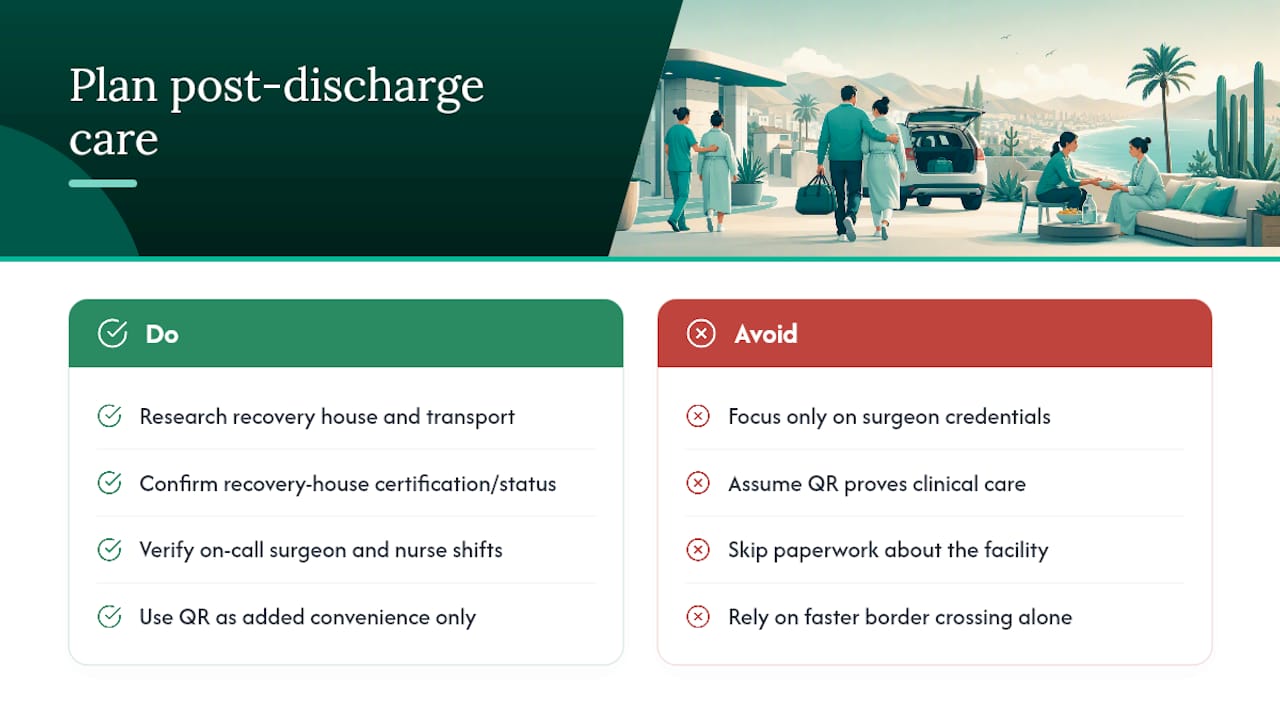
The QR-based pase médico rollout is a genuinely useful development, but it's not a substitute for vetting. A faster border crossing doesn't help you if the recovery house that issued your QR code has no nurse on shift at 2 a.m. Treat the technology as a convenience layer on top of real due diligence, not a replacement for it.
Medical reviewer: to be confirmed. Last reviewed: June 2026. This section reflects editorial analysis grounded in current reporting on Tijuana's medical tourism sector and is intended for educational purposes only. It is not medical advice, and it does not replace a consultation with your surgeon or a licensed physician. For provider credentials and accreditation details, review Obesitycontrolcenter.com and CYNTAR.mx partner listings, along with our procedure guides and accreditation primer.
— Ariel
Get help arranging accredited recovery care and transport
Weightlosssurgeryguide is the alternative to researching recovery houses and transport providers one confusing search result at a time. We compare accredited hospitals and surgeons in Tijuana, vet recovery-house partners for nursing staff and emergency protocols, and coordinate the transport and border logistics so you're not piecing it together solo two weeks before surgery.
Every recommendation we make ties back to documented accreditation, written pain-management plans, and clear escalation procedures, the same standards covered throughout this guide. A comparable domiciliary model exists in other markets too, as UK post-hospital home care guidance shows, but Tijuana's cross-border logistics require region-specific coordination that general guides don't cover.
If you're planning bariatric surgery in Mexico and want the recovery and transport pieces sorted before you book flights, request your free personalized quote and safety checklist and we'll match you with vetted, accredited options.
Sources
- Desarrollan aplicación digital: pases médicos y cruce ágil TJ-SD (Uniradio Baja)
- Recuperación Postoperatoria en Tijuana (Baja Premium Care / Baja Health Cluster)