Post-Op Care Returning to the USA: 2026 Recovery Guide
Published July 13, 2026

Post-Op Care Returning to the USA: 2026 Recovery Guide
Post-op care returning to the USA is the process of coordinating safe clinical follow-up, wound management, and rehabilitation after surgery performed abroad. 85% of US surgeons are willing to manage post-surgical care when patients arrive with clear clinical documentation. Without that documentation, even willing providers hesitate. Patients who return from international surgery with organized records, a scheduled appointment, and a clear recovery plan heal faster and face fewer complications than those who wait and see.
Medically reviewed for educational accuracy. Last reviewed: 2026. This article is for informational purposes only and does not constitute medical advice. Always consult a licensed healthcare provider for guidance specific to your condition.
What post-op care returning to the USA actually requires
The term "post-op care" covers a wide range of activities. After international surgery, it specifically means bridging the gap between your foreign surgical team and your US healthcare provider. That gap is where most complications occur.

Returning home does not end your clinical relationship with your surgeon abroad. Telemedicine allows minor concerns to be addressed within 24–48 hours, and many internationally accredited hospitals in Tijuana include 3–6 months of virtual follow-up in their standard surgical packages. That ongoing contact matters because your US provider will have questions your foreign surgeon can answer directly.
The three pillars of effective post-surgery recovery in the USA are documentation, early follow-up, and rehabilitation adherence. Each one builds on the last. Miss any one of them and the others weaken.
What medical documents do you need before leaving?
The single most important thing you can do before boarding your return flight is collect a complete set of surgical records. A billing-focused discharge summary is not enough.
Operative reports contain the clinical detail your US provider actually needs: surgical techniques used, implant specifications, suture types, and closure methods. Without this information, a US surgeon managing a complication is working blind. Request the full operative report, not just the discharge paperwork.
Collect the following before you leave the facility:
- Full operative report with surgical technique, implant details, and closure method
- Discharge summary with diagnosis codes and post-op instructions
- Medication list using generic drug names (brand names vary by country)
- High-resolution photos of your incision site for baseline healing comparison
- Lab results from pre-op and post-op blood work
- DVT clearance letter signed by your surgeon confirming you are cleared for commercial air travel
Keep all of these in your carry-on bag, not checked luggage. Digital copies stored in a cloud folder or emailed to yourself give you a backup that survives lost bags.
Pro Tip: Ask your foreign coordinator to send your operative report directly to your US doctor's office before you land. That one step removes the most common reason US providers decline to take on post-op patients.
| Document | Why it matters |
|---|---|
| Operative report | Gives US providers the technical detail needed for revisions or complication management |
| Generic medication list | Prevents dangerous substitutions when filling prescriptions stateside |
| Incision photos | Establishes a visual baseline for wound healing assessment |
| DVT clearance letter | Required for safe commercial air travel post-surgery |
| Lab results | Allows US providers to track recovery without repeating costly tests |
How do you schedule your first US follow-up appointment?
Schedule your first appointment within 1–2 weeks of returning home. That window is not arbitrary. It gives your body time to stabilize after travel while keeping you within the window where early complications are still easy to manage.
Contact your primary care physician before you land. Send your operative report and discharge summary by email or patient portal so your provider can review them before the appointment. Patients who send records in advance spend their first visit on actual care, not paperwork.
- Email records to your US provider's office at least 48 hours before your appointment.
- Frame the conversation clearly. Tell your doctor you had surgery abroad, you have complete documentation, and you need them to serve as your local care coordinator, not to second-guess the procedure.
- Ask specifically about wound checks, lab work, and medication review so the appointment has a defined agenda.
- If your primary care doctor is hesitant, request a referral to a wound care specialist or ask your foreign coordinator to send an introductory email directly to your US provider.
- Set up a telemedicine check-in with your foreign surgical team for the same week, so both providers can communicate if needed.
Proactively connecting your foreign surgeon with your US doctor is the single most effective way to reduce provider hesitation. A brief email introduction from your surgical coordinator changes the dynamic from "unknown foreign procedure" to "documented international case with available specialist support."
Pro Tip: Ask your foreign hospital's patient coordinator to draft a one-paragraph introduction email you can forward to your US doctor. Most internationally accredited facilities do this routinely. If yours does not, request it explicitly.
For a detailed breakdown of coordinating with US doctors after bariatric surgery abroad, Weightlosssurgeryguide has a dedicated guide covering communication templates and provider scripts.
What should you expect in your first 48 hours back home?
The first 48 hours after returning home are the highest-risk window of your entire recovery. Anesthesia effects, travel fatigue, and post-surgical inflammation all peak during this period.
Do not drive or make significant decisions for at least 24 hours after surgery. This applies even if you feel alert. Anesthesia impairs judgment and reaction time in ways that are not always obvious to the person affected.
A fever above 101°F (38.3°C) in the first 48 hours is a red flag for surgical site infection and requires immediate medical attention. Do not wait to see if it resolves on its own. Go to urgent care or an emergency room and bring your operative report.
Set up your home environment before you travel. You need a recovery space at ground level if possible, easy access to your medications, and someone present for the first 24 hours. Stock your kitchen with soft foods, electrolyte drinks, and easy-to-open containers. Prescription refills should be filled before your surgery date, not after you land.
Monitor your incision site twice daily. Look for increasing redness, warmth, swelling, or discharge. Take photos at each check and compare them to your baseline images from the hospital. This visual record becomes critical if you need to describe changes to a provider over telemedicine.
What are the rehabilitation phases for post-surgery recovery in the USA?
Recovery is an active, multi-phase process. Up to 50% of patients fail to complete their prescribed post-surgical rehabilitation, and that failure directly reduces long-term outcomes. Knowing the phases in advance makes you far less likely to fall into that group.
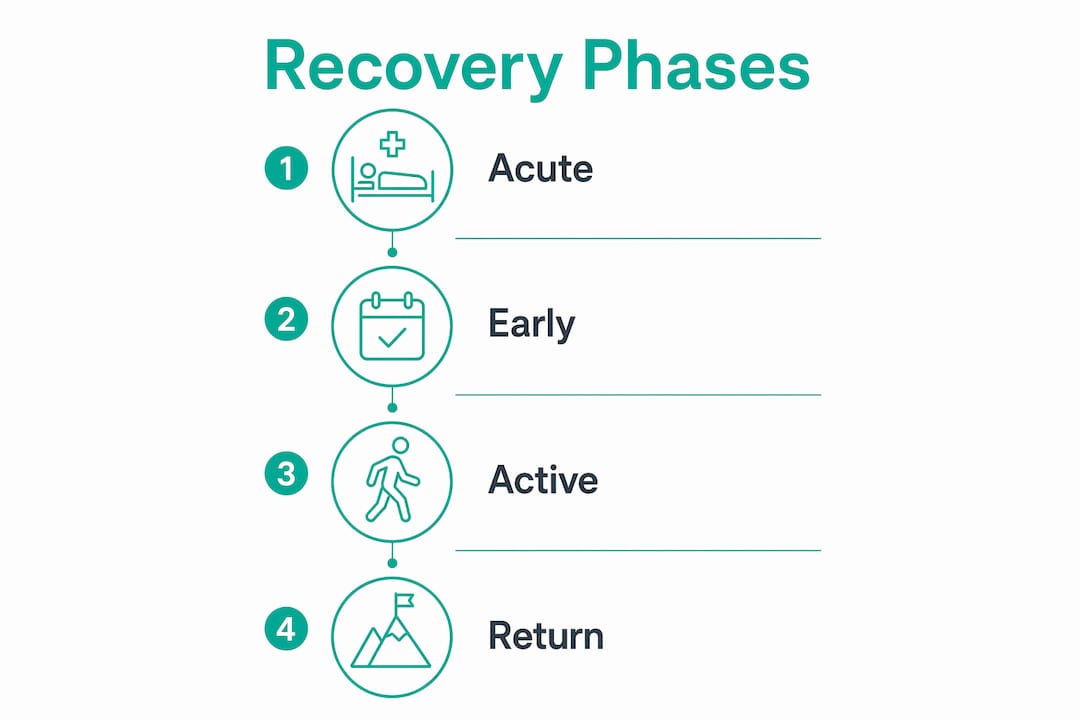
The four recovery phases
Acute phase (0–48 hours): Rest, pain management on a fixed schedule, and basic mobility. Pain managed proactively on a schedule heals faster than pain managed reactively. Short, frequent walks reduce stiffness and prevent blood clots. Do not wait until pain becomes severe before taking prescribed medication.
Early phase (1–3 weeks): Wound healing, gradual increase in daily activity, and first US follow-up appointments. Physical therapy often begins during this phase for orthopedic and bariatric patients. AAOS data shows that outpatient therapy typically starts 2–6 weeks after discharge for joint replacement patients.
Active phase (4–12 weeks): Structured rehabilitation with measurable functional milestones. This is where most patients either commit to recovery or stall. Rehab compliance at this stage produces 62% better outcomes at 12 months compared to patients who stop structured therapy early.
Return to activity (3–6 months): Progressive return to work, exercise, and normal daily function. Milestones vary by procedure but are defined in your operative discharge instructions.
Pro Tip: Ask your foreign surgical team for a written rehabilitation protocol before you leave. Bring it to your first US physical therapy appointment. Therapists work faster and more confidently when they have the surgeon's specific protocol in hand.
| Phase | Timeframe | Key focus |
|---|---|---|
| Acute | 0–48 hours | Rest, scheduled pain management, short walks |
| Early | 1–3 weeks | Wound care, first US follow-up, light activity |
| Active | 4–12 weeks | Structured physical therapy, functional milestones |
| Return to activity | 3–6 months | Progressive exercise, return to work and normal life |
Automated aftercare reminders and structured communication from your surgical team improve compliance and catch complications early. If your foreign hospital offers a post-op messaging program, enroll in it before you leave.
Key Takeaways
Effective post-op care returning to the USA requires complete surgical documentation, a follow-up appointment within 1–2 weeks, and consistent adherence to a structured rehabilitation plan.
| Point | Details |
|---|---|
| Collect full operative reports | Discharge summaries alone are not enough; get implant details, techniques, and closure methods. |
| Schedule follow-up within 1–2 weeks | Early appointments catch complications before they escalate and establish US care continuity. |
| Carry DVT clearance documentation | A signed clearance letter is required for safe commercial air travel after surgery. |
| Manage the first 48 hours carefully | Fever above 101°F requires immediate care; do not drive for at least 24 hours post-surgery. |
| Commit to all four rehab phases | Patients who complete structured rehab show 62% better outcomes at 12 months. |
Why the patient is the most important link in international care
I have seen patients arrive home from excellent surgery abroad and still end up in the emergency room within two weeks. Not because the surgery failed. Because no one connected the dots between the foreign team and the US provider.
The uncomfortable truth is that the US healthcare system is not designed to receive international surgical patients. Your primary care doctor did not train for this. Your local urgent care clinic has never seen your surgeon's operative notes. You are the only person who can carry that information across the border and place it in the right hands.
What actually works is treating yourself as a clinical coordinator, not just a patient. That means sending records before appointments, not during them. It means asking your foreign coordinator to make a direct introduction to your US provider. It means showing up to your first follow-up with a printed operative report, a medication list, and baseline incision photos. Providers respond differently when a patient walks in prepared.
Telemedicine has made this easier than it was five years ago. Your Tijuana surgeon can join a video call with your US physician. That conversation, which takes 15 minutes, eliminates weeks of uncertainty. The patients I have seen recover best are the ones who arrange that call before they even board their flight home.
The ASMBS medical tourism safety checklist is one of the most practical tools available for patients preparing to return home. Use it as your pre-departure audit, not as a post-arrival scramble.
— Ariel
How Weightlosssurgeryguide supports your return home
Returning from surgery abroad with a clear recovery plan is possible when you have the right resources before you leave.
Weightlosssurgeryguide provides verified provider rankings for 2026, procedure-specific recovery guides, and safety checklists built for US patients returning from surgery in Tijuana and across Mexico. The site covers accreditation standards, documentation requirements, and financing options so you can plan your full recovery, not just the surgical day. Whether you are preparing for a procedure or already home and coordinating follow-up care, Weightlosssurgeryguide gives you the tools to stay organized, ask the right questions, and connect with accredited providers who support continuity of care from day one.
FAQ
What documents do I need for post-op care in the USA?
You need a full operative report, discharge summary, generic medication list, baseline incision photos, lab results, and a signed DVT clearance letter. Keep all documents in your carry-on bag and send digital copies to your US provider before your first appointment.
How soon should I see a US doctor after returning from surgery abroad?
Schedule your first US follow-up within 1–2 weeks of returning home. 85% of US surgeons accept post-op patients from abroad when complete clinical documentation is provided in advance.
What are the warning signs I should watch for in the first 48 hours?
A fever above 101°F (38.3°C), increasing redness or swelling at the incision site, or unusual discharge all require immediate medical attention. Bring your operative report to any urgent care or emergency room visit.
Can I use telemedicine to stay connected with my foreign surgeon?
Yes. Most internationally accredited hospitals include virtual follow-up support for 3–6 months post-surgery. Telemedicine allows your foreign surgeon and US provider to communicate directly, which reduces delays and improves care quality.
What happens if I skip physical therapy after returning home?
Up to 50% of patients do not complete prescribed rehabilitation, and those patients show significantly worse outcomes at 12 months. Completing all four recovery phases, including structured physical therapy, is the most reliable way to protect your surgical results.
This article is for educational purposes only. It does not replace the advice of a licensed physician or surgeon. Always consult your healthcare provider before making decisions about your post-operative care.