Why Surgery Is Better Than Dieting for Lasting Weight Loss
Published July 5, 2026

Why Surgery Is Better Than Dieting for Lasting Weight Loss
Weight loss surgery is the most effective method for sustained, significant weight loss compared to dieting because it physically and metabolically changes how your body processes food and hunger signals from day one. Bariatric surgery produces over 20% greater weight loss at 12 months compared to GLP-1 drug therapy alone. That gap widens further when you factor in diabetes remission, cardiovascular protection, and long-term metabolic health. If you are weighing why surgery is better than dieting, the answer is rooted in biology, not willpower.
Reviewed by the Weightlosssurgeryguide medical team. Last reviewed: june 2026.
This article is for educational purposes only and does not constitute medical advice. Consult a qualified bariatric surgeon before making any treatment decisions.
Why surgery outperforms dieting: the core evidence
The American Society for Metabolic and Bariatric Surgery (ASMBS) supports surgery as the gold standard for treating severe obesity. A large real-world study found that surgery produces significantly higher remission rates for type 2 diabetes (+42%), hypertension (+12.8%), and high cholesterol (+20.8%) compared to medical therapy. Those are not marginal gains. They represent the difference between managing a disease for life and, in many cases, reversing it entirely.
Dieting works on one lever: calorie restriction. Surgery works on several at once, including stomach volume, gut hormone output, metabolic rate, and appetite signaling. That is why the outcomes are not even close when the goal is durable, clinically meaningful weight loss. For people with a BMI above 35 and obesity-related conditions, the surgery vs dieting benefits gap is especially pronounced.

A 10-year network meta-analysis of randomized controlled trials confirmed that most bariatric procedures outperform medical therapy in long-term weight loss and diabetes remission. The only exception was adjustable gastric banding, which has largely fallen out of favor. Every other major procedure delivered results that diet alone could not replicate.
What physiological changes does surgery create that dieting cannot?
Surgery rewires your body's relationship with food at a biological level. Dieting does not.
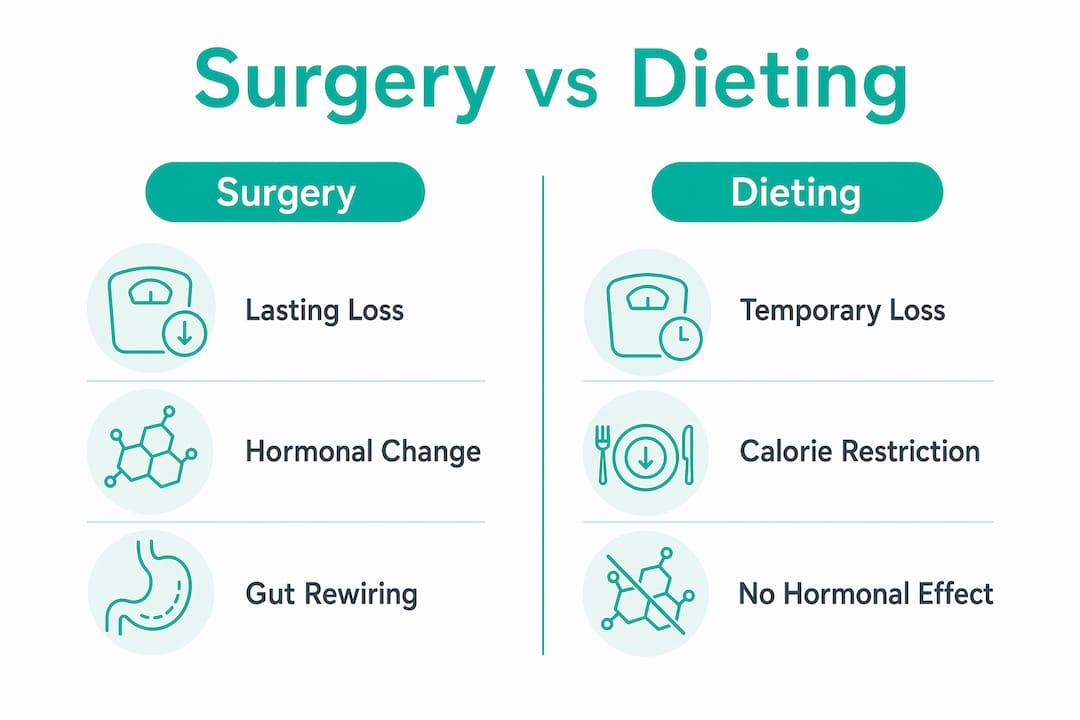
How the gut changes after surgery
When a surgeon performs a sleeve gastrectomy, roughly 80% of the stomach is removed. This reduces food intake capacity immediately. But the more important change is hormonal. Surgical weight loss rewires gut hormone secretion that modulates hunger, satiety, energy metabolism, and glucose control. These effects are absent in dieting.
Procedures like gastric bypass and biliopancreatic diversion with duodenal switch (BPD/DS) reroute the digestive tract. This triggers a surge in GLP-1 and GIP hormones, which increase satiety and improve insulin sensitivity. The result is that patients feel full faster, stay full longer, and experience fewer cravings. No diet produces this hormonal shift.
Here is what changes physiologically after surgery that dieting simply cannot replicate:
- Stomach volume reduction: Sleeve gastrectomy removes the hunger-producing fundus of the stomach, cutting ghrelin output dramatically.
- Gut hormone surge: Gastric bypass causes a rapid rise in GLP-1 and GIP after meals, improving satiety and blood sugar control.
- Metabolic reset: Insulin sensitivity improves within days of surgery, often before significant weight loss occurs.
- Rerouted digestion: BPD/DS limits calorie absorption by bypassing a large section of the small intestine, producing the greatest weight loss of any procedure.
- Appetite rewiring: Patients report a fundamental shift in how they experience hunger, not just smaller portions.
Pro Tip: If you want to understand exactly how each procedure triggers these hormonal changes, the bariatric surgery mechanisms guide on Weightlosssurgeryguide breaks it down procedure by procedure.
What does research show about long-term weight loss outcomes?
The clinical evidence comparing surgery for obesity vs diet is now extensive and consistent. Surgery wins on every major metric over time.
The 10-year network meta-analysis referenced above found that sleeve gastrectomy produces a mean weight loss difference of 17.73% over medical therapy. BPD/DS reaches 28.87%. These are not short-term results. They reflect a decade of follow-up across randomized controlled trials.
"Surgery benefits persist after weight loss plateaus, unlike medication effects which often diminish after discontinuation. GLP-1 medications do not match surgery's magnitude or durability, but they are an important adjunct tool in obesity treatment."
The table below summarizes key weight loss surgery outcomes compared to medical therapy across major procedures:
| Procedure | Mean excess weight loss vs medical therapy | Diabetes remission |
|---|---|---|
| Sleeve gastrectomy | +17.73% | High |
| Gastric bypass (RYGB) | +22–26% | Very high |
| BPD/DS | +28.87% | Highest |
| Adjustable gastric band | Comparable to medical therapy | Low |
Surgery patients also experience fewer serious cardiovascular events than those on medical weight loss therapy during approximately six years of follow-up. That finding matters because cardiovascular disease is the leading cause of death in people with severe obesity. Reducing that risk is not a side benefit. It is a primary goal of treatment.
Why does dieting fail for obesity, and how does surgery overcome it?
Dieting fails most people with obesity not because of weak willpower, but because of biology. Caloric restriction alone rarely leads to sustained weight loss due to metabolic adaptation and behavioral challenges. The body responds to a calorie deficit by lowering its basal metabolic rate, making it progressively harder to lose weight and easier to regain it.
Here is why dieting consistently falls short for significant obesity:
- Metabolic adaptation: The body reduces energy expenditure in response to calorie restriction, often within weeks of starting a diet.
- Hunger hormone rebound: Ghrelin, the primary hunger hormone, rises sharply after weight loss from dieting, driving intense cravings.
- Behavioral fatigue: Sustained severe calorie restriction requires constant vigilance. Most people cannot maintain it for years.
- No hormonal reset: Dieting does not alter GLP-1, GIP, or ghrelin production in any lasting way.
- Weight regain pattern: Most people who lose weight through diet alone regain the majority within two to five years.
Surgery overcomes each of these obstacles directly. It reduces ghrelin production, triggers lasting GLP-1 increases, and lowers the set point at which the body defends its weight. Obesity is a chronic disease requiring surgery as part of a multimodal long-term treatment, especially when comorbid diabetes or cardiovascular risk is present.
Pro Tip: Ask your bariatric team about your personal metabolic adaptation history before surgery. Patients who have yo-yo dieted extensively may need additional post-op support to stabilize their metabolism.
How do surgery and dieting compare on safety and side effects?
Surgery carries real risks, but they are lower than most people assume. Surgical complication rates are lower than those of routine hip replacement surgery, which is widely considered a safe elective procedure. That comparison reframes the risk conversation entirely.
The most common surgical risks include infection, blood clots, anastomotic leaks (in bypass procedures), and nutritional deficiencies. Experienced surgical teams at accredited centers manage these risks through standardized protocols. Mortality rates for bariatric surgery at high-volume centers are comparable to those of gallbladder removal.
Dieting carries its own risks, which are less dramatic but still significant:
- Nutritional deficiencies: Crash diets and very low-calorie protocols frequently cause deficiencies in iron, B12, and vitamin D.
- Muscle loss: Severe calorie restriction without adequate protein causes lean muscle mass to decline.
- Psychological stress: Chronic dieting is associated with increased rates of anxiety, disordered eating, and depression.
- Weight cycling: Repeated cycles of loss and regain increase cardiovascular risk independently of body weight.
| Factor | Surgery | Dieting |
|---|---|---|
| Long-term weight loss | Sustained, significant | Often temporary |
| Hormonal changes | Permanent reset | None |
| Complication risk | Low (comparable to hip replacement) | Nutritional and psychological |
| Cardiovascular outcomes | Significantly improved | Modest improvement |
| Requires lifelong commitment | Yes | Yes |
Combining surgery with GLP-1 agonist therapy post-operatively is emerging as an effective strategy for patients facing weight regain or plateau. Surgery provides the metabolic reset. Medications help manage later-stage hunger return. The two approaches are not competitors. They are increasingly used together.
What practical factors should you consider before choosing surgery?
Surgery is not right for everyone, but the candidacy criteria are broader than many people realize. Standard guidelines recommend bariatric surgery for adults with a BMI of 40 or above, or a BMI of 35 or above with at least one obesity-related condition such as type 2 diabetes, hypertension, or sleep apnea.
Key factors to evaluate before moving forward:
- Medical eligibility: Your primary care physician and bariatric surgeon will assess BMI, comorbidities, and surgical risk together.
- Psychological readiness: Preoperative counseling improves realistic goals and long-term success rates. Most accredited programs require a psychological evaluation.
- Procedure selection: Sleeve gastrectomy suits most patients. Gastric bypass offers greater metabolic benefit for those with severe diabetes. BPD/DS delivers the highest weight loss for super-obesity.
- Long-term support: Successful outcomes depend on access to a multidisciplinary team including a dietitian, psychologist, and bariatric surgeon for follow-up.
- Accreditation: Choose a facility accredited by the Joint Commission International (JCI), Surgical Review Corporation (SRC), or an equivalent body.
Pro Tip: Review the ASMBS medical tourism safety checklist before evaluating any international surgical provider. It covers credentials, facility standards, and follow-up care requirements.
You can also compare GLP-1 vs bariatric surgery in detail on Weightlosssurgeryguide to understand which approach fits your health profile before your first consultation.
Key Takeaways
Weight loss surgery produces greater, more durable weight loss than dieting because it permanently alters gut hormones, metabolic rate, and appetite regulation in ways that calorie restriction alone cannot achieve.
| Point | Details |
|---|---|
| Surgery outperforms dieting | Bariatric surgery produces over 20% greater weight loss at 12 months than GLP-1 drug therapy. |
| Hormonal reset is the key difference | Surgery alters GLP-1, GIP, and ghrelin in lasting ways that dieting cannot replicate. |
| Long-term outcomes are sustained | A 10-year meta-analysis confirms most bariatric procedures maintain superior weight loss over medical therapy. |
| Safety is comparable to common surgery | Bariatric complication rates are lower than those of routine hip replacement procedures. |
| Commitment is required post-surgery | Psychological preparation and lifelong lifestyle modification are central to lasting surgical success. |
Surgery changed how I think about obesity treatment
I have spent years reviewing bariatric outcomes data and speaking with patients who tried every diet imaginable before surgery. The pattern is consistent. Dieting is not a character test that some people pass and others fail. It is a biological battle that most people with severe obesity are set up to lose, because the body fights back harder than the diet can push.
What shifted my thinking was understanding the hormonal data. When you see that a patient's ghrelin drops dramatically after sleeve gastrectomy, and their GLP-1 surges after gastric bypass, you realize this is not about eating less. It is about the body operating under a completely different set of instructions. That is something no meal plan produces.
I also want to be direct about what surgery is not. It is not a passive fix. Patients who succeed long-term are the ones who treat surgery as the beginning of a new relationship with food and health, not the end of a struggle. The metabolic advantage surgery provides is real and significant. But it works best when paired with nutritional support, psychological follow-up, and honest self-assessment.
For anyone with a BMI above 35 and a condition like type 2 diabetes or hypertension, the evidence is clear. Surgery offers a level of disease remission that dieting cannot approach. That is not a sales pitch. It is what the clinical data shows, consistently, across a decade of follow-up in randomized controlled trials.
— Ariel
Weightlosssurgeryguide: your starting point for safe surgical options
Choosing a bariatric surgeon is one of the most consequential medical decisions you will make. Weightlosssurgeryguide exists to make that decision clearer and safer for American patients considering surgery in Mexico.

The 2026 Tijuana bariatric surgery rankings on Weightlosssurgeryguide evaluate providers on accreditation status, surgical volume, complication rates, and patient outcomes. Every listed facility meets internationally recognized safety standards. Patients who use accredited centers in Tijuana save 60–75% compared to U.S. surgical costs without sacrificing care quality. The site also includes an evidence and verification library where you can review the clinical sources behind every recommendation. If you are ready to take the next step, request a free personalized quote directly through Weightlosssurgeryguide.
FAQ
Why is surgery more effective than dieting for obesity?
Surgery permanently alters gut hormones like GLP-1 and ghrelin, producing metabolic changes that calorie restriction cannot replicate. This leads to greater and more durable weight loss than any diet-based approach.
Is weight loss surgery safer than long-term dieting?
Bariatric surgery complication rates are lower than those of routine hip replacement surgery. Long-term dieting carries its own risks, including nutritional deficiencies, muscle loss, and weight cycling that increases cardiovascular risk.
How much more weight do surgery patients lose compared to dieters?
A large real-world study found that bariatric surgery produces over 20% greater weight loss at 12 months compared to GLP-1 drug therapy. A 10-year meta-analysis confirms this advantage holds across most major procedures.
Who qualifies for weight loss surgery?
Standard guidelines recommend surgery for adults with a BMI of 40 or above, or a BMI of 35 or above with at least one obesity-related condition such as type 2 diabetes or hypertension.
Can you combine surgery with medications after the procedure?
Combining surgery with GLP-1 agonist therapy post-operatively is an emerging strategy for patients who experience weight regain or plateau. Surgery provides the metabolic foundation, and medications support appetite control in later stages.
Sources: ASMBS, Harvard Health, Springer Bariatric Surgery Network Meta-Analysis, StatPearls/NCBI. Full references available at the Weightlosssurgeryguide references page.
This article is educational and does not replace personalized medical advice from a licensed bariatric surgeon.
Recommended
- How Bariatric Surgery Causes Weight Loss: 2026 Guide | Weight Loss Surgery Guide
- Surgical Weight Loss Definition: What You Need to Know | Weight Loss Surgery Guide
- GLP-1 vs Bariatric Surgery | Compare Long-Term Weight Loss Options
- Bariatric Surgery Savings for US Patients: 2026 Guide | Weight Loss Surgery Guide