JCI Accreditation for Hospitals in Mexico: How to Verify It
Published November 10, 2026

JCI Accreditation for Hospitals in Mexico: How to Verify It
JCI accreditation is a voluntary, international quality seal that applies to one specific hospital, not to a city, a hospital group or a surgeon. In Mexico only a small number of hospitals hold it, and the only reliable way to confirm a hospital's status is the official JCI directory. This guide explains what the seal measures, how it differs from Mexico's own certification, what it does not promise, and how to check it in five minutes.
Written by Ariel, Weight Loss Surgery Guide. Last reviewed: November 8, 2026. Reviewer credentials and our evidence standards are on our Sources & Verification page.
TL;DR
- JCI (Joint Commission International) accredits individual hospitals after an unannounced on-site survey. It does not accredit doctors.
- Mexico has only a limited list of JCI-accredited hospitals, and the list changes. Check the exact facility name in the official JCI directory.
- Mexico has its own certification, run by the Consejo de Salubridad General (CSG), which adopted JCI-based standards in 2009.
- Accreditation lowers risk but does not guarantee an outcome. Vet the surgeon, the procedure plan and your complication coverage separately.
- This article is education, not medical advice. Decisions about surgery belong with your own physician.
Table of Contents
- What JCI accreditation is
- What JCI actually evaluates
- JCI versus Mexico's own certification
- How many Mexican hospitals hold JCI accreditation
- How to verify a hospital in five steps
- What JCI accreditation does and does not tell you
- What to check besides accreditation
- Our perspective
- Plan your care with a verified team
- Education, not medical advice
- FAQ
- Sources
What JCI accreditation is
Joint Commission International is the international arm of the US-based Joint Commission. According to JCI's own description of accreditation, it is an evaluation process that helps health care organizations measure, assess and improve performance so they can provide safe, high-quality care. The award follows an unannounced, on-site survey. Surveyors review patient records, observe care, and interview staff and patients.
Accreditation typically lasts three years (two for laboratories). Accredited organizations may display the Gold Seal of Approval. A hospital cannot buy the seal. It has to pass a survey and then pass again at the next cycle.
It is also voluntary. A Mexican university thesis from UNAM describes JCI accreditation as a voluntary process that endorses organizations meeting quality and patient safety standards, and implies continuous improvement in care processes. No law in Mexico or the US requires a hospital to hold it. A 2024 legal analysis of medical tourism notes that it usually takes a hospital 18 to 24 months and about $30,000 to obtain. That is a useful detail: a hospital that holds the seal has chosen to invest in outside scrutiny.
What JCI actually evaluates
JCI's standards cover the whole hospital, not only the operating room. The Hospital Accreditation Program lists 11 core areas:
- Access to care and continuity of services
- Assessment and care of patients
- Anesthesia and surgical care
- Medication management
- Patient and family rights and education
- Quality improvement and patient safety
- Prevention and control of infections
- Governance and leadership
- Facility management and safety
- Staff qualifications and education
- Management of information
For anyone considering surgery, items 3, 4, 6 and 7 matter most. They cover how anesthesia is delivered, how drugs are stored and given, how errors are reported and how infection is controlled.
Two methods make the survey harder to game. The first is tracer methodology: surveyors follow a patient's path through the hospital and talk to patients and staff, so they see how standards work in practice and not only what the policy binder says. The second is the SAFER Matrix, which helps prioritize improvement on the areas with the highest risk of harm. Both are described on JCI's hospital program page.
The current standards edition
JCI published its 8th Edition of the hospital standards on 1 July 2024. From 1 January 2025, all hospitals seeking accreditation or reaccreditation must follow it. The edition adds environmental sustainability standards, with full compliance required from 1 January 2026. A hospital accredited recently has therefore been measured against a newer rulebook than one accredited several years ago. That is one reason the effective date in the directory is worth reading.

JCI versus Mexico's own certification
Mexico has a national system run by the Consejo de Salubridad General (CSG). Under an official agreement published in the Diario Oficial de la Federación, the certification model covers hospitals, outpatient units, rehabilitation units, mental health units and other establishments from the public, social or private sectors. Participation is voluntary.
The two systems are related. A review of certification in Mexico reports that the CSG adopted JCI standards for hospital accreditation in 2009 and promoted tracer-based evaluation. Its process has three phases (registration and self-evaluation, audit, and ruling), and the certificate is valid for one to five years depending on the score.
| JCI accreditation | CSG certification | |
|---|---|---|
| Who runs it | Joint Commission International (US-based) | Consejo de Salubridad General (Mexico) |
| Participation | Voluntary | Voluntary |
| Validity | Typically three years | One to five years, depending on score |
| Where you check it | JCI's online directory | CSG's official certification records |
| Recognition abroad | Widely recognized by US and Canadian patients | Less familiar outside Mexico |
A hospital can hold one, both, or neither. Neither is a substitute for checking the surgeon.
How many Mexican hospitals hold JCI accreditation
The number is small and moves. One September 2026 count puts Mexico at 12 JCI-accredited hospitals plus 7 outpatient organizations, and other trackers give slightly different totals depending on the date and on whether outpatient programs are counted. Treat any total, including this one, as a snapshot. The official directory is the only source that is current by definition.
The JCI directory for Mexico lists hospitals in Mexico City, Cancún, Tijuana and other cities, each with an accreditation program, a decision and an effective date. Those effective dates vary widely: some hospitals were first accredited more than a decade ago, others renewed within the last few years.
How to verify a hospital in five steps
- Open the official directory. Go to the JCI "Find Accredited International Organizations" page and filter by Mexico.
- Search the exact name. Match the legal or trade name of the building where your surgery will happen, not the name of a clinic, brand or coordinator.
- Check the program. The listing shows whether the organization is accredited under the Hospital Program or the Ambulatory Care Program. These are different scopes.
- Read the decision and effective date. You want a decision of Accredited and a date that fits the roughly three-year cycle. If the date looks old and there is no renewal, ask why.
- Confirm the campus. Accreditation belongs to a specific facility. A network having accredited hospitals does not mean every location is accredited, as Avia's guide to JCI hospitals in Mexico also stresses.
Wording to watch for
Some providers say they "work with a JCI hospital." That is not the same as the provider or its clinic being accredited. What matters is where your anesthesia, surgery and overnight recovery physically take place. If that building is on the directory, the seal applies to that care. If only an office or a recovery house is, it does not. For more on how to read these claims, see our guide to how international hospital standards work for bariatric surgery in Tijuana.
What JCI accreditation does and does not tell you
What it indicates. It shows a hospital has been surveyed, unannounced, against standards covering surgery, anesthesia, medication and infection control, and that it must keep meeting them to renew. The UNAM thesis frames it as an incentive for improvement: entities analyze their results, find strengths and weaknesses, and compare themselves with others. A 2025 systematic review of JCI accreditation and patient safety, which screened nearly 300 articles, reported measurable improvements in documented safety culture and incident reporting, while noting the evidence base remains limited.
What it does not do. It does not certify the surgeon. The medical tourism legal analysis states that JCI accredits hospitals and other facilities but does not regulate healthcare providers, including physicians. It does not promise a result either. A 2024 peer-reviewed study of hospital accreditation in Mexico looked at the national hybrid accreditation and licensing model in second-level hospitals and did not find significant gains in effectiveness, efficiency or safety. It linked part of the story to financial incentives that, until the end of 2019, tied accreditation to Seguro Popular funding. That study concerns the Mexican national system in public-sector hospitals, not private hospitals that chose JCI for international patients. Still, it is a good reason to treat any seal as one input among several and not as the whole decision.

What to check besides accreditation
The surgeon
Verify the surgeon separately. In Mexico that means checking board certification with the relevant specialty council, such as CONACEM for medical specialties, and the surgeon's professional license. For post-weight-loss plastic surgery, our guide to verifying CMCPER and COFEPRIS walks through the checks. If you are comparing teams in Tijuana, our provider directory lists surgeons with the credentials we have verified.
Bariatric-specific accreditation
Hospital accreditation is general. Weight loss surgery programs can also hold program-level recognition, and our page on bariatric accreditation, including JCI, SRC and ISO explains how the layers fit together.
Complication coverage and aftercare
Accreditation reduces clinical risk but not financial risk. Standard health plans and ordinary travel insurance often do not pay for complications of elective surgery abroad, so ask your own insurer, and arrange specific coverage before you travel. Our page on reimbursement and insurance for patients having surgery in Mexico covers what US and Canadian patients can and cannot expect. Also ask what follow-up looks like after you return home, and who handles it.
Your own medical suitability
A seal cannot assess whether a particular operation suits your health history. That is a conversation with your own physician and the surgical team, using your records. The CDC advises researching both the facility and the treating professional before committing to care abroad.
Our perspective
We built Weight Loss Surgery Guide because patients kept asking the same question: how do I know a hospital in Mexico is safe? Our answer starts with accreditation, because it is the one signal that someone outside the hospital has inspected the work, unannounced, against written standards.
We would rather you read the directory yourself than take our word for it. That is why we publish our verification method and why we compare facilities on accreditation first and price second. Savings matter, but they only count when the care sits inside a framework of audited safety standards.
Our approach is integrated. Bariatric surgery and the plastic surgery many patients want afterward are provided at one facility, Hospital Cyntar, which we describe as JCI- and SRC-accredited, with high-volume, board-certified surgeons and long-term aftercare for US and Canadian patients. Continuity matters: the team that knows your surgery is the team that follows you after it.
We are open about how we earn revenue. We connect patients with affiliated accredited hospitals and surgical teams, and we say so on every page. Read the Hospital Cyntar and Ariel Center page for the facility's credentials and decide with your own doctor.
Ariel
Plan your care with a verified team
If you are comparing accredited options for weight loss surgery in Tijuana, we can match you with a hospital and surgical team, outline travel logistics and prepare a personalized quote. Start with our overview of bariatric surgery in Mexico, or go to the guide for US patients or Canadian patients.
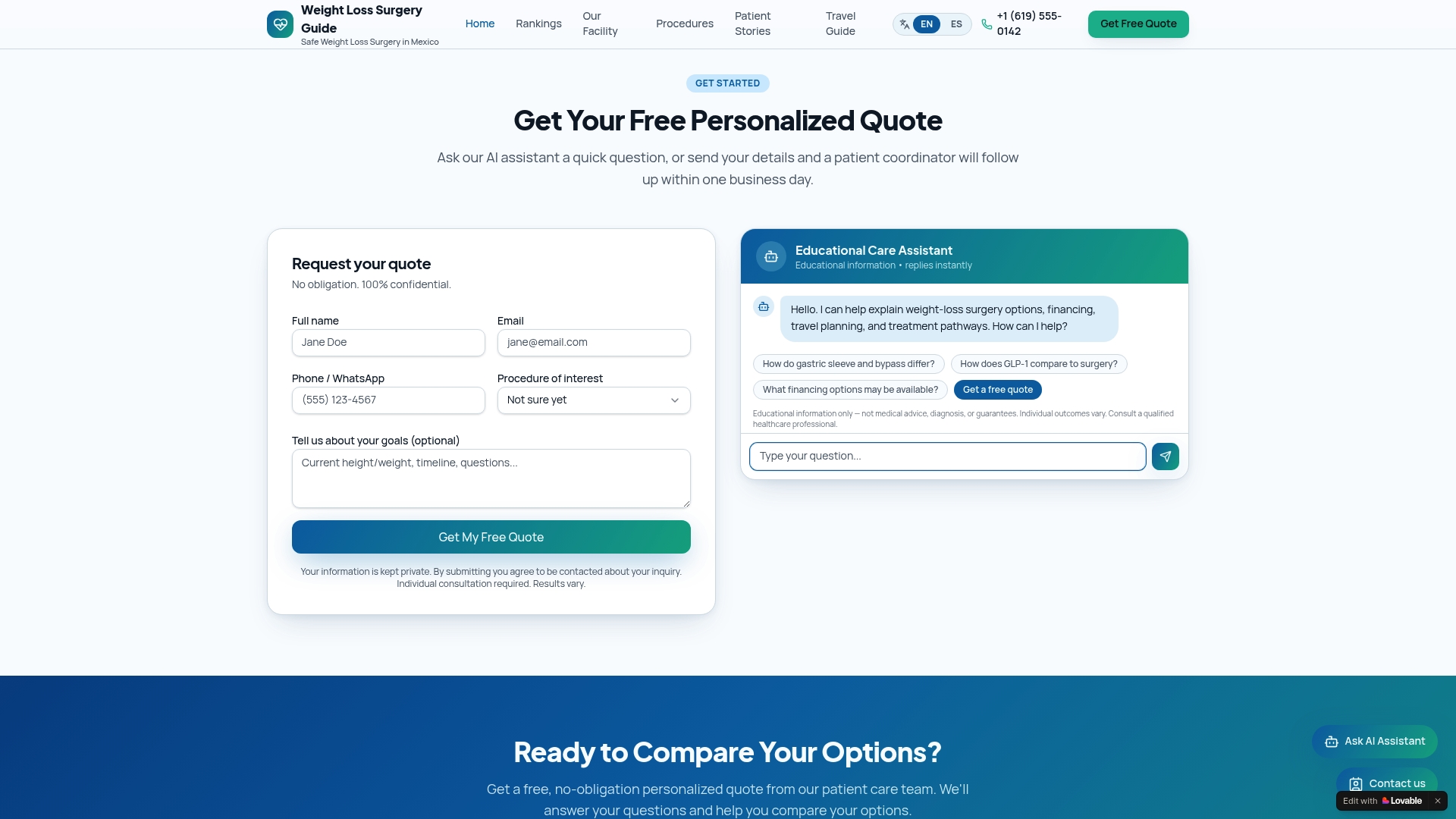
When you are ready, request your free personalized quote on our main page. You can also see how we compare providers in our Tijuana rankings.
Education, not medical advice
This article is general education about hospital accreditation. It is not medical advice, a diagnosis or a recommendation for any procedure, and reading it does not create a doctor-patient relationship. Whether bariatric or plastic surgery is right for you, which procedure fits, and what risks apply to your health depend on your history and need a qualified physician. Accreditation facts can change: standards editions, directory listings and hospital statuses are updated by JCI and the CSG, so confirm the current position on their official pages. Our evidence methods are described in our evidence library.
FAQ
Is JCI accreditation mandatory for hospitals in Mexico?
No. JCI accreditation is voluntary, and so is certification by the Consejo de Salubridad General. Hospitals choose to undergo the process, which is why the list of accredited hospitals is short compared with the total number of hospitals in the country.
How do I know if a hospital's JCI accreditation is current?
Search the official JCI directory, filtered to Mexico, and match the exact hospital name. The listing shows the program, the decision and the effective date. Accreditation typically lasts three years, so a date much older than that without renewal deserves a question.
Does JCI accreditation mean my surgeon is qualified?
No. JCI evaluates the hospital, not individual physicians. Check your surgeon's board certification and license separately, for example through the relevant Mexican specialty council, before you book.
Is JCI accreditation the same as the Mexican CSG certification?
They are separate programs. The CSG adopted JCI standards for hospital accreditation in 2009 and runs its own three-phase certification with validity of one to five years. A hospital may hold either, both or neither.
Does accreditation guarantee a good surgical result?
No. Accreditation signals that a hospital meets audited safety standards, but outcomes also depend on the surgeon, your health and your aftercare. Discuss your own risks with your physician, and arrange complication coverage before you travel.
Sources
- What is Accreditation? | Joint Commission International
- Hospital Accreditation Program | Joint Commission International
- JCI Publishes 8th Edition of International Accreditation Standards
- Find Accredited International Organizations | Joint Commission
- UNAM thesis on JCI accreditation
- Acuerdo del Modelo de Certificación, Diario Oficial de la Federación
- Certificación de establecimientos de atención médica en México (SciELO)
- Hospital accreditation in Mexico fails to improve the quality of care (PMC, 2024)
- Medical Tourism: The Need for the U.S. to Require Joint Commission Accreditation (2024)
- JCI-Accredited Hospitals in Mexico (2026)
- What Is a JCI Hospital? How to Verify One