Why Revision Surgery Is Needed After Bariatric Surgery
Published July 10, 2026

Why Revision Surgery Is Needed After Bariatric Surgery
Revisional bariatric surgery is a secondary surgical procedure performed when an initial weight loss operation fails to deliver lasting results or causes complications that require correction. About 11% of all bariatric procedures performed annually in the U.S. are revisional, according to the American Society for Metabolic and Bariatric Surgery (ASMBS). That figure reflects a medical reality: the body changes after surgery, and sometimes a second intervention becomes the most responsible path forward. Understanding why revision surgery is needed after bariatric procedures is the first step toward making an informed decision about your care.
Why revision surgery is needed after bariatric procedures
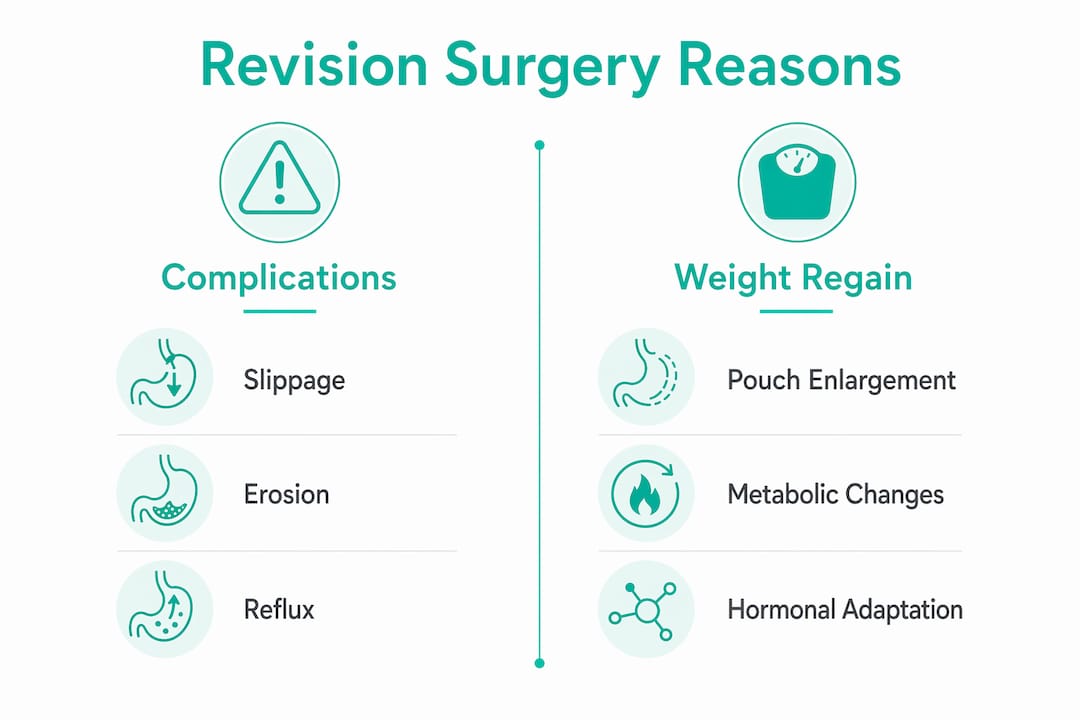
Revision surgery addresses two distinct categories of problems. The first is inadequate weight loss or significant weight regain. The second is a surgical complication that affects quality of life or long-term health.

These categories are not mutually exclusive. A patient may experience pouch enlargement that simultaneously reduces restriction and contributes to weight regain. Recognizing which category applies to you shapes every decision that follows, from the type of revision considered to the timing of intervention.
The ASMBS classifies revisional procedures into corrective operations (fixing a complication), conversion operations (switching to a different procedure), and refinement operations (adjusting the original anatomy). Each type carries its own risk profile and expected outcome. Knowing the distinction helps patients ask better questions during consultations.
What complications after bariatric surgery lead to revision?
Surgical complications are the most urgent reason for revisional bariatric surgery. The specific complication depends heavily on which procedure was performed originally.
Band-related complications
LAP-BAND patients face the highest revision rate among common bariatric procedures. More than 10% of LAP-BAND patients require revision within 24 months due to band slippage, erosion, or port failure. That rate climbs further over a decade of follow-up. The most common revision for these patients is band removal followed by conversion to sleeve gastrectomy or gastric bypass.
Sleeve and bypass complications
Sleeve gastrectomy patients frequently develop gastroesophageal reflux disease (GERD) that does not respond to medication. Sleeve-to-gastric bypass conversion is the standard revision for this problem, as the bypass anatomy significantly reduces acid exposure. Gastric bypass patients may develop marginal ulcers, strictures at the anastomosis site, or internal hernias, all of which can require corrective revision.
| Original procedure | Common complication | Typical revision |
|---|---|---|
| LAP-BAND | Slippage, erosion, port failure | Band removal, conversion to sleeve or bypass |
| Sleeve gastrectomy | Severe GERD, inadequate weight loss | Conversion to gastric bypass or duodenal switch |
| Gastric bypass | Marginal ulcer, stricture, hernia | Corrective repair, pouch resizing |
| Gastric band | Reflux, dysphagia | Band removal, conversion |
Nutritional deficiencies also drive revision decisions. Severe malabsorption after certain procedures can require anatomical correction to restore adequate nutrient absorption.
Pro Tip: If you experience persistent reflux, vomiting, or difficulty swallowing after any bariatric procedure, request an upper endoscopy before symptoms worsen. Early detection of strictures or band erosion significantly expands your revision options.
Why do patients experience weight regain that requires revision?
Studies show that 20%–30% of patients experience inadequate weight loss or significant weight regain after their initial bariatric procedure. That number is not a reflection of personal failure. It reflects the complexity of human metabolism.
Weight regain after bariatric surgery results from a combination of factors:
- Metabolic adaptation: The body lowers its resting metabolic rate in response to sustained caloric restriction, making further weight loss progressively harder.
- Hormonal shifts: Ghrelin, leptin, and insulin resistance patterns change over time, often in ways that increase appetite and reduce satiety signals.
- Anatomical changes: Pouch or sleeve enlargement reduces restriction, allowing larger meal volumes and diminishing the procedure's effectiveness.
- Behavioral factors: Eating patterns, stress, and sleep quality all influence long-term outcomes independent of surgical anatomy.
Weight regain is driven by complex biology, not lack of effort. Surgeons and bariatric specialists consistently emphasize this point because patients who understand the biology make better decisions about next steps.
Before revision surgery is considered for weight-related reasons, the ASMBS recommends a step-wise escalation through non-operative treatments. This includes structured nutrition counseling, behavioral therapy, and pharmacologic options such as GLP-1 receptor agonists. Patients who explore GLP-1 medications vs. surgery as part of this process often gain clarity on whether revision is truly the right next step.
Pro Tip: Request a multidisciplinary evaluation before any revision consultation. A team that includes a bariatric surgeon, dietitian, psychologist, and endocrinologist will identify whether your weight regain has a correctable anatomical cause or primarily a metabolic one. That distinction changes the recommended intervention entirely.
How is eligibility for revision bariatric surgery determined?
Eligibility for revisional bariatric surgery is not determined by a single test. It requires a structured, multi-step evaluation that assesses anatomy, nutrition, psychology, and behavior together.
The standard pre-revision workup includes:
- Detailed medical history review: Documenting the original procedure, timeline, complications, and all weight loss attempts since surgery.
- Anatomical imaging: Upper GI series, CT scan, and upper endoscopy to visualize the current pouch size, anastomosis integrity, and any structural abnormalities.
- Nutritional assessment: Blood panels to identify deficiencies in iron, B12, vitamin D, zinc, and protein that must be corrected before surgery.
- Psychological evaluation: Screening for eating disorders, depression, and behavioral patterns that could undermine revision outcomes.
- Behavioral review: Assessment of dietary adherence, physical activity, and prior engagement with post-operative support programs.
Comprehensive preoperative workups tailor the surgical plan to each patient's specific anatomy and history. This individualization is why the ASMBS states that no one-size-fits-all revision plan exists for patients with non-response or weight recurrence.
Timing matters as well. Surgeons generally recommend waiting at least 12–18 months after the initial procedure before pursuing elective revision, unless an urgent complication requires earlier intervention. Reviewing a bariatric surgery candidacy guide can help patients understand where they stand before their first revision consultation.
Pro Tip: Bring your original operative report and all post-operative lab results to your revision consultation. Surgeons who can see your full history from day one make faster, more accurate decisions about which revision approach fits your anatomy.
What types of revisional bariatric procedures exist?
The type of revision performed depends on the original procedure, the reason for revision, and the patient's current anatomy. Three broad categories cover most cases.
Corrective procedures
Corrective revisions fix a specific mechanical problem without changing the fundamental procedure type. Examples include repairing a marginal ulcer after gastric bypass, correcting a stricture, or removing an eroded LAP-BAND. These are the most targeted revisions and typically carry the narrowest risk profile.
Conversion procedures
Conversion revisions switch the patient from one procedure type to another. The most common conversion is sleeve gastrectomy to gastric bypass, performed to address severe GERD or inadequate weight loss. LAP-BAND removal with simultaneous conversion to sleeve or bypass is another frequent conversion. Some patients with inadequate weight loss after sleeve gastrectomy convert to a duodenal switch for greater malabsorptive effect.
Refinement procedures
Refinement revisions adjust the existing anatomy without converting to a different procedure. Pouch resizing after gastric bypass is a common example. When the gastric pouch stretches over time, surgical resizing restores the restriction that made the original bypass effective.
Revision surgeries require careful dissection of adhesions and altered anatomy from the first operation. This elevates technical demands and operative risk compared to primary bariatric surgery. Patients should select surgeons with documented experience in revisional procedures specifically, not just primary bariatric surgery volume.
An effective revision strategy integrates surgical correction with nutritional, behavioral, and pharmacologic support for sustained outcomes. Surgery alone rarely produces durable results without the surrounding support structure.
Pro Tip: Ask your surgeon specifically how many revisional procedures they perform per year, not how many bariatric surgeries overall. Revision volume is a better predictor of technical competence for your specific situation.
Key Takeaways
Revisional bariatric surgery is a medically necessary intervention for a significant portion of patients, driven by anatomy, biology, and individual response rather than personal failure.
| Point | Details |
|---|---|
| Revision is common | About 11% of all U.S. bariatric procedures annually are revisional surgeries per ASMBS. |
| Two main triggers | Revision addresses either surgical complications or inadequate weight loss and weight regain. |
| Biology drives regain | Metabolic adaptation, hormonal shifts, and pouch enlargement cause weight regain, not patient failure. |
| Evaluation comes first | A full workup including imaging, nutrition, and psychology assessment precedes any revision decision. |
| Surgeon experience matters | Revision complexity requires a surgeon with specific revisional procedure volume, not just general bariatric experience. |
Revision surgery is a medical adjustment, not a setback
Ariel's perspective:
The framing that surrounds revision surgery frustrates me. Patients arrive at consultations apologizing, as if needing a second procedure means they did something wrong. They did not. The body adapts to bariatric surgery in ways that no surgeon can fully predict at the time of the first operation. Anatomy stretches. Hormones shift. Metabolism recalibrates. These are biological facts, not character flaws.
What I have observed, both in reviewing clinical data and in following patient outcomes over time, is that the patients who do best after revision are the ones who treat it as a clinical problem to solve rather than a personal failure to overcome. They ask precise questions. They complete the full pre-revision evaluation without shortcuts. They engage with the nutritional and behavioral components of their care as seriously as they engage with the surgical component.
The ASMBS individualized approach to revision planning exists because there genuinely is no universal answer. A sleeve-to-bypass conversion that works beautifully for one patient may be the wrong choice for another with identical weight regain but different anatomy. The evaluation process is not bureaucratic delay. It is the mechanism that produces a plan specific enough to actually work.
My honest view: revision surgery, done at the right time with the right team, produces outcomes that rival primary bariatric surgery in many patients. The key word is "right team." Surgeons who specialize in revisional procedures navigate scar tissue and altered anatomy in ways that generalists simply cannot replicate. Choosing that expertise is the single most controllable variable in your revision outcome.
— Ariel
Planning your next step with Weightlosssurgeryguide
Weightlosssurgeryguide evaluates accredited bariatric programs in Tijuana for U.S. patients who want medically credible options at 60–75% lower cost than domestic pricing. That evaluation extends to revision surgery providers.

The 2026 Tijuana bariatric surgery rankings include programs with documented revisional procedure volume, JCI and SRC accreditation status, and multidisciplinary team structures. Patients considering revision can filter by surgeon experience with specific conversion types, including sleeve-to-bypass and LAP-BAND removal cases. Weightlosssurgeryguide also publishes accreditation standards explained so patients understand exactly what JCI, SRC, and ISO certification means for surgical safety before they book a consultation.
This article is educational and does not constitute medical advice. Consult a qualified bariatric surgeon before making any treatment decision. See our medical disclaimer for full details.
Reviewed by the Weightlosssurgeryguide editorial and medical review team. Last reviewed: 2026.
Sources: ASMBS | MemorialCare | Penn Medicine | Loyola Medicine | Acibadem International
FAQ
What is revisional bariatric surgery?
Revisional bariatric surgery is a secondary procedure performed to correct complications or address inadequate weight loss after an initial bariatric operation. It includes corrective, conversion, and refinement procedures tailored to each patient's anatomy and history.
How common is the need for revision after bariatric surgery?
Approximately 11% of all bariatric procedures performed annually in the U.S. are revisional surgeries, according to ASMBS. The rate varies by original procedure type, with LAP-BAND patients showing the highest revision rates.
Does needing revision surgery mean the first surgery failed?
No. Weight regain and complications are driven by metabolic adaptation, hormonal changes, and anatomical shifts, not patient failure. Surgeons view revision as an adjustment to the body's changing biology, not a correction of patient behavior.
What evaluations are required before revision bariatric surgery?
Pre-revision evaluation includes upper endoscopy, CT or upper GI imaging, nutritional blood panels, psychological screening, and a full behavioral review. This workup determines candidacy and shapes the specific surgical plan.
Can GLP-1 medications replace revision surgery for weight regain?
GLP-1 receptor agonists are part of the ASMBS-recommended step-wise escalation before revision surgery, but they do not correct anatomical problems like pouch enlargement or band erosion. Patients with structural complications still require surgical revision regardless of medication response.
Recommended
- Bariatric Revision Surgery From Canada: 2026 Guide | Weight Loss Surgery Guide
- What to Expect from Bariatric Surgery | Weight Loss Surgery Guide
- How Bariatric Surgery Causes Weight Loss: 2026 Guide | Weight Loss Surgery Guide
- Bariatric Surgery Consultation Checklist: 2026 Guide | Weight Loss Surgery Guide