Mental Health Clearance for Bariatric Surgery: What to Expect
Published July 28, 2026

Mental Health Clearance for Bariatric Surgery: What to Expect
Medically reviewed by the Weightlosssurgeryguide Editorial Team | Last reviewed: 2026
Mental health clearance for bariatric surgery is a focused clinical assessment that documents your capacity for informed consent and your readiness for the behavioral and emotional demands of major weight-loss surgery. It is not a moral judgment, a personality test, or a hurdle designed to exclude people. Most candidates are ultimately cleared or conditionally cleared, and a large portion of bariatric patients have a preoperative mental-health diagnosis, which means having a psychiatric history is the norm, not the exception.
Here is what you need to know before your first appointment:
- Who evaluates you: Licensed psychologists (PhD/PsyD) and board-certified psychiatrists are the most widely accepted evaluators; some programs also accept licensed clinical social workers (LCSWs) or licensed professional counselors (LPCs), but insurer and hospital policies vary.
- How outcomes are worded: Expect one of three results: cleared, conditionally cleared (pending therapy or stabilization), or deferred pending further treatment. True permanent denials are rare.
- Most candidates pass: Clinical reviews confirm that the majority of candidates receive an unconditional recommendation for surgery; only a minority are advised to complete additional treatment first.
- Your first step right now: Call your surgeon's office and your insurer to confirm which evaluator credentials they accept and whether they require specific report wording or a particular format before you schedule anything.
Pro Tip: Ask your surgeon's office for a sample clearance letter or the exact language your insurer requires in the report. Getting that language in writing before your evaluation appointment prevents the single most common cause of delays: a valid evaluation that uses the wrong credential or wording.
Table of Contents
- Why does bariatric surgery require a psychological evaluation?
- What do clinicians actually assess during the evaluation?
- Who can perform the evaluation, and why does it matter?
- What actually happens at the evaluation appointment?
- What findings delay or prevent clearance?
- How are results reported, and what do insurers need?
- How to prepare for your evaluation appointment
- What happens if you're not immediately cleared?
- What mental-health risks should you monitor after surgery?
- How do policies vary across U.S. programs, and what if you use an international evaluator?
- Key Takeaways
- The evaluation is a tool for you, not against you
- Planning international bariatric care? Verify your psychological evaluation first
- Useful sources and authoritative resources
Why does bariatric surgery require a psychological evaluation?
The short answer: evaluations exist to protect your safety and to plan the support you will need after surgery, not to screen out people with mental-health histories.
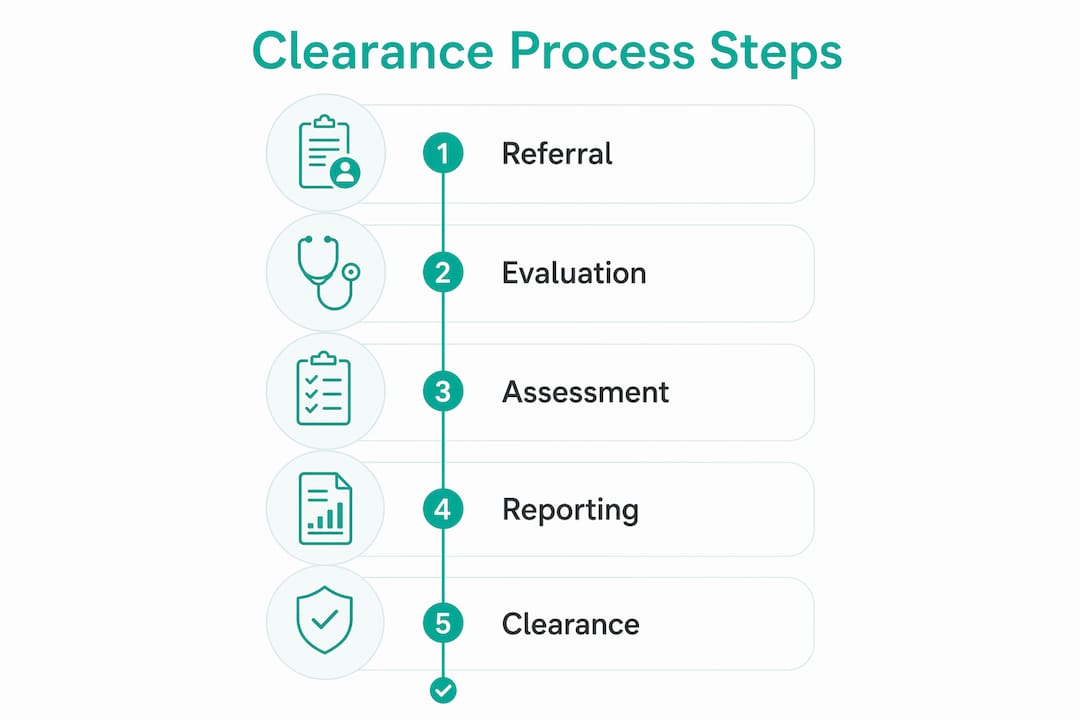
Bariatric surgery is not a passive procedure. It demands lifelong dietary changes, consistent follow-up, and the psychological resilience to navigate a body that changes rapidly and sometimes unpredictably. Clinical teams need to know, before the operating room, that you understand what you are agreeing to and that active risk factors are identified and addressed.
The core clinical goals are:
- Informed consent capacity: Can you understand the risks, benefits, and alternatives well enough to make a genuine decision?
- Adherence potential: Are there behavioral or psychiatric barriers to following the postoperative regimen, including dietary rules, supplement schedules, and follow-up appointments?
- Active risk identification: Is there active suicidality, uncontrolled substance use, or psychosis that would make surgery unsafe right now?
- Social support planning: Do you have the living situation and support network to recover safely?
The evidence base for evaluations is well-established as standard practice, though systematic reviews note that the predictive validity of preoperative psychosocial screening for long-term weight-loss outcomes is mixed. Many experts now call for targeted, standardized screening rather than one-size-fits-all gatekeeping. The field is moving toward assessing functional stability and capacity for self-care rather than categorical diagnoses.
Major insurers, including Medicaid programs in states like Illinois and Washington, require a completed psychosocial evaluation as part of preauthorization. Without it, surgery will not be approved regardless of your medical eligibility.
What do clinicians actually assess during the evaluation?
The evaluation covers eight core domains. Knowing what each one involves lets you prepare documentation and think through your answers before the appointment.
- Mental-health history and current symptoms: Your psychiatric diagnoses, past hospitalizations, current medications, and whether symptoms are stable. Clinicians use the PHQ-9 to screen for depression severity and the GAD-7 for anxiety. Stable, treated depression is not disqualifying; untreated, active symptoms that impair daily functioning are a different matter.
- Eating behaviors and eating-disorder screening: Binge eating, purging, night eating, and emotional eating patterns are assessed, often with the Eating Disorder Examination Questionnaire (EDE-Q). Uncontrolled binge-eating disorder may require targeted therapy before clearance because it directly affects post-op adherence.
- Substance use: The AUDIT screens for alcohol use disorder; the DAST covers drug use. Active, uncontrolled alcohol or drug use is a common reason for deferral, and many programs require documented sobriety of at least one year for alcohol specifically.
- Cognitive capacity and informed consent: Can you process and retain information about the procedure? Cognitive impairment that prevents genuine informed consent is a contraindication, though it is uncommon in most candidate populations.
- Motivation and expectations: Clinicians look for realistic expectations about weight loss and quality-of-life outcomes. Expecting surgery to resolve relationship problems or guarantee a specific clothing size raises flags; expecting meaningful health improvement with sustained effort does not.
- Coping skills and stress management: How do you handle setbacks, stress, and emotional discomfort? People who rely primarily on food for emotional regulation need a plan for alternative coping before surgery.
- Social support and living situation: Who will help you during recovery? Do you have a stable home environment? Isolation and lack of practical support are modifiable risk factors, not automatic disqualifiers.
- Readiness for behavior change: Are you already engaging with dietary changes, exercise, or behavioral health treatment? Demonstrated effort matters more than perfection.
Experts increasingly recommend shifting emphasis from categorical psychiatric diagnoses to functional stability and the patient's capacity for postoperative self-care. A diagnosis on paper matters far less than whether your symptoms are managed and you are engaged in treatment.
Who can perform the evaluation, and why does it matter?
Licensed psychologists (PhD or PsyD) and board-certified psychiatrists are the most broadly accepted evaluators across U.S. hospitals and major insurers. That said, some institutional and insurer policies explicitly require one of those two credential types and will not accept evaluations performed solely by LCSWs, LPCs, or nurse practitioners.
The credential distinctions matter in practice:
- Psychiatrists (MD/DO): Can prescribe medications, diagnose psychiatric conditions, and conduct the clinical interview. Widely accepted by virtually all programs.
- Licensed psychologists (PhD/PsyD): Specialize in formal psychological testing and structured assessment. The MMPI-2 and other broadband instruments are typically administered and interpreted by psychologists. Widely accepted.
- LCSWs and LPCs: Commonly provide therapy and may conduct clinical interviews, but some payors and hospital credentialing committees exclude them for standalone clearance evaluations. Accepted by some programs, rejected by others.
- Nurse practitioners and physician assistants: Less commonly accepted for standalone psychological clearance, even when they have behavioral health training.
Washington State's Medicaid program, for example, specifies that the comprehensive psychosocial evaluation must be performed by a psychiatrist, a licensed psychiatric ARNP, or a licensed independent social worker with at least two years of post-master's experience in a mental-health setting. Illinois Medicaid requires a licensed psychologist, psychiatrist, clinical social worker, or advanced practice nurse in collaboration with a co-signing psychiatrist. Those are two different standards from two neighboring programs.
Pro Tip: Before you schedule your evaluation, email your surgeon's office and your insurer and ask: "Which evaluator credentials do you accept for bariatric psychological clearance, and do you require a specific report format or wording?" Get the answer in writing. Credential mismatches are the most common fixable cause of repeat evaluations.

What actually happens at the evaluation appointment?
The evaluation typically follows an intake interview, one or more standardized screeners, and possibly broadband psychological testing. Here is the usual sequence:
- Scheduling and referral: Your surgical team or insurer provides a referral or a list of approved evaluators. Confirm the evaluator's credentials match your program's requirements before booking.
- Intake paperwork: You complete demographic and medical history forms, often including a medication list and a summary of current mental-health treatment.
- Clinical interview: The evaluator conducts a structured or semi-structured interview covering the eight domains above. This is the core of the evaluation and typically runs 60–90 minutes.
- Standardized screeners: You complete self-report questionnaires. Common instruments include:
- PHQ-9: Nine-item depression screener; scores above 10 indicate at least moderate depression.
- GAD-7: Seven-item anxiety screener.
- AUDIT: Ten-item alcohol use screener.
- DAST: Drug use screener.
- EDE-Q: Eating Disorder Examination Questionnaire, assessing binge eating and other disordered eating patterns.
- MMPI/MMPI-2: A broadband personality and psychopathology inventory used when the evaluator needs a more detailed psychological profile; not required by every program.
- Review of records: The evaluator may request prior therapy notes, psychiatric records, or medication documentation. Bring what you have; gaps are not automatically disqualifying.
- Feedback session: Some evaluators provide brief verbal feedback at the end of the appointment; others send the written report directly to your surgical team.
- Written report and transmission: The evaluator prepares a formal report and forwards it to your surgical team and insurer.
A single-session evaluation typically takes two to three hours. When formal psychological testing like the MMPI-2 is included, some programs schedule a separate testing session followed by a feedback appointment, extending the process to two or three visits over one to two weeks.
What findings delay or prevent clearance?
True absolute contraindications are rare. Most issues result in conditional clearance or deferment pending stabilization, not permanent denial.
The findings that most commonly delay clearance:
- Active psychosis: Symptoms that impair reality testing prevent genuine informed consent. Stabilization with psychiatric treatment is required before re-evaluation.
- Current severe suicidal ideation with intent or plan: Active suicidality is a safety contraindication. Stabilization and documented follow-up are required.
- Uncontrolled severe substance use disorder: Active alcohol or drug dependence increases surgical risk and impairs adherence. Most programs require documented sobriety, often six months to one year, with formal treatment engagement.
- Cognitive impairment preventing informed consent: When a candidate cannot retain or process information about the procedure, surgery is deferred until capacity is established or a supported decision-making plan is in place.
- Untreated severe eating disorders: Active, uncontrolled purging or binge-eating disorder that would directly interfere with post-op dietary requirements typically requires targeted treatment first.
Manageable issues that do not automatically block clearance include stable, treated depression or anxiety, a past substance use disorder in documented long-term remission, and a history of binge eating that is currently being addressed in therapy. What surgical teams look for is documented engagement in treatment and objective evidence of improvement, not a perfect psychiatric history.
Pro Tip: If you know you have an active issue, start treatment before your evaluation rather than waiting. Showing up with three months of therapy notes and a letter from your therapist documenting progress is far more useful than disclosing an untreated problem on the day of the appointment.
The evaluation's orientation is planning, not gatekeeping. Clinical consensus frames it as an opportunity to educate patients about postoperative challenges and to build a follow-up plan, not to permanently block access to surgery.
How are results reported, and what do insurers need?
Clearance outcomes are normally worded as cleared, cleared with conditions, or deferred pending further treatment. The term "denied" is rarely used as a final label without an accompanying remediation plan.
| Outcome | Typical report language | What it means operationally |
|---|---|---|
| Cleared | "Patient is psychologically cleared for bariatric surgery." | Surgery scheduling can proceed; no additional behavioral health requirements. |
| Conditionally cleared | "Patient is cleared pending completion of [X sessions of CBT / psychiatric stabilization / 6 months sobriety]." | Surgery is on hold until the stated condition is met and documented. |
| Deferred | "Recommend deferral pending further evaluation and treatment of [specific issue]." | Re-evaluation required after treatment; timeline depends on the issue. |
For insurance preauthorization, the report typically needs to include:
- Evaluator's full name, professional license type, and license number
- Formal letterhead with the evaluator's practice address and contact information
- Summary of findings across the core assessment domains
- Explicit clearance statement using language your insurer recognizes
- Recommended follow-up or conditions, if any
- Evaluator's signature and date
Reports are commonly considered valid for 6–12 months from the date of the evaluation, though this varies by program. If your surgery is delayed beyond that window, you may need a brief update letter or a new evaluation. Timing matters: completing the evaluation too early in the process can mean it expires before your insurer processes the prior authorization.
How to prepare for your evaluation appointment
Being transparent and bringing relevant documentation speeds the process and produces more useful recommendations than showing up with nothing and hoping for the best.
What to bring:
- Recent mental-health records (therapy notes, psychiatric evaluations, discharge summaries)
- Current medication list with dosages and prescribing clinicians
- Documentation of any current therapy, including session frequency and start date
- Prior neurocognitive or psychological testing, if any
- A brief written summary of your current symptoms and how they are being managed
- Contact information for your treating clinicians so the evaluator can communicate directly if needed
Three myths worth debunking:
- "You need a perfect mental-health history to be cleared." False. Most bariatric candidates have at least one lifetime mental-health diagnosis. The evaluation assesses stability and readiness, not a clean record.
- "Admitting past depression will disqualify you." False. Disclosing treated, stable depression with documented follow-up actually strengthens your case by showing self-awareness and engagement in care.
- "The evaluator is looking for reasons to say no." False. The process is designed to identify supports and plan follow-up, not to exclude candidates who have struggled.
Pro Tip: Request the specific clearance language your surgeon or insurer requires before your evaluation appointment. Bring it to the evaluator and ask them to use that exact wording in the report. This one step eliminates the most common reason evaluations have to be rewritten or supplemented.
For a full pre-op preparation checklist, the bariatric surgery consultation checklist from Weightlosssurgeryguide covers what to bring and ask at every preoperative appointment.

What happens if you're not immediately cleared?
Not being immediately cleared almost always leads to a defined remediation plan rather than a permanent denial. The evaluator specifies what needs to happen, and once you complete it, re-evaluation is straightforward.
Common remediation pathways and realistic timelines:
- Binge-eating disorder: Brief cognitive behavioral therapy (CBT), typically 6–12 sessions, with documented reduction in binge episodes. A useful sentence to request from your therapist: "Patient engaged in weekly CBT for 8 sessions with documented reduction in binge episodes and improved coping strategies."
- Alcohol or substance use: Eight to twelve weeks of demonstrated sobriety with outpatient substance-use treatment and regular attendance documentation. Some programs require six months to one year of sobriety for alcohol specifically.
- Mood disorder stabilization: Medication adjustment with a psychiatrist, documented follow-up appointments, and a letter confirming symptom stability over a defined period, typically two to three months minimum.
- Anxiety or PTSD: Engagement in evidence-based therapy (CBT, EMDR) with progress notes showing functional improvement.
For re-evaluation documentation, collect progress notes from your therapist or psychiatrist, a formal letter on letterhead with session counts and a functional improvement statement, and any objective screening scores (PHQ-9, GAD-7) showing improvement over time.
Administratively: submit the updated report to both your surgeon's office and your insurer promptly. Confirm whether re-evaluation must be performed by the original evaluator or whether your treating clinician's documentation is sufficient. Some programs accept a letter from the treating clinician; others require a formal re-evaluation by the original assessor or an equivalent credentialed evaluator.
Access to qualified behavioral health providers is not uniform across the U.S. Reimbursement for comprehensive psychological testing and feedback is inconsistent, and wait times for licensed psychologists can be long in rural areas. If access is a barrier, ask your surgical team whether telehealth evaluations are accepted and whether your insurer covers the cost of the evaluation itself.
What mental-health risks should you monitor after surgery?
The evaluation screens for postoperative risks as much as it assesses current readiness. Early detection and routine screening after surgery reduce downstream complications significantly.
Common postoperative mental-health concerns to watch for:
- Addiction transfer (cross-addiction): Some patients shift from food-related behaviors to alcohol, gambling, or other substances after surgery. The NCBI Bookshelf review notes that substance use screening post-op is a clinical priority, particularly for alcohol.
- Depression and suicidality: Depression can worsen or emerge after surgery, partly due to nutritional changes and the psychological adjustment to rapid body change. PHQ-9 screening at every follow-up visit is recommended.
- Eating disorders: Binge eating may return or new restrictive patterns may emerge. Weight trends and eating behavior should be monitored at each follow-up.
- Body image distress: Rapid weight loss does not automatically produce positive body image. Loose skin, identity shifts, and unmet expectations are common sources of distress.
Many programs recommend follow-up with a behavioral health provider within one to three months post-op, then at six and twelve months, then annually. Your post-operative bariatric care plan should include explicit mental-health check-ins, not just nutritional and surgical follow-up.
Emergency signs that require immediate contact with a provider: active suicidal thoughts, inability to keep any food or fluids down, severe depression lasting more than two weeks, or any return to substance use. Do not wait for a scheduled appointment.
How do policies vary across U.S. programs, and what if you use an international evaluator?
Policies and insurer rules vary more than most patients expect. Verify evaluator type and required report wording before you schedule an evaluation, especially if you plan to use an evaluator outside the U.S.
| Evaluator type | Typical U.S. acceptance |
|---|---|
| Licensed psychologist (PhD/PsyD) | Widely accepted by hospitals and major insurers |
| Board-certified psychiatrist (MD/DO) | Widely accepted by hospitals and major insurers |
| LCSW (licensed clinical social worker) | Accepted by some programs; rejected by others |
| LPC (licensed professional counselor) | Accepted by some programs; rejected by others |
| Nurse practitioner / physician assistant | Less commonly accepted for standalone clearance |
For patients considering care outside the U.S., the single most common administrative problem is a credential mismatch between the foreign evaluator and U.S. insurer or hospital requirements. Before you travel:
- Confirm acceptable evaluator credentials with your U.S. surgeon and insurer in writing, not by phone.
- Ask the international clinic for the evaluator's license name, number, and issuing authority.
- Confirm the report will be issued on formal letterhead with the evaluator's full credentials.
- Ask whether the evaluator will communicate directly with your U.S. surgical team if questions arise.
- Confirm whether your insurer requires an English-language report and whether translation or notarization is needed.
Some state Medicaid programs and private insurers explicitly exclude certain evaluator types by name. Verifying early, before you pay for an evaluation, is the only way to avoid paying for one that will not be accepted.
For U.S. patients planning surgery abroad, the weight loss surgery checklist for Americans from Weightlosssurgeryguide covers the full verification process, including how to confirm evaluator credentials across borders.
Key Takeaways
Mental health clearance for bariatric surgery is a clinical readiness assessment, not a gatekeeping process, and most candidates with stable, treated mental-health conditions are cleared or conditionally cleared with a defined plan.
| Point | Details |
|---|---|
| Most candidates are cleared | Clinical reviews confirm the majority receive unconditional or conditional clearance; a psychiatric history alone is not disqualifying. |
| Evaluator credentials matter | Licensed psychologists (PhD/PsyD) and board-certified psychiatrists are most widely accepted; verify your program's requirements before scheduling. |
| Reports have a validity window | Most programs consider clearance reports valid for 6–12 months; time your evaluation to align with your expected surgery date. |
| Deferral means a plan, not a door closed | Conditional clearance or deferral comes with a specific remediation path; completing it and documenting progress leads to re-evaluation. |
| Weightlosssurgeryguide resources | Use Weightlosssurgeryguide's verification tools and accreditation guides to confirm evaluator credentials and program standards before committing. |
The evaluation is a tool for you, not against you
Most people approaching a psychological evaluation for bariatric surgery carry some anxiety about it, and that anxiety usually rests on a misunderstanding of what the process is for. The goal is not to find a reason to say no. It is to understand where you are right now and to build a plan that gives your surgery the best possible chance of a safe, supported outcome.
Stable, treated depression, a history of anxiety, or past struggles with eating or substances do not close the door. What surgical teams look for is evidence that you understand what you are signing up for and that you are engaged in managing your health. Documented treatment, honest disclosure, and realistic expectations carry far more weight than a spotless psychiatric record.
The one piece of advice worth repeating: be honest in the evaluation. Evaluators are not looking for perfection. They are looking for self-awareness and a workable plan. Patients who disclose challenges and show they are actively addressing them tend to move through the process faster than those who present a curated version of themselves and then struggle post-operatively without the support that could have been planned in advance. The mental health benefits of weight loss are real and well-documented, and the evaluation exists to help you get there safely.
Planning international bariatric care? Verify your psychological evaluation first
If you are considering accredited international care, do not assume your U.S. insurer or U.S.-based surgical team will accept every foreign evaluator's report. That assumption is the most common administrative snag for medical tourists, and it is entirely avoidable.
Before you book anything, ask the international clinic three specific questions: What is the evaluator's license name, number, and issuing authority? Will the report be issued on formal letterhead with full credentials? Will the evaluator communicate directly with your U.S. surgical team if needed? Getting those answers in writing, before you travel, eliminates the credential mismatch that derails timelines.
Weightlosssurgeryguide provides a vetted directory of accredited facilities and surgeons in Tijuana, along with an ASMBS-aligned safety checklist specifically designed for U.S. patients considering international programs. For patients who want to verify a facility's accreditation standing before committing, the accreditation guide explains what JCI, SRC, and ISO credentials mean in practice. U.S. patients can save 60–75% compared to domestic costs while accessing internationally accredited care. Find an accredited surgeon and request a free personalized quote to get started.
This section is planning information only and is not medical advice. Confirm all credential and insurance requirements with your own surgical team and insurer before making any decisions.
Useful sources and authoritative resources
- Psychological Assessment of the Patient Undergoing Bariatric Surgery (PMC) — Peer-reviewed clinical review covering evaluation components, outcome categories, and the evidence base for preoperative psychological assessment.
- Psychiatric Complications of Bariatric Surgery (NCBI Bookshelf) — Comprehensive StatPearls review of pre- and postoperative psychiatric risks, screening tools, and management strategies.
- Mental Health Assessment and Psychosocial Interventions for Bariatric Surgery (NCBI Bookshelf) — Covers recommended screening instruments including PHQ-9, GAD-7, AUDIT, DAST, EDE-Q, and MMPI.
- Mental Health in Bariatric Surgery: Selection, Access, and Outcomes (Wiley) — Large cohort review reporting 57% preoperative mental-health diagnosis prevalence, and discussing predictive validity of evaluations.
- Psychiatric Evaluation and Follow-Up of Bariatric Surgery Patients (APA/Psychiatry Online) — APA-published review emphasizing the evaluation as a planning and educational tool and recommending postoperative follow-up cadence.
- Should Presurgical Psychological Evaluations Still Be Mandated? (ScienceDirect) — Critical review of predictive validity, access barriers, and the debate over standardized vs. targeted screening.
Disclaimer: This article is general educational information about the mental health clearance process for bariatric surgery in the United States. It is not medical advice, a clinical evaluation, or a substitute for consultation with a licensed healthcare provider. Confirm all requirements, credential standards, and insurance policies with your own surgical team, insurer, and qualified clinicians before making any decisions about your care.
Sources: See the Weightlosssurgeryguide evidence library for a full list of references and verification resources. For information about accredited facilities and surgeon credentials, visit the Obesity Control Center and CYNTAR.mx facility profiles linked through Weightlosssurgeryguide.
Recommended
- Bariatric Surgery Consultation Checklist: 2026 Guide | Weight Loss Surgery Guide
- Bariatric Surgery Candidacy Explained for 2026 | Weight Loss Surgery Guide
- Crossing the Border for Bariatric Surgery: 2026 Guide | Weight Loss Surgery Guide
- Weight Loss Surgery Checklist for Americans: 2026 Guide | Weight Loss Surgery Guide