Vertical Gastric Sleeve Complications: What Patients Need to Know
Published August 4, 2026
Vertical Gastric Sleeve Complications: What Patients Need to Know
Medically reviewed by the Weightlosssurgeryguide editorial team | Last reviewed: 2026
Vertical sleeve gastrectomy (VSG) carries an overall complication rate between 1% and 10%, with the most serious early risks being staple-line leak, hemorrhage, and thromboembolism, and the most common long-term concerns being GERD, nutritional deficiencies, and sleeve stenosis. Most patients do well. But "most" is not "all," and knowing what can go wrong, how often, and what it looks like is the difference between catching a problem early and ending up in the ICU.
Staple-line leaks occur in roughly 0.16% to 3% of cases, with the majority happening at the esophagogastric junction. Postoperative bleeding runs between 0.6% and 2.3%. Those ranges look small until you are the one in them.
Go to the ER immediately if you experience any of these after VSG:
- Severe or worsening abdominal pain, especially in the left shoulder or upper abdomen
- Heart rate above 120 beats per minute at rest
- Fever above 101°F (38.3°C)
- Uncontrolled vomiting or inability to keep down any liquids
- Vomiting blood or passing black, tarry stools
- Sudden shortness of breath or chest pain
- Leg swelling with pain or redness (possible deep vein thrombosis)
These are not symptoms to "wait and see" on. Call 911 or go directly to the nearest emergency room.
Table of Contents
- What does VSG actually do, and why do certain complications happen?
- Early complications of vertical sleeve gastrectomy (first 30 days)
- Late complications: what can happen months or years after surgery
- Who is at higher risk for complications?
- How are VSG complications diagnosed and treated?
- How to reduce your risk before and after surgery
- What should you realistically expect long-term after VSG?
- When to seek emergency care: symptoms that cannot wait
- Evidence summary: what the data actually shows
- Key Takeaways
- A surgeon's perspective on risk, consent, and follow-up
- Weightlosssurgeryguide: accredited providers and personalized support for U.S. patients
- Authoritative sources and further reading
What does VSG actually do, and why do certain complications happen?
VSG removes roughly 75–80% of the stomach, leaving a narrow, tube-shaped pouch. Weight loss follows two main mechanisms: physical restriction of food volume and a significant reduction in ghrelin, the hunger-signaling hormone produced primarily in the fundus of the stomach, which is the portion removed. Understanding how bariatric surgery causes weight loss helps explain why certain complications are specific to this anatomy.
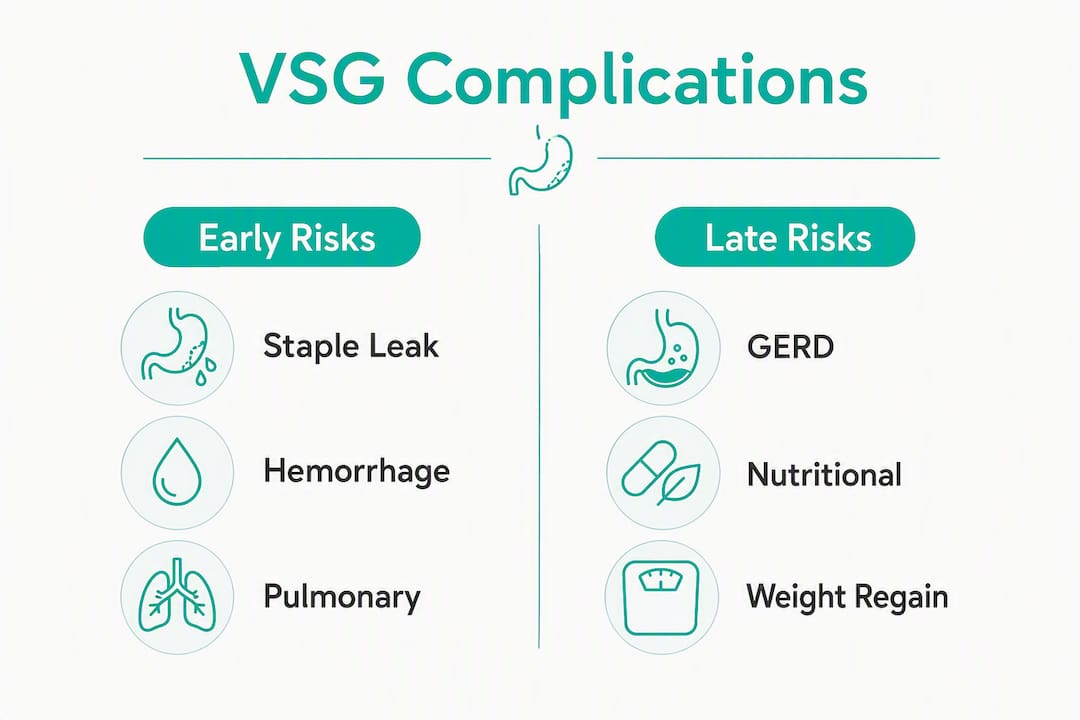
Unlike Roux-en-Y gastric bypass, VSG does not create an intestinal anastomosis, which eliminates the risk of anastomotic leak at a bowel connection. That is a genuine advantage. The trade-off is that VSG concentrates all of its mechanical and vascular stress along a single long staple line, particularly at the esophagogastric junction (EGJ). Division of the short gastric vessels during sleeve creation reduces blood supply to that area, making it the most ischemia-prone point on the staple line and the site where most leaks originate. Increased intragastric pressure in the narrow tube also pushes against that junction constantly, especially if the sleeve is fashioned too tightly.
Early complications of vertical sleeve gastrectomy (first 30 days)
The first month after surgery is when the most acute and life-threatening complications occur. Recognizing them fast is what determines whether they are managed with a scope or a second operation.

Hemorrhage
Bleeding after VSG is either intraluminal (inside the sleeve, presenting as blood in the drain or melena) or extraluminal (intraabdominal, from the staple line or adjacent organs). Postoperative bleeding occurs in a small percentage of cases. Tachycardia, dropping hemoglobin on labs, and abdominal pain are the classic triad. Management ranges from observation and transfusion for minor bleeds to endoscopic hemostasis or reoperation for significant hemorrhage.
Staple-line leak
A leak is the complication surgeons fear most. The staple line fails, gastric contents spill into the abdominal cavity, and sepsis can develop within hours. Most leaks occur at the EGJ because of the relative ischemia created when the short gastric vessels are divided. Symptoms include persistent tachycardia (often the earliest sign), left shoulder pain from diaphragmatic irritation, fever, and abdominal pain. Diagnosis is confirmed with CT scan using oral and IV contrast or an upper GI swallow study.
Treatment depends on timing and severity:
- Acute leaks (within 1–3 days): Usually require reoperation for washout and drainage.
- Early leaks (4–7 days): Often managed with percutaneous drainage, IV antibiotics, and endoscopic stenting.
- Intermediate or chronic leaks: Endoscopic management, including stents, internal drainage, and direct closure, heals many leaks without reoperation in experienced hands, with reported success rates commonly in the 70–90% range for selected cases.
Pro Tip: Persistent tachycardia after VSG, even without fever or obvious pain, is a leak until proven otherwise. Do not wait for fever to develop before calling your surgeon or going to the ER. Early imaging changes outcomes.
Pulmonary complications and thromboembolism
Pulmonary embolism (PE) and deep vein thrombosis (DVT) are among the most preventable causes of death after bariatric surgery. Patients with higher BMI, limited mobility, or prior clotting history carry elevated risk. Standard prevention includes early ambulation, sequential compression devices, and pharmacologic anticoagulation per your center's protocol. Shortness of breath, chest pain, or unilateral leg swelling after discharge demands immediate evaluation.
Pulmonary complications also include atelectasis and pneumonia, particularly in patients with obstructive sleep apnea. Incentive spirometry in the first 48 hours reduces this risk substantially.
Wound infection and abscess
Superficial surgical-site infections occur in a small percentage of cases and are usually managed with antibiotics and local wound care. Intraabdominal abscesses, often a sequela of a contained leak, require CT-guided percutaneous drainage and prolonged antibiotic therapy.
Early complication incidence at a glance
| Complication | Reported Incidence Range | Primary Source |
|---|---|---|
| Staple-line leak | 0.16%–3% | PMC / MBSAQIP data |
| Postoperative bleeding | 0.6%–2.3% | StatPearls |
| Overall complication rate | 1%–10% | StatPearls |
| Portal/mesenteric venous thrombosis | around 0.3% | MDPI review |
Late complications: what can happen months or years after surgery
Early complications get most of the attention, but the long-term effects of gastric sleeve surgery shape quality of life for years. Some are manageable with medication; others eventually require revision surgery.
GERD and worsening reflux
GERD is the most common late complication of VSG, and it catches many patients off guard. The narrow, high-pressure sleeve reduces the angle of His, impairs the lower esophageal sphincter, and accelerates gastric emptying, all of which promote acid reflux. Patients who had mild reflux before surgery often see it worsen significantly. Pre-existing moderate-to-severe GERD is frequently considered a relative contraindication to VSG for this reason; many centers favor gastric bypass for reflux-dominant patients.

Management starts with proton pump inhibitors (PPIs) and dietary modification. When reflux is severe, persistent, or causing esophageal injury, conversion to Roux-en-Y gastric bypass (RYGB) is the definitive solution. This is one of the most common reasons patients eventually need revision surgery after bariatric procedures.
Sleeve stenosis and stricture
A sleeve that is fashioned too tightly, or that heals with excessive scarring, can narrow to the point where solid food, and eventually liquids, will not pass. Patients present with progressive dysphagia and vomiting, typically weeks to months after surgery. Diagnosis is made with an upper GI swallow study or endoscopy.
Treatment follows a stepwise path: endoscopic balloon dilation is first-line, but chronic stenosis typically requires multiple sessions. When dilation fails repeatedly, laparoscopic seromyotomy or conversion to RYGB becomes necessary. Bougie size and stapling technique during the original procedure are the primary technical factors that determine stenosis risk.
Nutritional deficiencies
VSG is a restrictive procedure, not a malabsorptive one, but reduced food intake and altered eating patterns still create meaningful deficiency risk over time. Iron, vitamin B12, vitamin D, and folate are the most commonly affected. Iron deficiency is particularly common in premenopausal women. Without consistent supplementation and lab monitoring, these deficiencies progress silently.
A structured bariatric nutrition plan and regular blood work at 3, 6, and 12 months, then annually, are non-negotiable parts of post-op care. The partner resource from Just Move Supplements on post-surgery protein and nutrition covers practical supplementation strategies worth reviewing.
Gallstones
Rapid weight loss after bariatric surgery increases gallstone formation risk. Bile becomes supersaturated with cholesterol during rapid fat mobilization, and gallstones can form within months of surgery. Some surgeons recommend prophylactic ursodiol (Actigall) for the first 6 months post-op; others discuss prophylactic cholecystectomy in patients with pre-existing gallbladder disease. Ask your surgeon about their protocol before your procedure.
Adhesions, internal hernias, and bowel obstruction
VSG does not involve intestinal rerouting, so internal hernia risk is lower than with gastric bypass. Adhesions from any abdominal surgery can still cause small bowel obstruction over time, presenting as crampy abdominal pain, nausea, and vomiting. These cases require prompt evaluation and sometimes surgical intervention.
Weight regain and sleeve dilation
The sleeve can dilate over years, particularly with consistent overeating. Weight regain is common in the 3–5 year range and is not always a sign of surgical failure; it often reflects behavioral and metabolic factors. Revisional options include re-sleeve or conversion to RYGB or duodenal switch, depending on the clinical picture.
Pro Tip: If you are experiencing new or worsening reflux more than 6 months after VSG, get an upper endoscopy. Chronic, untreated reflux after sleeve surgery can progress to Barrett's esophagus, a precancerous condition. Early detection matters.
Who is at higher risk for complications?
Not every patient faces the same odds. Several factors, both patient-related and surgical, shift the risk profile meaningfully.
Patient-level risk factors
- Higher BMI at time of surgery: Increases operative difficulty and cardiopulmonary stress.
- Poorly controlled type 2 diabetes: Impairs wound healing and immune response.
- Cardiovascular disease or hypertension: Raises anesthetic and hemodynamic risk.
- Chronic kidney disease: Affects fluid management and drug clearance.
- Active anticoagulant use: Increases bleeding risk; requires careful perioperative bridging.
- Current smoking: Reduces tissue oxygenation and significantly increases leak and pulmonary complication risk.
- Obstructive sleep apnea (uncontrolled): Raises pulmonary complication risk post-extubation.
- Poor functional status or limited mobility: Increases DVT and PE risk.
Surgical and technical risk factors
Technical choices during VSG directly affect leak and stenosis rates. Smaller bougie sizes create a tighter sleeve with higher intraluminal pressure, increasing both leak and stricture risk. Stapling too close to the EGJ concentrates ischemic stress at the most vulnerable point. Lack of staple-line reinforcement (oversewing or buttressing material) may increase bleeding risk in some series.
Surgeon experience and center volume matter in ways that are hard to overstate. Systematic reviews show leak incidence falls as surgeon experience grows, and MBSAQIP registry data from 189,477 sleeve gastrectomy cases reported leak rates below 1%, reflecting the aggregate performance of high-volume accredited centers.
Pre-op conversation checklist
Before surgery, ask your team:
- What is your personal leak rate and overall complication rate for VSG?
- What bougie size do you use, and why?
- Do you reinforce the staple line, and with what technique?
- What is your protocol for DVT prophylaxis?
- How do you manage GERD in VSG patients, and what is your threshold for recommending bypass instead?
- What is your center's volume for bariatric procedures annually?
How are VSG complications diagnosed and treated?
Diagnostic tools
- CT scan with oral and IV contrast: First-line for suspected leak, abscess, or bleeding. Identifies fluid collections, contrast extravasation, and vascular complications.
- Upper GI swallow study: Useful for leak confirmation and for diagnosing stenosis or stricture.
- Endoscopy: Directly visualizes the staple line, identifies intraluminal bleeding, and allows therapeutic intervention (stenting, dilation, hemostasis).
- Labs (CBC, CMP, lactate, CRP): Tachycardia with rising white count and lactate is a sepsis signal that should trigger immediate imaging.
- Ultrasound: Useful for gallstone evaluation and DVT workup.
Treatment pathways
- Suspected staple-line leak: Resuscitate with IV fluids and antibiotics. Order CT with oral contrast. If stable with a contained collection, proceed to percutaneous drainage plus endoscopic stenting. If hemodynamically unstable or peritonitic, take to the operating room for washout and drainage.
- Postoperative hemorrhage: Assess hemodynamic stability. Minor bleeds: transfuse and observe. Significant intraluminal bleeding: endoscopic hemostasis. Intraabdominal hemorrhage with instability: reoperation.
- Sleeve stenosis: Start with endoscopic balloon dilation. Repeat as needed. Refractory cases: laparoscopic seromyotomy or conversion to RYGB.
- Pulmonary embolism: Anticoagulation (heparin bridge to warfarin or direct oral anticoagulant). Massive PE with hemodynamic compromise: interventional radiology or surgical embolectomy.
- Intraabdominal abscess: CT-guided percutaneous drainage plus prolonged antibiotics. Surgical drainage if percutaneous access is not feasible.
Multidisciplinary care is not optional for serious complications. Interventional radiology, GI endoscopy, critical care, and the bariatric surgical team need to communicate in real time. Centers that lack this infrastructure should transfer unstable patients promptly.
How to reduce your risk before and after surgery
Pre-op optimization checklist
- Stop smoking at least 4–6 weeks before surgery. Smoking is one of the most modifiable risk factors for leak and pulmonary complications.
- Optimize glycemic control. Target HbA1c below 8% before elective bariatric surgery; tighter control is better.
- Review all medications with your surgeon and anesthesiologist, particularly anticoagulants, NSAIDs, and diabetes medications that require dose adjustment post-op.
- Complete a nutritional assessment. Correct pre-existing iron, B12, or vitamin D deficiencies before surgery.
- Follow any pre-op weight-loss diet your surgeon prescribes. Liver reduction diets reduce operative difficulty and complication risk.
- Treat obstructive sleep apnea and bring your CPAP to the hospital.
- Confirm vaccination status (influenza, pneumococcal) if your center recommends it.
Post-op care checklist
- Ambulate within hours of surgery. Early walking is the single most effective DVT prevention measure.
- Use incentive spirometry every hour while awake for the first 48 hours.
- Follow the prescribed liquid-to-soft-food progression exactly. Advancing too fast stresses the staple line.
- Take all prescribed supplements from day one: a multivitamin, calcium citrate, vitamin D, and iron if indicated.
- Attend every follow-up appointment: typically at 2 weeks, 6 weeks, 3 months, 6 months, and 12 months, then annually.
- Get labs at each visit: CBC, comprehensive metabolic panel, iron studies, B12, vitamin D, and PTH annually.
- Report symptoms immediately: do not wait for a scheduled appointment if something feels wrong.
Pro Tip: Set a phone reminder for your supplement schedule from the day you get home. Adherence to supplementation in the first year is the strongest predictor of avoiding nutritional deficiencies at the 3-year mark. Consistent post-operative bariatric care is not optional.
What should you realistically expect long-term after VSG?
Most patients who undergo uncomplicated VSG lose 60–70% of their excess body weight within 12–18 months. Comorbidities, including type 2 diabetes, hypertension, and sleep apnea, often improve or resolve within the first year. Complications, when they occur, can delay this trajectory and occasionally require additional procedures.
A rough timeline of what patients typically experience
- First month: Liquid and soft diet, fatigue, incision soreness, and adjustment to dramatically smaller portions. This is when acute complications are most likely.
- Months 1–6: Rapid weight loss phase. Highest risk for gallstone formation and nutritional deficiencies if supplements are skipped. Energy improves steadily.
- Months 6–12: Weight loss continues but slows. GERD symptoms, if present, are usually apparent by now. Sleeve stenosis typically presents in this window.
- Years 1–3: Weight stabilization. Some patients begin to see weight regain. Long-term GERD management and annual lab monitoring become the focus.
- Beyond 3 years: A subset of patients experience meaningful weight regain or worsening reflux requiring revisional evaluation. Lifelong supplementation and annual follow-up remain necessary for all patients.
Patients who develop chronic GERD after VSG need periodic upper endoscopy to screen for Barrett's esophagus. This is not alarmist; it is standard surveillance for anyone with persistent reflux and a history of sleeve surgery.
When to seek emergency care: symptoms that cannot wait
Some symptoms after VSG are inconvenient. These are not.
Go to the ER or call 911 immediately for:
- Severe abdominal pain, especially in the upper left abdomen or radiating to the left shoulder
- Resting heart rate above 120 bpm
- Fever above 101°F (38.3°C) within the first 30 days
- Vomiting blood or passing black, tarry stools
- Inability to keep down any liquid for more than 4–6 hours
- Sudden shortness of breath or chest tightness
- One leg significantly more swollen, red, or painful than the other
- Confusion, extreme fatigue, or feeling faint
Persistent tachycardia alone, even without pain or fever, is enough to warrant an ER visit in the first two weeks. Leak-related sepsis can develop rapidly, and the window for less invasive management closes fast.
This article provides general educational information. It is not a substitute for professional medical advice. Always consult your surgeon or a qualified healthcare provider about your specific situation.
Evidence summary: what the data actually shows
The reported incidence of VSG complications varies considerably across data sources, and understanding why helps patients interpret the numbers they encounter.
| Complication | Incidence Range | Data Source |
|---|---|---|
| Overall complication rate | 1%–10% | StatPearls / systematic reviews |
| Staple-line leak | 0.16%–3% | MBSAQIP registry / PMC review |
| Postoperative bleeding | 0.6%–2.3% | StatPearls |
| Leak rate (systematic review) | ~2.2% | PMC perioperative review |
| Leak rate (MBSAQIP registry, 189,477 cases) | <1% | MDPI rare complications review |
| Portal/mesenteric venous thrombosis | around 0.3% | MDPI rare complications review |
The gap between the MBSAQIP registry figure (<1% leak rate across nearly 190,000 cases) and the upper end of single-center series (up to 3%) reflects two realities: registry data aggregates high-volume, accredited centers with standardized reporting, while smaller series may include centers earlier on the learning curve or with different patient populations. Neither number is wrong; they describe different practice environments.
Rare but serious complications, including portal vein thrombosis, splenic infarct, and staple-line malformations, each occur in fewer than 1% of cases but require prompt recognition and multidisciplinary management. Intraoperative staple-line malformations, when recognized immediately, can be corrected with oversewing or resection of the affected segment, which substantially reduces downstream morbidity.
The bariatric surgery complications overview on Weightlosssurgeryguide provides additional context on how these rates compare across procedure types.
Key Takeaways
Vertical sleeve gastrectomy carries a low overall complication rate, with the most dangerous early risk being staple-line leak and the most common long-term concern being GERD, which can require conversion to gastric bypass if severe.
| Point | Details |
|---|---|
| Leak is the most dangerous early risk | Staple-line leak occurs in 0.16%–3% of cases; up to 90% happen at the esophagogastric junction. |
| Tachycardia is the first leak warning sign | Persistent heart rate above 120 bpm after VSG warrants immediate imaging, even without fever. |
| GERD often worsens long-term | Reflux is the most common late complication and may require conversion to Roux-en-Y gastric bypass. |
| Lifelong supplements are required | Iron, B12, and vitamin D deficiencies develop silently without consistent supplementation and annual labs. |
| Weightlosssurgeryguide provider matching | Weightlosssurgeryguide connects U.S. patients with accredited, high-volume bariatric centers in Tijuana where surgeon experience directly lowers complication rates. |
A surgeon's perspective on risk, consent, and follow-up
Most patients who ask about VSG complications are not looking for reassurance. They want the honest version. Here it is.
The consent conversation for VSG is not about listing rare events to satisfy a legal requirement. It is about calibrating expectations so that when something feels off at day 5, the patient calls instead of waiting. The single biggest contributor to poor outcomes after sleeve gastrectomy is not the complication itself; it is delayed recognition. A leak caught at 48 hours is a very different clinical situation from one caught at day 10.
What surgeons emphasize in that conversation: leak prevention starts in the operating room with technique, bougie selection, and staple-line management, but it continues at home with the patient knowing what tachycardia means. Reflux counseling matters because GERD after VSG is not a minor inconvenience for a subset of patients; it is a structural consequence of the anatomy that requires active management and, in some cases, a second procedure. And long-term follow-up is not optional. The patients who do best at five years are the ones who showed up at every annual visit, kept their labs current, and adjusted their supplements when the numbers drifted.
The benefit-to-risk calculus for VSG is genuinely favorable for most patients. Obesity carries its own serious long-term risks, and VSG addresses them effectively. But "favorable" does not mean "trivial." Choosing an accredited, high-volume center with a structured follow-up program is the most concrete risk-reduction step a patient can take before the operation even begins.
Weightlosssurgeryguide: accredited providers and personalized support for U.S. patients
U.S. patients who want VSG performed at a high-volume, internationally accredited center, without the $20,000–$30,000 domestic price tag, have a concrete option. Weightlosssurgeryguide connects patients with vetted bariatric surgeons and hospitals in Tijuana, Mexico, where JCI and SRC-accredited facilities perform sleeve gastrectomy at 60–75% lower cost than U.S. providers, with the same structured follow-up protocols that drive the low complication rates seen in MBSAQIP registry data.
The site's provider directory lets you filter by accreditation, procedure type, and surgeon volume. The accreditation guide explains exactly what JCI and SRC certification means for patient safety, so you are not taking anyone's word for it. For patients who want to verify the evidence behind any claim on the site, the evidence library links directly to the primary studies.
When you are ready to move from research to a real conversation, request a free personalized quote through the provider directory. A patient coordinator will match you with surgeons whose volume, technique, and complication data align with what you have read here.
This section describes the services offered by Weightlosssurgeryguide. It is promotional in nature. All medical decisions should be made in consultation with a qualified bariatric surgeon.
Authoritative sources and further reading
- Bariatric Surgery Complications, StatPearls, NCBI Bookshelf: Comprehensive clinical overview of VSG and bypass complications, including incidence ranges for bleeding and overall complication rates.
- Diagnosis and Management of Postoperative Complications After Sleeve Gastrectomy, NCBI Bookshelf: Detailed clinical reference on technical contributors to leak and stenosis, diagnostic workup, and treatment pathways.
- Gastrointestinal Complications After Bariatric Surgery, PMC: Peer-reviewed review covering leak incidence, EGJ anatomy, and management strategies.
- Perioperative Complications of Sleeve Gastrectomy: Review of the Literature, PMC: Systematic review reporting ~2.2% leak rate and the impact of surgeon experience on outcomes.
- Sleeve Gastrectomy, StatPearls, NCBI: Procedure-level reference with bleeding incidence data and technical considerations.
- Rare Complications Following Laparoscopic Sleeve Gastrectomy, MDPI: Documents portal vein thrombosis, staple-line malformations, and MBSAQIP registry leak data.
- Vertical Sleeve Gastrectomy, MedlinePlus Medical Encyclopedia: NIH patient-facing overview covering gallstone risk, lifestyle requirements, and post-op expectations.
- Weightlosssurgeryguide Evidence Library: Site-specific primary-source library for readers who want to verify claims and access study summaries.
- ASMBS Medical Tourism Bariatric Surgery Safety Checklist: ASMBS-aligned safety checklist for patients considering surgery outside the U.S.
- Gastric Sleeve Complication Rates in Mexico, Weightlosssurgeryguide: Country-specific complication rate analysis for U.S. and Canadian patients researching Mexico-based surgery options.
Recommended
- Bariatric Surgery Complications: Awareness Guide 2026 | Weight Loss Surgery Guide
- Gastric Sleeve Complication Rates in Mexico: 2026 Guide | Weight Loss Surgery Guide
- Post-Operative Bariatric Care: What Patients Need to Know | Weight Loss Surgery Guide
- Gastric Sleeve Outcomes Mexico: What the Data Shows | Weight Loss Surgery Guide