4 Safety Verified Recovery Hotels in Tijuana for U.S. Patients
Published September 22, 2026

4 Safety Verified Recovery Hotels in Tijuana for U.S. Patients
The strongest post-surgical recovery hotels in Tijuana right now are Zen & Healthy Recovery, Grand Care at Grand Hotel Tijuana, Bella Recovery House, and Cocoon. Before booking any of them, confirm two things in writing: REPSABI or COEPRIS registration and a documented 24/7 certified nursing schedule. Also make sure you're booking a post-op recovery hotel, not an addiction rehab center. The two are confused constantly, and they serve completely different patients.
TL;DR:
- Recovery hotels in Tijuana must be verified for REPSABI or COEPRIS registration and a documented, 24/7 certified nursing schedule before booking.
- Facilities like Grand Care and Cocoon provide detailed medical monitoring, including vitals checks every four hours and on-site pharmacy access, which are essential for safety.
- Clear, written plans for medication management, pain control, and emergency transfers are crucial to ensure proper post-operative care and quick response if complications arise.
- Most recovery stays last between three and five nights, with longer-term options available for extended supervision, but prices and included services vary widely and should be itemized upfront.
Table of Contents
- What Are the Best Recovery Hotels for Post-Surgery Care in Tijuana?
- Practical Profiles: What Each Recommended Recovery Hotel Includes
- How to Verify Safety and Accreditation in Mexico
- Getting Picked Up and Getting Home After Surgery
- What to Confirm Before You Book
- How Long Does Recovery Take, and What Should It Cost?
- Do Patient Reviews Actually Tell You Anything Useful?
- Comparing Pricing Packages and Insurance Acceptance
- What Medical Equipment and Therapies Are Available On-Site?
- Why Proximity to a Hospital Matters More Than It Seems
- Comfort Amenities: Nutrition and Physical Therapy Support
- Our Take on Choosing a Recovery Hotel
- Get Help Verifying Your Recovery Stay Before You Book
- Sources
- FAQ
What Are the Best Recovery Hotels for Post-Surgery Care in Tijuana?
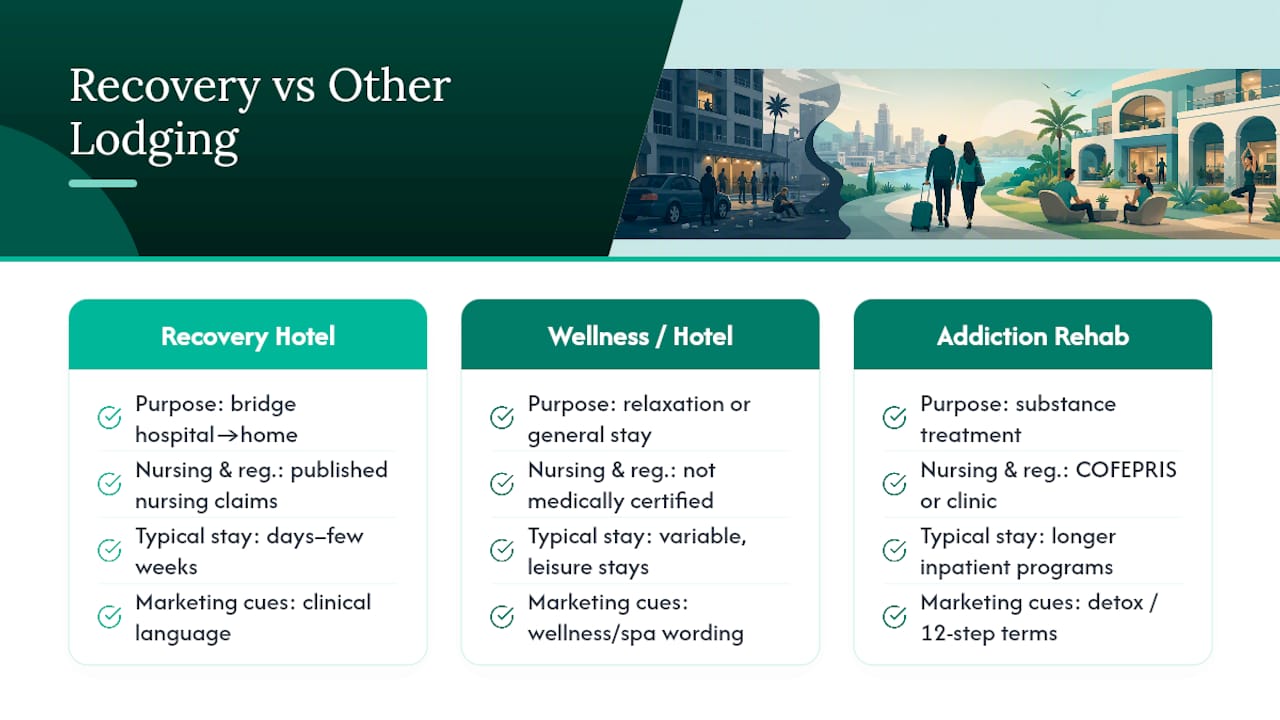
Searching "hoteles recuperación tijuana" turns up a mix of hospitality-style recovery hotels, small registered recovery houses, and assisted-living operators. The distinction matters because they're built for different needs. A recovery hotel bridges the gap between hospital discharge and a normal flight home. It's built around nursing coverage, vitals checks, and a controlled environment where a surgical patient can heal for a few days to a couple of weeks without hospital-level intensity.
That's different from a Tijuana wellness retreat or a general-purpose hotel stay, and it's very different from an addiction recovery lodging. If a facility's marketing leans on words like "detox," "sobriety," or "12-step," you're looking at a rehab center, not a post-surgical recovery option. Clínica Baja del Sol, for example, is a COFEPRIS-certified inpatient rehabilitation center that offers private shuttle service from San Diego or the San Ysidro border crossing. It does excellent work for addiction treatment, but it isn't built for someone three days out from a gastric sleeve.
The facilities below made the shortlist because they publish specific, checkable claims about nursing, registration, and room features rather than vague wellness language. That's the bar for anyone comparing best rehab centers Tijuana searches often surface alongside actual post-op recovery lodging. Confirm the distinction early, because it changes what questions you should ask staff on arrival.
Practical Profiles: What Each Recommended Recovery Hotel Includes
Here's how the leading options break down on the details that actually affect your recovery.
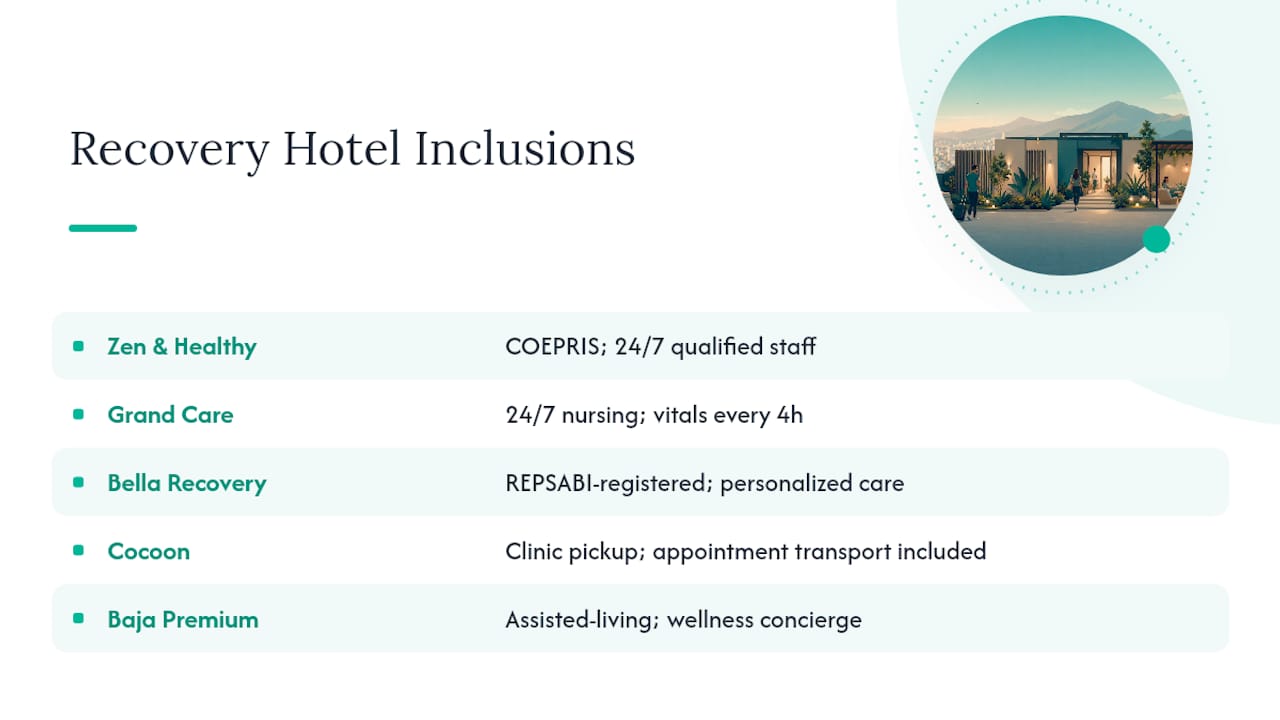
Zen & Healthy Recovery positions itself as an early post-surgical recovery hotel and advertises COEPRIS compliance and 24/7 qualified personnel. It's best for patients who want a recovery-focused stay near Tijuana's medical tourism district without the extras of a resort-style package.
Grand Care, the medical recovery program at Grand Hotel Tijuana, is the most documented option on paper. It lists 24/7 certified nursing, vitals taken every four hours, daily medical visits, in-room adjustable beds, and an on-site pharmacy. That level of published detail is what a family member checking on a patient from another country actually wants to see. Best for patients who want hotel-style comfort paired with a defined medical monitoring schedule.
Bella Recovery House states it carries REPSABI registration granted by the State Commission for the Protection Against Sanitary Risks of Baja California, and it emphasizes personalized, small-scale care. Best for patients who prefer a house-sized setting over a hotel-sized one.
Cocoon builds clinic pickup and local appointment transport into its packages, which removes a genuine logistical headache for someone flying in solo. Best for patients who want transport handled without arranging a separate car service.
Baja Premium runs more like an assisted-living community with wellness concierge services, aimed at longer-term post-op supervision rather than a short surgical recovery window. Best for patients who need extended supervision beyond the typical week.
Before you commit to any of these, ask for the facility's registration number and a written sample of its daily care plan. A facility that hesitates to produce either is telling you something.
How to Verify Safety and Accreditation in Mexico
COEPRIS is Mexico's federal sanitary risk protection agency; COEPRIS BC is its Baja California branch, and REPSABI is the state-level registration it grants to health service providers, including recovery houses. For a post-op recovery facility, REPSABI registration is one of the clearest signals you're dealing with a legitimate, inspected operation rather than a converted guesthouse calling itself a "recovery center."
Beyond registration, check these operational points directly with staff:
- 24/7 certified nursing — ask who is on shift overnight and what their credentials are.
- Vitals monitoring frequency — Grand Care's model of checks every four hours is a useful benchmark to compare against.
- Daily physician visits — confirm a doctor, not just a nurse, sees the patient each day.
- Wound care protocol — ask exactly who changes dressings and how often.
- Pharmacy access or hospital partnership — an on-site pharmacy or a named partner hospital matters if medication needs change overnight.
- Emergency transfer plan — get the name of the partner hospital and the estimated transfer time.
Ask for three documents before booking: a copy of the facility's registration, proof of nursing certifications, and a written sample daily-care schedule. Each one proves something different, and together they tell you whether the facility can back up its marketing. For more on checking accompaniment and nursing coverage specifically, the breakdown of 24/7 nursing verification walks through the exact questions to ask by phone before you fly.
Pro Tip: Call the facility and ask directly for their REPSABI registration number, then note it down. You can cross-check it with COEPRIS BC or the local health commission before you commit to a deposit.
Getting Picked Up and Getting Home After Surgery
Transport logistics trip up more patients than the surgery itself. Some recovery hotels, like Cocoon, build clinic-to-facility pickup and local appointment trips directly into their packages, which matters if you're traveling without a companion. Others expect you to arrange your own transport between the hospital, the recovery facility, and the border.
Ask specifically whether pickup from the surgical hospital is included, whether follow-up appointment transport is covered, and whether airport or border drop-off is part of the package. If it isn't, budget for a local car service and get the facility's recommendation, since staff usually know which drivers are reliable for post-op patients who can't sit upright comfortably for long stretches.
The border crossing itself deserves its own planning. Mexico introduced streamlined re-entry documentation for medical tourism patients, and Weight Loss Surgery Guide's guide to the June 2026 QR Pass covers what paperwork to carry and how to time the crossing so a recovering patient isn't standing in a long pedestrian line. Plan the crossing for a low-traffic window, and confirm your recovery facility can arrange transport to the border rather than just to a taxi stand nearby.
What to Confirm Before You Book
Three things need to be nailed down before you send a deposit: medications, the pain management plan, and who gets called in an emergency.
On medications, ask exactly what the facility stocks on-site versus what you need to bring from home or fill locally. A facility with an in-house pharmacy or a direct hospital partnership can resolve a medication gap same-day; one without either option leaves you scrambling.
On pain management, insist on a written plan before arrival, not a verbal assurance. A clear written pain plan with a named nurse responsible for administering medication reduces the chance of missed doses, which is a real risk when patients are groggy and communicating in a second language.
On emergencies, get the name of the partner hospital, the estimated transfer time, and who at the facility is authorized to make that call. Also confirm who they'll contact on your behalf, a spouse, a sibling, whoever you name, and make sure that person has the facility's direct phone number, not just an email address.
How Long Does Recovery Take, and What Should It Cost?
Recovery hotel stays typically run anywhere from three days to two weeks depending on the procedure. A gastric sleeve patient might need three to five nights of monitored recovery before flying home, while a more involved procedure or a combined bariatric and plastic surgery case can push that toward ten days or longer.
Pricing varies by facility and by how much is bundled in. Some recovery hotels charge a flat nightly rate covering nursing, meals, and basic monitoring; others price transport, wound care supplies, or physician visits separately. Get an itemized quote before booking so you're not surprised by add-on charges for something you assumed was included, like extra vitals checks or a second daily physician visit.
Extended-stay options like Baja Premium price differently again, since their model assumes weeks rather than days. If your surgeon's aftercare plan calls for a longer supervised recovery, that pricing structure may fit better than a standard recovery hotel's nightly rate.
Do Patient Reviews Actually Tell You Anything Useful?
Reviews are useful for spotting patterns, not for making the final call. A facility with consistent mentions of responsive nursing staff and clear communication is worth more than one with a high star rating and no specifics in the comments. Read for whether reviewers mention actual medical details, wound care, medication timing, doctor visits, rather than only comfort and hospitality.
Be skeptical of reviews that read like they were written by staff or that praise the facility in vague terms without naming anything a real patient would notice. Cross-reference what reviewers say against the written documents you requested during your own verification calls; if a facility claims daily physician visits but reviewers never mention seeing a doctor, that's worth a follow-up question before you book.
Comparing Pricing Packages and Insurance Acceptance
Most Tijuana recovery hotels operate on a self-pay model, and few accept U.S. or Canadian insurance directly. Some facilities will provide itemized invoices you can submit to your insurer for partial reimbursement, particularly if your policy covers post-surgical care abroad, but confirm this before you travel rather than assuming it.
Package structures differ meaningfully. All-inclusive models, like Cocoon's, roll transport, meals, and medical monitoring into one price. Others price nursing hours and room rate separately, then add wound care or physician visits as line items. Ask for a full breakdown in writing so you can compare facilities on equal footing rather than comparing a headline nightly rate that hides what's actually included.
What Medical Equipment and Therapies Are Available On-Site?
Equipment availability varies widely by facility type. Hotel-based programs like Grand Care list adjustable beds and vitals monitoring equipment as standard. Smaller recovery houses may have more limited on-site equipment and rely on a partner clinic or hospital for anything beyond basic monitoring.
If your recovery plan includes physical therapy, compression therapy, or specialized wound care technology, ask directly whether that's available on-site or requires a separate trip to a clinic. Don't assume a facility offers a service just because it's common in the industry; get it confirmed in writing alongside the daily-care schedule you're already requesting.
Why Proximity to a Hospital Matters More Than It Seems
Distance to a partner hospital is one of the most overlooked factors in choosing a recovery facility. A recovery hotel that looks comfortable and well-reviewed still needs a fast, reliable path to hospital-level care if something goes wrong.
Ask for the name of the partner hospital and roughly how long a transfer takes. The guide to hospital accreditation in Tijuana explains what accreditation actually signals and how hospital-based recovery rooms differ from standalone recovery hotels in terms of emergency response. A facility fifteen minutes from an accredited hospital is a fundamentally different risk profile than one an hour away, even if the room itself looks identical in photos.
Comfort Amenities: Nutrition and Physical Therapy Support
Post-op comfort isn't just about the bed. Nutrition support matters immensely after bariatric surgery, since most patients are on a strict liquid or puréed diet for the first week or two. Facilities that publish an actual sample menu, rather than a vague promise of "healthy meals," give you a much clearer picture of what you'll be eating.
Physical therapy or gentle mobility support also comes up often in recovery packages, particularly for post-bariatric plastic surgery patients who need to avoid blood clots without straining healing incisions. Some recovery houses mention spa treatments and aesthetic follow-ups alongside medical care. Those are pleasant extras, but confirm the core medical monitoring and emergency protocol separately from any holistic add-ons before you factor comfort amenities into your decision.
Our Take on Choosing a Recovery Hotel
The recovery-hotel market in Tijuana has grown fast enough that marketing language has outpaced actual verification. Nearly every facility claims "24/7 care" and "certified staff." Few publish the specifics that let you confirm it before you're already on a plane. That gap is the real risk, not the surgery itself.
Evaluating recovery options against criteria such as documented accreditation status, a written 24/7 nursing schedule, a published emergency transfer protocol, and transparent transport arrangements helps patients make informed decisions. Facilities that publish all four, like Grand Care's detailed vitals and pharmacy listing, earn more confidence than those relying on general wellness language. For deeper comparisons, see the guide on private hospital rooms versus recovery hotels and the safe re-entry planning guide.
Readers can find services that connect them to accredited hospitals and vetted recovery arrangements through personalized quotes, leveraging local affiliated credentials. This article is educational and does not replace direct medical advice from your surgeon or care team.
Medical reviewer: pending assignment. Last reviewed: February 2026. Sources are linked throughout this article.
— Ariel
Get Help Verifying Your Recovery Stay Before You Book
Comparing recovery hotels from another country, checking registration numbers, reading between the lines of marketing copy, is a lot to manage on top of preparing for surgery itself. Resources exist to help reduce research time by providing comparisons of accredited hospitals and surgical teams in Tijuana, addressing key safety considerations.
If you're still deciding between a standalone recovery hotel and a hospital-based recovery room as part of your surgical package, our guide to bariatric surgery options for U.S. patients breaks down how accredited hospitals structure aftercare, including which ones partner directly with recovery facilities like the ones covered above. You can also request a personalized quote that accounts for your specific procedure and recovery needs, rather than guessing which package fits. Whatever facility you land on, confirm your medication plan and pain management schedule directly with your surgeon; this article is meant to help you ask better questions, not to substitute for that conversation.
This article is general information, not a substitute for advice from a qualified doctor. Consult a qualified healthcare professional about your own circumstances before acting on anything here.
FAQ
Is a Tijuana recovery hotel the same as a rehab center?
No. A recovery hotel supports post-surgical healing with nursing and monitoring, while a rehab center like Clínica Baja del Sol treats addiction. Confirm the facility's stated purpose before booking to avoid mixing the two up.
What does REPSABI registration actually confirm?
REPSABI is a state-level registration granted through Baja California's sanitary risk protection commission. Bella Recovery House cites this registration as evidence it meets state oversight standards for recovery care.
How many nights do I need at a recovery hotel?
Most patients stay three to five nights for straightforward procedures, with some cases running up to two weeks depending on the surgery and the surgeon's aftercare plan. Longer-term options like Baja Premium suit patients needing extended supervision.
Does Weight Loss Surgery Guide book recovery hotels directly?
Weight Loss Surgery Guide provides educational comparisons and connects patients to accredited hospitals and affiliated recovery arrangements through personalized quotes. Current details on services and partnerships are available through the bariatric surgery guide for U.S. patients.
What should I ask about emergency transfer before booking?
Ask for the name of the partner hospital and the estimated transfer time from the recovery facility. A written pain plan and a named nurse responsible for medications should also be confirmed alongside the emergency protocol.